Panama Slot Auction Pause Adds Fresh Pressure to Global Chokepoint Watch
🔔 Subscribe to ShipUniverse Weekly →
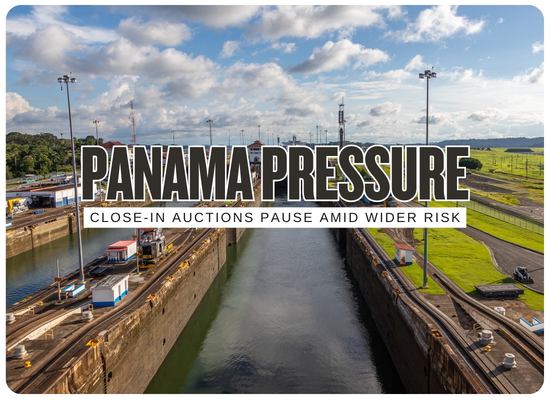
The latest chokepoint update brings Panama back into the maritime risk conversation at the same time Middle East corridors remain unstable. The Panama Canal is temporarily suspending close-in auction slots for certain Regular and Super vessel segments, a move tied to hydrological conditions and forward water management as the canal prepares for a potentially difficult weather pattern. The measure affects a small share of daily canal capacity, but it matters because Period 3 slots are the late-window auction option used by vessels operating on tight schedules without earlier reservations. At the same time, Hormuz traffic remains unusually weak, with commodity vessel movement still far below normal and no VLCC or LNG transits in the latest reported snapshot, while Bab el-Mandeb and Red Sea routing are under renewed pressure after Houthi warnings pushed more ships to alter course.
Panama Joins the Active Chokepoint Dashboard
Close-in auction access is tightening just as Hormuz traffic stays weak and Red Sea routing risk rises again.
Panama Close-In Access
Period 3 auctions for Regular and Super segments are being temporarily suspended, reducing late-window flexibility for vessels without earlier bookings.
Canal Water Management
The action is tied to hydrological conditions and forward planning ahead of a potentially difficult weather pattern.
Hormuz Traffic Weakness
Commodity-vessel movement remains sharply reduced, with large crude and LNG movements especially sensitive to security conditions.
Red Sea Rerouting
Houthi warnings tied to Saudi ports are already changing vessel behavior around Bab el-Mandeb and Suez-linked trades.
Freight and Fuel Exposure
Delay days, auction uncertainty, Cape diversions, bunker burn, insurance cost, and schedule reliability are moving together.
Operator Readout
The new Panama move is small in slot count but important in timing. It removes part of the last-minute access market at a moment when operators are already dealing with Gulf security risk, Red Sea rerouting, and more fragile schedule planning across global trade lanes.
Fresh Chokepoint Update
Panama slot access, Hormuz traffic, and Red Sea rerouting are now moving at the same time.
The Panama Canal update is the centerpiece because it changes the last-minute access market. Period 3 auctions are the close-in slots offered 96 to 48 hours before transit. Suspending them for Regular and Super segments does not shut the canal or remove most capacity, but it narrows the emergency access path for ships that did not secure earlier reservations.
Temporary suspension date for Panama Period 3 auctions affecting Regular and Super vessel segments.
Approximate daily transit slots affected by the Panama close-in auction change.
Reported commodity-vessel crossings through Hormuz in the latest traffic snapshot.
Chokepoint Status Table
| Corridor | Latest Update | Commercial Meaning | Stakeholders Affected | Watch Level |
|---|---|---|---|---|
| Panama Canal | Close-in Period 3 auctions suspended for Regular and Super segments from July 25 | Late-window access gets tighter for ships without pre-arranged transit reservations. | LPG carriers, bulkers, containerships, agents, charterers | High |
| Panama water management | Action tied to hydrological conditions and weather-risk preparation | Draft, booking, auction, and delay assumptions may need closer monitoring through the season. | Operators, brokers, cargo planners, insurers | Watch |
| Strait of Hormuz | Commodity crossings fell further, with no VLCC or LNG movements in the latest report | Gulf energy flows remain constrained by security, insurance, and vessel-approval concerns. | Tankers, LNG carriers, refiners, energy traders | High |
| Bab el-Mandeb | Houthi warnings tied to Saudi ports are changing vessel behavior | Ships may divert, pause, disable tracking, or avoid Red Sea exposure depending on risk terms. | Tankers, container lines, insurers, cargo owners | High |
| Suez-linked routes | Red Sea uncertainty keeps the Suez corridor exposed to renewed disruption | Cape diversions can lengthen voyages, reduce effective capacity, and add bunker cost. | Carriers, shippers, forwarders, ports | Medium |
| Malacca Strait | Structural watch point as the largest oil-transit corridor by recent EIA volume estimates | Even without a fresh closure event, any rerouting pressure from Middle East flows can shift attention toward Asian corridor resilience. | Energy buyers, Asian refiners, regional ports, insurers | Watch |
Planning note: The Panama change affects a small number of slots, but it matters because it removes flexibility from ships that need short-notice access at the same time other chokepoints are pushing operators toward more conservative routing.
Chokepoint Delay Cost Estimator
Estimate the commercial exposure from Panama slot uncertainty, Hormuz security delay, or Red Sea diversion pressure.
Selected delay or diversion period for the chokepoint case.
Estimated vessel-time and bunker exposure from the selected case.
Estimated exposure before cost recovery.
Estimated remaining cost after selected recovery.
The modeled case creates meaningful delay, fuel, cargo, and access-cost exposure.
Recheck voyage economicsThis tool is for editorial and commercial sensitivity only. It does not replace live canal advisories, carrier schedules, port-agent guidance, insurance quotes, auction results, bunker prices, charterparty review, security advisories, or professional voyage planning.
We welcome your feedback, suggestions, corrections, and ideas for enhancements.
Please click here to get in touch