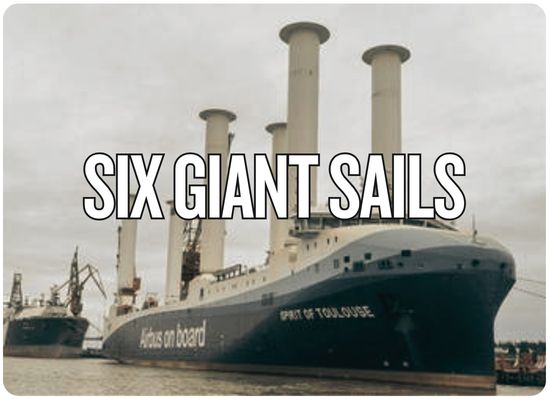
Airbus’s next-generation transatlantic cargo ship has completed installation of six 35-meter-high Norsepower rotor sails in Shanghai and is preparing for sea trials before its maiden voyage from China to France. The 168-meter Spirit of Toulouse, owned and operated by LD Armateurs and built by Wuchang Shipbuilding, is the first of three purpose-built RoRo vessels chartered by Airbus to carry wings, fuselage sections, engine pylons and tail assemblies between Saint-Nazaire/Montoir in France and the A320/A321 final assembly operation in Mobile, Alabama. The six 35 x 5-meter rotating cylinders work alongside two dual-fuel main engines and two dual-fuel generator sets capable of using e-methanol, bio-methanol or marine diesel. Airbus expects the three-ship fleet to cut average annual transatlantic CO₂ emissions from about 68,000 tonnes to 33,000 tonnes by 2030, while handling higher cargo volumes.
Spirit of Toulouse · Airbus Atlantic Logistics
Six 35-Meter Rotors Are Now Standing Above the Deck
The cylinders are not conventional cloth sails. Electric motors rotate them,
allowing wind flowing around the cylinders to generate aerodynamic lift and
forward thrust through the Magnus effect.
Mechanical Sails Installed6Norsepower Rotor Sails
Each rotor is 35 meters tall and 5 meters in diameter.
All six have now been installed at a coastal outfitting site in Shanghai
ahead of sea trials.
0135m × 5m
0235m × 5m
0335m × 5m
0435m × 5m
0535m × 5m
0635m × 5m
Length Overall168 m
Purpose-built RoRo design by Deltamarin.
Beam23.32 m
Design draft approximately 5.7 meters.
Deadweight~5,300 t
Specialized high-volume rather than heavy-bulk transport.
Service Speed14 kn
Wind propulsion assists rather than replaces the main engines.
The Regular Atlantic Supply Chain
EuropeSaint-Nazaire / Montoir
Airbus aerostructures including fuselage sections, wings,
pylons and tail assemblies enter the maritime logistics chain.
→
Atlantic CrossingWind + Methanol Capability
Rotor sails, weather routing and dual-fuel machinery work together
to reduce conventional fuel demand.
→
United StatesMobile, Alabama
Aircraft structures feed Airbus's U.S. A320/A321 final assembly operation.
6 Aircraft Sets
Capacity for six single-aisle aircraft subassembly sets including
wings, fuselage, engine pylons and horizontal and vertical tails.
~70 × 40-ft Containers
Additional container capacity increases the usefulness of each crossing
beyond the oversized aircraft components themselves.
Not One Decarbonization Technology
Airbus Built a Stack: Wind + Methanol + Routing + Efficiency
The rotor sails are the most visible feature, but the ship's expected
emissions reduction depends on several systems operating together.
WindSix Rotor Sails
Wind creates auxiliary thrust, reducing the propulsive load demanded from
the main engines when conditions are favorable.
Fuel FlexibilityDual-Fuel Methanol
Two main engines and two generator sets can operate on e-methanol,
bio-methanol or marine diesel.
DigitalWeather & Wind Routing
Routing software can alter the Atlantic track to capture favorable wind
while avoiding wave and weather conditions that erase efficiency gains.
Waste EnergyHeat Recovery
An Organic Rankine Cycle system captures otherwise wasted heat
and converts part of it back into useful energy.
HydrodynamicsLow-Friction Hull
Low-friction antifouling and optimized propellers reduce the power
required to move the hull at the same speed.
Energy ManagementSmart Power Control
The vessel coordinates engine loading, generator demand and wind-assist
operation rather than treating the sails as an independent retrofit.
35m × 5m Rotor Model0–180 rpm
Current Norsepower technical data for its 35-by-5-meter model show how
mechanical the system really is: these are actively driven composite
cylinders, not passive sails.
Height35 m
Roughly equivalent to an 11-story building.
Diameter5 m
Large cylindrical aerodynamic surface.
Current Model Motor175 kW
Nominal electric motor rating in Norsepower's current 35×5m specification.
ControlAutomated
Sensors and control software determine when spinning the rotor produces a net benefit.
Airbus's Fleet-Level CO₂ Target
Earlier Transatlantic Fleet68,000 t/yr
Airbus's reference annual transatlantic CO₂ figure when the replacement program was announced.
→
2030 Target33,000 t/yr
Expected average annual transatlantic fleet emissions after renewal,
even as transport capacity increases.
Spirit of Toulouse
Lead ship. Rotor installation complete. Sea trials next.
Spirit of Mobile
Second sister ship, launched in June 2026.
Spirit of Mirabel
Third vessel in the three-ship Airbus logistics program.
The 50% to 70% emissions figures are project expectations, not measured rotor-sail savings.
LDA expects each new vessel to produce about 70% lower annual CO₂ emissions
than the previous generation when the full technology package is considered.
At fleet level, Airbus/LDA expect transatlantic emissions to fall roughly 50%
while transport capacity increases. The contribution from the rotor sails alone
will only be established through sea trials and commercial operation.
Ship Universe Wind-Assist Tool
Rotor Sail Fuel-Savings Scenario
Test how different wind-assist performance levels could change annual fuel use,
fuel cost and combustion CO₂. The inputs are intentionally user controlled
because Spirit of Toulouse has not yet published measured annual operating results.
tonnes/year
Example scenario only. Not a published Spirit of Toulouse figure.
%
Norsepower reports typical system savings of roughly 5–25% across suitable applications.
$/tonne
t CO₂/t fuel
Editable simplified combustion factor. Lifecycle emissions depend on fuel pathway.
ships
years
Fuel Saved per Ship750 t
baseline fuel × entered wind-assist percentage
Fuel Remaining per Ship4,250 t
baseline minus modeled wind contribution
Annual CO₂ Avoided per Ship2,400 t
modeled fuel saved × entered combustion factor
Fleet Fuel Saved2,250 t
modeled annual saving across entered fleet
Scenario Lifetime Saving$15.8M
annual fleet fuel-cost saving × entered years
Fuel-Energy Split
Wind does not eliminate the engines. It reduces the amount of engine
power and fuel required when conditions allow useful rotor thrust.
Baseline Fuel
5,000 t
Wind Saving
750 t
Fuel Remaining
4,250 t
Wind Contribution
Material Assist
At the entered 15% saving, wind provides a meaningful reduction in engine fuel demand
while conventional or alternative-fuel machinery remains the primary propulsion source.
Ships3
Saving15%
Fuel Price$700/t
Years10
Scenario model only:
Spirit of Toulouse has not yet published verified annual rotor-sail fuel savings.
Norsepower's 5–25% range reflects broader operational experience, not a guaranteed
result for this ship. Wind availability, route, vessel speed, engine loading,
sea state and routing strategy can materially change performance. The CO₂ calculation
is combustion-only and does not represent lifecycle emissions from e-methanol or bio-methanol.
Feedback Welcome
We welcome your feedback, suggestions, corrections, and ideas for enhancements.