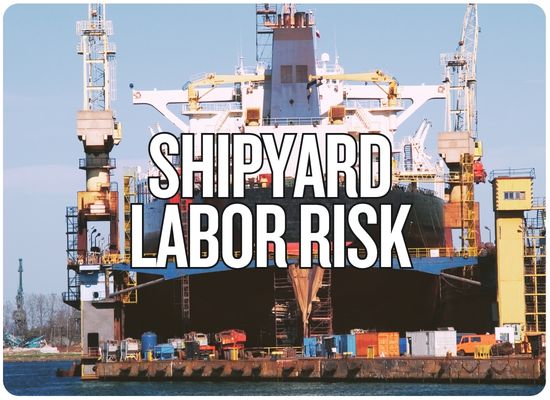
Labor pressure at HD Hyundai Heavy Industries escalated sharply on October 19 as the union representing workers at the Ulsan complex began five consecutive days of seven-hour partial strikes, while union leader Kim Dong-ha continued a protest roughly 25 meters above the yard on a crane near Main Assembly Plant No. 1. The action runs through October 23 and follows the rejection of a September 30 tentative wage agreement by 52.14% of voting members. No ship delivery delay has yet been publicly attributed to the current stoppage, but the dispute is now occurring inside a yard that HD Hyundai says operates 10 major building docks and normally constructs around 50 large vessels annually, with new commercial contracts already extending into 2029.
Ulsan Labor Escalation · October 19–23
Five Days of Near-Full-Shift Walkouts
The latest action moves the dispute from intermittent bargaining pressure toward sustained disruption across a full working week.
Daily Action7 hrs
9 a.m. to 5 p.m., excluding lunch.
Strike Window5 days
October 19 through October 23.
Crane Protest~25 m
Union chief Kim Dong-ha began the sit-in October 18.
Deal Rejected52.14%
Share voting against the first tentative agreement.
Scheduled Labor Action
Oct 197-hour partial strike
Oct 207-hour partial strike
Oct 217-hour partial strike
Oct 227-hour partial strike
Oct 237-hour partial strike
Rejected Tentative DealKRW120K + KRW11M + 200%
Monthly base-pay increase plus lump-sum and percentage-based payments.
Union's Original PositionKRW149.6K + profit sharing
Includes a larger fixed-pay increase and a demand for at least 30% of operating profit to be shared as performance compensation.
From Labor Action to Delivery Risk
The Yard Is Full, and the Production Chain Is Sequential
A shipyard can absorb short interruptions, but repeated stoppages become more difficult to recover when fabrication, erection, outfitting and trials depend on one another.
Ulsan Shipbuilding Capacity~50 ships/yr
HD Hyundai's stated annual output for large commercial vessels.
Production Infrastructure10 docks
Supported by nine major Goliath cranes at the shipbuilding unit.
HD KSOE Group Orderbook526 vessels
About $75.6B of orders across group yards as of late August 2026.
Where Lost Time Can Propagate
Steel / BlocksFabrication schedules feed later assembly.
AssemblyBlocks must arrive in sequence.
Dock ErectionDock slots are calendar-sensitive.
OutfittingSpecialist trades converge onboard.
Trials / DeliveryLate-stage delays can reach the owner.
Current StatusNo confirmed delivery delayThe October action has not yet been publicly tied to a slipped ship handover.
H1 2026 Orders71 vesselsIncluding 34 gas-sector units and 22 containerships.
New Contract HorizonInto 2029Recent LNG, FSRU and RoRo contracts extend construction commitments well ahead.
Escalation TriggerLonger or broader actionThe commercial risk rises if stoppages become continuous or disrupt critical-path trades.
Ship Universe Yard Schedule Runway
How Fast Could a Strike Consume Delivery Buffer?
Model scheduled stoppage time against an assumed project buffer and recovery rate without treating union hours as automatic production-delay hours.
5 days
7 hrs
30%
7 days
Schedule Buffer Consumption44% consumed
Buffer intactWatchDelivery risk
Scenario Status
WATCHThe modeled action consumes part of the assumed buffer but does not exhaust it.
Modeled Schedule Effect
Scheduled strike hours35 hrs
8-hour workday equivalent4.38 days
After selected recovery assumption3.06 days
Remaining assumed buffer3.94 days
Scenario tool only. It does not estimate actual HD Hyundai production loss or predict a vessel delivery delay. Subcontractor activity, nonunion labor, sequencing, dock position, overtime, material availability, safety limits and the construction stage of each vessel can materially change the real outcome.
Feedback Welcome
We welcome your feedback, suggestions, corrections, and ideas for enhancements.