Nuclear Cruise Ships: The Clean Power Idea Still Waiting for a Real Breakthrough
🔔 Subscribe to ShipUniverse Weekly →
Nuclear-powered cruise ships are back in the conversation because they appear to solve several big cruise problems at once. In theory, a nuclear cruise liner could operate for years without refueling, cut point-of-use emissions to zero, keep hotel loads running without depending on shore power, and make polar or remote itineraries easier to sustain. Lloyd’s Register says interest from cruise lines is now real enough that it has held exploratory discussions with most major operators, but the same source is equally clear that cruise deployment remains a long way off and that perception, regulation, waste handling, port acceptance, and workforce requirements are still the hardest barriers. At the same time, the IMO only began revising the outdated 1981 nuclear merchant ship framework in 2025, which shows how early the rulebook still is for any modern civil nuclear passenger vessel.
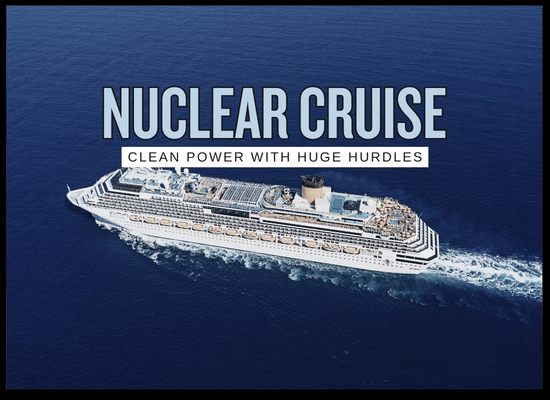
Nuclear power looks transformative on paper because it solves range bunkering and hotel-load pressure all at once but cruise adoption still hinges on politics ports insurance regulation and passenger trust
That makes nuclear one of the most fascinating long-range ideas in cruise decarbonization. It is not a near-term mainstream answer, but it is also no longer a fringe conversation. The core strategic question is whether cruise lines should treat nuclear as a serious long-horizon design path or as a technically intriguing option that still sits behind too many commercial barriers to matter for the next investment cycle.
The attraction is obvious
Cruise is one of the most energy-hungry segments in commercial shipping because it combines propulsion with giant hotel loads. That is exactly why nuclear keeps reappearing in the discussion.
A nuclear cruise ship would not be constrained by ordinary bunkering intervals, which could materially change deployment logic on remote or fuel-intensive itineraries.
Nuclear power is especially compelling for passenger ships because cabins, pools, galleys, air conditioning, entertainment spaces, and water systems consume huge amounts of continuous energy.
The concept is attractive partly because the ship could remain alongside without local exhaust emissions and without depending on shore power infrastructure.
The hard split in the debate
The nuclear cruise case breaks into three layers. One layer is technically exciting. One layer is commercially difficult. One layer is politically fragile.
The strongest arguments in favor
Nuclear is compelling because it addresses several cruise pain points simultaneously. A reactor-based vessel could avoid ordinary bunkering dependence, sustain enormous hotel loads for long periods, and operate with no exhaust emissions at the point of use. That makes the idea particularly interesting for remote destinations, polar deployments, and ships serving regions where local emissions restrictions are tightening.
Very high energy density can support long deployment horizons and more autonomy from fuel infrastructure.
The ship could become easier to position in remote or infrastructure-poor itineraries where alternative fuels are harder to source reliably.
The mixed middle ground
Even supporters generally treat nuclear as a long-term option rather than a next-orderbook solution. The commercial argument improves if advanced reactors reduce onboard crewing needs, simplify refueling logistics, and slot into a clear international rule set. But even then, cruise would probably not be first. Early commercial nuclear vessels may emerge in other shipping segments before passenger ships because cargo sectors have fewer public-acceptance hurdles.
The idea may become technically mature before the cruise market becomes socially or politically comfortable with it.
Cruise operators may watch nuclear closely while spending near-term capital on batteries, LNG-pathway flexibility, shore power, and efficiency retrofits instead.
The hardest barriers
The heaviest obstacles are not only engineering. They include outdated and incomplete rules, alignment between maritime and nuclear regulators, port and coastal-state acceptance, insurance and liability structures, waste handling, decommissioning pathways, workforce training, and public trust. Passenger acceptance may be the most difficult variable because one high-profile accident anywhere in the nuclear conversation shapes perception far beyond maritime facts.
Commercial cruise depends on broad public confidence, not just technical feasibility.
A technically excellent design could still fail commercially if ports, insurers, or passengers are unconvinced.
The cruise segments that would care first
If nuclear ever reaches cruise in a serious way, the first interest would likely come from segments that place the highest value on range, remote access, and large continuous hotel loads rather than from the broadest mass-market fleets first.
Polar and remote expedition
These ships could gain the most from long endurance and infrastructure independence. Their itineraries often value remote access, long deployment windows, and reduced dependence on fuel supply chains. But this same segment also operates in environmentally sensitive regions, which makes acceptance more politically complex, not less.
Luxury long-range expedition
Luxury expedition ships combine heavy hotel loads with premium fare structures, which makes them more capable of absorbing novel capital concepts. Yet they also rely on environmentally conscious guests and intimate destination storytelling, making passenger perception a particularly sharp hurdle.
Very large resort cruise ships
Megaships have exactly the kind of round-the-clock hotel demand that makes nuclear theoretically attractive. But they also face the worst public-perception problem because they operate at mass scale, in major consumer markets, with high media visibility and enormous passenger counts.
The deeper opportunity and barrier table
The table below goes past the simple “future fuel” story and separates where nuclear could genuinely change cruise economics from where it creates new friction.
| Decision lens | Nuclear upside | Nuclear drag | Near-term strength | Long-term strength | Cruise relevance | Adoption risk | Owner read |
|---|---|---|---|---|---|---|---|
|
Range and endurance
One of nuclear’s biggest attractions.
|
Removes ordinary bunkering dependence and opens up much longer service horizons. | The range value is large, but only if the line is comfortable with the regulatory and political tradeoffs. | Low | Very high | High | High | Strong theoretical advantage, especially for remote expedition or long-duration deployment, but not a near-term commercial unlock by itself. |
|
Hotel load support
Cruise is unusually power-hungry.
|
Continuous large-scale power could support cabins, HVAC, pools, galleys, entertainment, and water systems without fuel-supply anxiety. | Cruise would need passengers to trust a reactor serving the same spaces they live in for days or weeks. | Low | High | Very high | High | This is one of the most serious reasons cruise executives keep listening to the nuclear conversation. |
|
Point-of-use emissions
The zero-exhaust case.
|
No ordinary exhaust emissions at the point of operation and no need for traditional bunkering calls. | Full environmental debate shifts toward reactor risk, waste pathways, and lifecycle governance instead of stack emissions. | Low | High | High | Very high | Powerful in theory, but cruise would not receive a free public-relations win just because the stack disappears. |
|
Port-side flexibility
Self-contained microgrid logic.
|
Could reduce dependence on local grid capacity and ease hotel operation alongside. | Port acceptance may become one of the hardest gatekeepers of all. | Low | Medium to high | High | Very high | Attractive in remote ports and weaker-grid regions, but port politics could still outweigh technical benefit. |
|
Internal ship layout
Less fuel-tank pressure.
|
Removing or reducing large conventional fuel storage could eventually change machinery and service-space planning. | Reactor shielding, safety separation, and security demands could consume part of that theoretical gain. | Very low | Medium | Medium | High | Interesting design upside, but still too conceptual to treat as a near-term cabin or revenue advantage. |
|
Regulatory framework
Still being modernized.
|
The rulebook is starting to move again, which is essential for any serious project pipeline. | Outdated codes and multi-agency jurisdiction make progress slow and legally complex. | Very low | High if completed | Very high | Very high | Until international rules mature, nuclear stays in the long-horizon file for cruise rather than the active orderbook file. |
|
Insurance and liability
Often under-discussed in public.
|
A mature framework could eventually make financing and risk allocation more understandable. | Current nuclear risk structures are not a simple extension of ordinary P&I thinking. | Very low | Medium | High | Very high | This is one of the quiet issues that could slow cruise adoption even if ship design progresses. |
|
Passenger acceptance
The hardest public-facing variable.
|
If public confidence ever rises, nuclear could become a differentiator for ultra-long-range, high-comfort low-emission ships. | Fear, confusion, and military associations can damage acceptance regardless of technical merit. | Very low | Unclear | Very high | Extreme | Cruise depends on mass consumer trust. This may be the single sharpest barrier to commercial reality. |
|
Crew and workforce
A new competency layer.
|
Advanced automation and specialist shoreside support could reduce some onboard burden compared with older nuclear models. | Training, certification, radiation protection, emergency planning, and specialist staffing remain major hurdles. | Low | Medium | High | High | Cruise would need a new workforce architecture, not just a new propulsion package. |
|
Competitive alternatives
Battery, LNG pathways, methanol, efficiency.
|
Nuclear offers a radically different long-endurance path if other low-carbon fuels remain constrained. | Cruise already has nearer-term routes to lower emissions that are easier to explain to regulators and passengers. | Low | Medium to high | Very high | High | Nuclear’s biggest commercial problem is not only its own complexity. It is that other options can absorb capital sooner. |
Nuclear cruise readiness tool
Adjust the sliders to estimate whether a notional cruise segment looks like a serious long-range nuclear candidate. The score rewards operational need and penalizes the barriers that are hardest to overcome in passenger shipping.
Higher values mean the ship would genuinely benefit from very long deployment horizons without ordinary refueling dependence.
Higher values mean the ship often serves remote regions or ports where fuel and shore-power constraints matter.
Higher values mean public acceptance is easier. Lower values mean the segment would struggle badly with consumer perception.
Higher values mean the segment looks more likely to obtain a workable rule and port-acceptance pathway.
Higher values mean the operator and segment can better absorb first-of-a-kind complexity, specialist workforce, and long development timelines.
We welcome your feedback, suggestions, corrections, and ideas for enhancements. Please click here to get in touch.