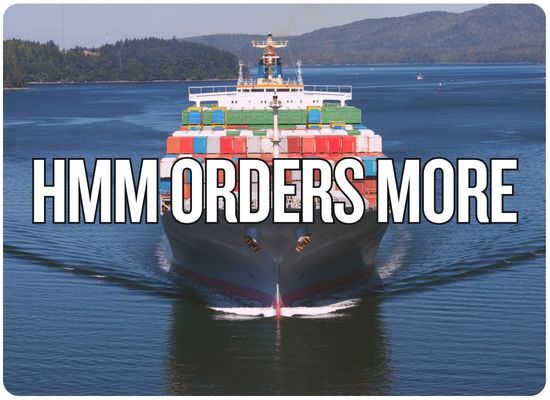
HMM's board approved KRW2.1678 trillion ($1.617 billion) of additional containership investment on October 15, covering eight newly ordered 13,000-TEU vessels plus four resale newbuildings already under construction: three 2,800-TEU ships and one 1,700-TEU ship. The package totals 114,100 TEU, with final deliveries scheduled by December 2029. HMM has not disclosed the yards, sellers or propulsion systems for the latest ships. The investment forms part of its expanded 2030 strategy targeting 166 containerships and 1.47 million TEU of capacity.
HMM Board Approval · October 15, 2026
Another 114,100 TEU Moves Onto HMM's Delivery Pipeline
$1.617B
KRW2.1678 trillion approved investment
What HMM Is Buying
8×
13,000-TEU Newbuildings
Fresh shipbuilding orders. Yards and propulsion remain undisclosed.
104,000 TEU
3×
2,800-TEU Resale Newbuilds
Ships already under construction and purchased before original delivery.
8,400 TEU
1×
1,700-TEU Resale Newbuild
Adds another smaller regional / feeder-size vessel.
1,700 TEU
Total Ships12
Eight direct orders plus four resale newbuildings.
Capacity Added114.1K TEU
Nominal capacity across the full package.
Current HMM Fleet1.03M TEU
97 ships in the latest Alphaliner fleet ranking.
Package vs Current Fleet~11%
Latest acquisition capacity relative to operating fleet.
Final DeliveryDec. 2029
All 12 vessels scheduled to be secured by then.
HMM Today
97 Ships · 1.03M TEU
HMM remains the world's eighth-largest container operator with about 3% of global liner capacity.
2030 Target
166 Ships · 1.47M TEU
The latest 114,100-TEU package alone covers roughly 26% of the nominal capacity gap between today's fleet and the 2030 target, before retirements, charter changes and other orders are considered.
The Industry-Level Question
HMM Is Buying Into the Largest Container Orderbook in Years
The risk is not the HMM order by itself. It is the collision between hundreds of similar fleet decisions, shortening Suez routes and a shipyard pipeline approaching half the capacity already trading.
Capacity Entering the Market
15.6M TEU
Linerlytica global containership orderbook
1,925 shipsNumber of containerships currently reported on order.
~45% of operating fleetOrderbook-to-fleet ratio near levels not seen since the previous major ordering cycle.
1.05M TEU ordered in September alone73 ships were contracted during one month according to Lloyd's List tracking.
9% physical fleet growth forecast for 2027BIMCO expects delivery growth to accelerate sharply next year.
×
Supply Collision
Capacity Still Being Absorbed
10.9%
fleet capacity recently tied up by port congestion
Cape diversions still consume ship-daysLonger Asia-Europe rotations have kept more ships employed than normal.
Suez normalization is acceleratingEarly-October Suez boxship capacity has already exceeded half of comparable pre-disruption levels.
Strong freight markets remain supportiveDrewry's October 15 WCI stood at $4,485 per 40-foot container.
Old ships provide a recycling buffer658 containerships aged 25 years or more represent around 1.6 million TEU.
Global Fleet · Oct. 16
34.91M TEU
Alphaliner operating-fleet capacity.
2027 Fleet Growth
+9%
BIMCO physical-capacity forecast.
Full Suez Risk
~10%
Potential offered-capacity excess versus vessel demand in BIMCO's full-normalization case.
HMM Latest Package
114.1K TEU
Only about 0.33% of the global fleet, but part of a much larger industry ordering wave.
Why Carriers Still Order
Newer ships can reduce unit costs, replace inefficient tonnage and meet tightening emissions requirements. Larger carriers also need scale to defend network coverage.
Why HMM Needs More Scale
At about 1.03 million TEU, HMM is materially smaller than the seven carriers ahead of it. Its 2030 plan is partly a strategic size and network decision, not merely a bet on freight rates.
Where the Risk Appears
If Suez removes voyage days at the same time congestion eases and shipyards deliver heavily, several separate capacity absorbers can unwind together.
The orderbook does not automatically equal oversupply. Older ships can be scrapped, carriers can slow-steam, add services, blank sailings or retire chartered tonnage, and trade growth can absorb capacity. The stress appears when fleet growth materially outruns ship-demand growth after those offsets.
Container Capacity Collision Runway
Stress-test 2027 as newbuild deliveries collide with cargo demand, Suez normalization and capacity removals.
Interactive Scenario Board
Move the Market
BIMCO's current 2027 physical fleet-growth forecast is 9%.
Cargo growth plus tonne-mile effects expressed as ship demand.
Modeled extra pressure as Cape voyage days disappear.
Capacity removed or absorbed by recycling, congestion, slow steaming and other friction.
65Pressure Index
High Capacity Pressure
Under these assumptions, fleet growth and shorter routing create materially more effective capacity than demand and removals absorb.
Pressure gap =
physical fleet growth − ship-demand growth + Suez capacity release − scrapping/disruption offset.
This is a scenario framework, not a freight-rate forecast. Later-year bars automatically taper the entered 2027 growth rate to illustrate how the fleet could continue expanding if deliveries remain elevated.
Feedback Welcome
We welcome your feedback, suggestions, corrections, and ideas for enhancements.