
🔔 Subscribe to ShipUniverse Weekly →
Singapore's Maritime and Port Authority (MPA) opened applications on November 12, 2026, for licences to operate up to two floating liquefied natural gas storage units in Singapore's anchorages. Each vessel must have at least 130,000 cubic meters of LNG storage capacity, be registered with the Singapore Registry of Ships and meet MPA's operational and safety requirements. The five-year licences are available to existing LNG bunker suppliers, which may partner with third-party terminal operators. Applicants must reserve most storage capacity for LNG bunkering, provide a minimum portion to other suppliers on open-access terms, disclose proposed maximum reloading fees and obtain ISCC-EU certification for handling bio-LNG and e-LNG. Applications close on February 4, 2027, at 5 p.m. Singapore time.
Two Floating LNG Storage Licences Are Now Up for Competition
Singapore is inviting existing LNG bunker suppliers to propose large Singapore-flagged floating storage units, with open access for competing suppliers and a five-year operating period.
No operator selected yet
Each proposed FSU
Per approved operator
17:00 Singapore time
Both panels represent hypothetical successful awards at minimum capacity. They are not identified vessels or existing installed storage.
Minimum nameplate LNG storage. Applicant must own or charter a compliant Singapore-registered vessel.
Second possible facility under the same minimum-size standard and a separate five-year licence.
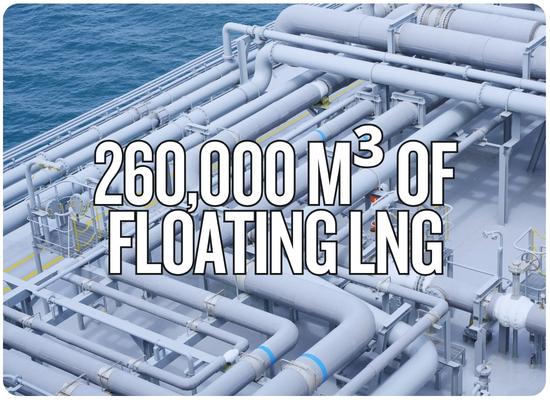
if both licences are awarded 260,000 m³
A conceptual LNG supply chain. The FSU is the large storage and reloading asset; the bunker vessel is the delivery asset.
An LNG supply vessel or approved source replenishes the floating storage inventory.
Inventory is held in an anchored ship and reloaded into compliant bunker delivery vessels.
A separate bunker craft delivers fuel to ships under applicable Singapore bunkering rules.
Applicants may partner third-party terminal operators. An unrelated LNG shipowner is not automatically eligible to apply alone.
At least one FSU of 130,000 m³ or more, registered under the Singapore flag and compliant with MPA conditions.
Most capacity must support LNG bunkering; a minimum portion must be available to other suppliers on open-access terms.
Applicants disclose intended maximum reloading charges to MPA. No uniform public dollar tariff is announced.
Facilities must be certified to handle bio-LNG and e-LNG through an auditable sustainability framework.
A purely illustrative volume-to-mass comparison using 0.45 tonnes per m³ of LNG and Singapore's 2025 LNG bunker sales of 571,400 tonnes.
260,000 m³ × 0.45 tonnes/m³, before working-fill limits or reserved capacity.
Volume equivalent to roughly 2.46 average months of 2025 Singapore LNG bunker sales.
MPA publishes the invitation for up to two FSU operators.
MPA schedules a session for interested qualifying companies.
Deadline: 5 p.m. Singapore time.
The Open-Access Rule Could Be as Important as the Ships
MPA is creating a licensed large-scale floating storage layer between LNG cargo supply and bunker delivery. Existing suppliers can seek operating licences, but a portion of capacity must serve other suppliers.
The land terminal, proposed floating storage units and LNG bunker vessels serve different functions. Their capacity figures must not be added as if they are equivalent throughput.
The vessel's m³ rating is its storage capacity at one time, not the volume it sells or reloads each year.
Annual service demand depends on the number of inventory turnovers, cargo arrivals, transfer rates and customer contracts.
The operator earns external fees or other contract payments only under its actual commercial arrangements, less vessel and terminal-service costs.
Recipients of the July 2026 supply licences. Their existing licence status does not mean any has submitted or won an FSU proposal.
A competitor can seek storage capacity in a licensed FSU rather than automatically having to control an entire large vessel.
Applicants must state proposed maximum LNG reloading fees. The public announcement does not supply an approved tariff.
Operating revenue must support vessel ownership or charter obligations over a licence term that may be shorter than the asset's economic life.
As a sense of physical scale, two minimum-size FSUs would provide 32.5% as much nameplate storage as SLNG's four existing onshore tanks. This is not a comparison of commercially available bunkering capacity.
Potential combined nameplate storage, conditional on two licence awards and suitable vessels.
Existing combined storage at Jurong Island, principally supporting national gas supply and multiple services.
MPA names successful LNG bunker suppliers for the five-year supply licensing round.
SLNG begins a land-terminal expansion and announces ISCC-EU bio-LNG certification.
New competition opens for up to two large anchorage-based LNG storage units.
SLNG targets completion of its separate small- and mid-scale reload jetty.
Would a 130,000 m³ Floating LNG Storage Unit Make Money?
Estimate storage allocation, annual LNG reloading, fee-based revenue, vessel hire costs and five-year cash contribution. Test one or two FSUs and compare hypothetical commercial scenarios.
Nameplate volume, storage allocation and annual reloading activity are separate. A full ship can be reloaded more than once over a year.
Additional editable inputs beyond Simple mode. These test commercial discounts, inventory losses, demand ceilings, upfront capital requirements and recurring financing costs.
The green and blue segments together represent capacity allocated to LNG bunkering. Open-access reservation is inside that allocation, not an additional vessel tank.
Selected units multiplied by rated vessel capacity.
User-defined allocation, not a published minimum quota.
Combined nameplate multiplied by working-fill percentage.
Annual physical throughput is not the same as the volume on which a service charge is collected.
Working inventory × annual turnover cycles.
Delivered volume after the selected billable share and any Advanced-mode loss.
Billable throughput at entered service fees.
Physical throughput converted at the entered density assumption.
Vessel hire across 365 days per selected unit.
Annual fixed cost per vessel multiplied by units.
Applies to the modeled physical LNG throughput.
After modeled annual costs, before taxes and nonmodeled items.
Rate needed to cover the modeled annual expense at selected volume.
Approximate cycles required at the entered fee and cost assumptions.
Annual contribution × selected licence term before setup capital.
Also deducts Advanced-mode one-time investment.
Change in annual cash contribution versus base volume.
The operating case is sensitive to the proportion of LNG reloaded on a fee-paying basis. Neither throughput nor the reloading tariff is guaranteed by MPA's licensing invitation.
Important commercial and regulatory limitations
A proposed storage allocation does not verify compliance with MPA's unpublished detailed access thresholds. A five-year operating licence does not guarantee five years of customer throughput or a particular start date. A gross service-fee equivalent cannot be counted as actual cash revenue when LNG is moved solely between units of the same business without a paid service contract. The billable-share input exists to avoid that assumption. The model does not establish transfer rates, cargo compatibility, minimum heel, berth access, boil-off recovery, gas quality, methane emissions, cargo title, custody-transfer losses, ISCC-EU audit outcomes, fees approved by regulators, or the ability to obtain a compliant Singapore-registered vessel. LNG density is adjustable in Advanced mode. All monetary scenarios use USD.We welcome your feedback, suggestions, corrections, and ideas for enhancements.
Please click here to get in touch