
🔔 Subscribe to ShipUniverse Weekly →
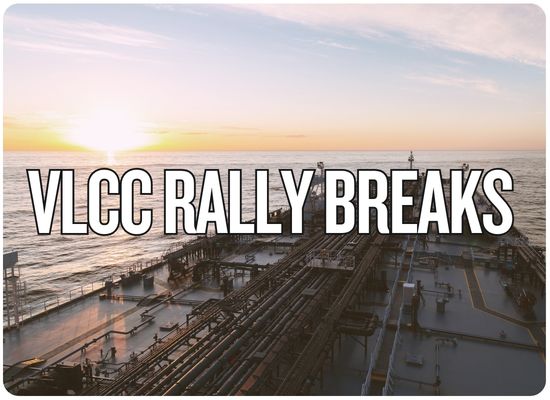
The first meaningful pullback has appeared in the extraordinary crude-tanker rally that pushed VLCC earnings above $1 million per day. Baltic Exchange data for October 16 show the Gulf of Oman-to-China TD34 benchmark falling to WS776.43 from WS841.07 a week earlier, a decline of about 7.7%, while the corresponding round-trip TCE fell from $912,660 to $837,569 per day. Rates also retreated on Middle East Gulf-China, West Africa-China and U.S. Gulf-China routes. The immediate pressure is coming from reduced tanker demand after renewed vessel attacks cut Middle East export volumes, combined with market expectations that Washington could eventually allow a limited number of sanctioned shadow-fleet tankers back into legitimate trade. The reversal is real, but it is not yet a normalization: the principal VLCC routes remain at historically extreme earnings levels, and the physical tanker shortage created by Hormuz risk, ship-to-ship transfers and longer voyages has not disappeared.
Record tanker rates have finally moved lower
The decline is still small relative to the historic run-up, but this is the first broad pullback after the VLCC market moved into unprecedented earnings territory.
The first crack in the record run
TD34 moved lower in both Worldscale terms and daily TCE. The rate remains exceptionally profitable despite the retreat.
Baltic TD34 round-trip TCE at WS841.07.
Baltic TD34 round-trip TCE at WS776.43.
Roughly 65 Worldscale points removed in one week.
About $75,000/day off the Baltic round-trip earnings estimate.
A correction from extreme levels rather than a weak tanker market.
Tanker rates have started falling from records. They have not fallen back to anything resembling normal historical earnings.
How Broad Is the Pullback?
Friday's Baltic assessments show weakness across the main crude-tanker benchmarks, but current earnings remain extraordinary by historical standards.
| Route | Current Assessment | Current Round-Trip TCE | Week-on-Week Move | Market Signal | Interpretation |
|---|---|---|---|---|---|
| TD34 Gulf of Oman → China | WS776.43 Down from WS841.07. | $837,569/day Previous week: $912,660/day. | WS roughly −7.7%; TCE roughly −8.2%. | Clear Pullback | Softer cargo demand after attacks reduced export volumes on a route that had been absorbing large amounts of VLCC tonnage. |
| TD3C Middle East Gulf → China | WS1,281.25 Down 37.5 Worldscale points. | $1.37M/day Standard Baltic VLCC round trip. | Lower, but much less sharply than TD34. | Still Extreme | Hormuz risk and complex export logistics continue to sustain exceptionally high voyage economics. |
| TD15 West Africa → China | WS711.88 Down slightly more than 38 points. | $720,400/day | TCE down from about $763,000/day last week. | Atlantic Easing | Shows the rate retreat is spreading beyond the immediate Gulf of Oman market. |
| TD22 U.S. Gulf → China | $80.58M Voyage assessment. | $559,334/day | Baltic says lump-sum freight fell by $8.75M this week. | Long-Haul Pullback | Long-distance substitution trades remain expensive even as the market retreats from peak freight. |
| TD20 Nigeria → UK Continent | WS920 Suezmax benchmark. | $522,600/day | Down 76 Worldscale points. | Suezmax Weakens | The correction is not confined to the largest crude carriers. |
| TD6 CPC → Augusta | WS1,092+ | $888,400/day | Up about 68 points. | Exception | Tight Black Sea tonnage and the November CPC loading plan kept this Suezmax route moving higher. |
| Clean LR2 MEG → Japan | WS986 | $285,400/day | Up 47 points. | Still Rising | The dirty-crude correction should not be confused with a universal decline across every tanker segment. |
Renewed attacks reduced Middle East export volumes and therefore the immediate demand for VLCCs on the Gulf of Oman route.
Once record-high cargo demand stops accelerating, charterers gain room to resist owner offers and freight can move quickly.
U.S. discussion of case-by-case sanctions relief immediately changed freight expectations even though relatively few ships may actually re-enter mainstream service.
Is This the Start of a Real VLCC Correction?
Turn signals on as they occur. The board weighs structural correction forces against factors that can send tanker rates higher again.
Market developments
Turning-point reading
Softer cargo demand and sanctions-relief expectations are pushing rates down, but continuing attacks and inefficient routing still provide powerful support.
We welcome your feedback, suggestions, corrections, and ideas for enhancements.
Please click here to get in touch