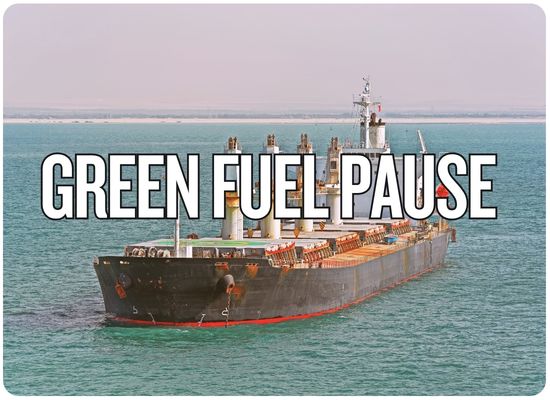
Marine biofuel demand has reversed sharply at the world's largest bunkering hub. Singapore sold about 603,000 tonnes of marine biofuel from January through September 2026, down 47% from the same period last year, according to government data. The decline follows a rapid expansion phase: Singapore's bio-bunker sales reached roughly 883,000 tonnes in 2024 and a record 1.36 million tonnes in 2025. The broader bunker market did not collapse with it. Singapore's conventional and biofuel sales actually increased about 1.8% year over year during the first nine months of 2026, while LNG bunker sales rose more than 21%. Industry executives point primarily to regulatory uncertainty around the IMO Net-Zero Framework and an unexpected surplus of FuelEU Maritime compliance balances that allows some European operators to meet requirements without purchasing as much additional biofuel.
Singapore Marine Biofuel Market
From Record Growth to a 47% Reversal
Shipping did not suddenly stop bunkering in Singapore. The decline is concentrated in biofuel, making the regulatory slowdown visible in physical fuel sales.
2024 Full Year883K t
Bio-blended bunker sales increased nearly 70% year over year.
→
2025 Full Year1.36M t
A new Singapore record, up about 54% from 2024.
→
Jan–Sep 2026~603K t
Approximately 47% below the corresponding nine-month 2025 period.
Implied Jan–Sep 2025~1.14M t
Derived mathematically from the reported 47% year-over-year decline.
Approx. Lost Volume~535K t
Difference between the implied 2025 nine-month level and reported 2026 sales.
Singapore LNG Jan–Sep+21%
LNG bunker demand rose while marine biofuel demand contracted.
Biofuel MarketDemand collapsed
Singapore's most established drop-in lower-carbon marine fuel suffered a major reversal.
Overall Bunker MarketDemand did not collapse
Conventional plus biofuel bunker volumes were about 1.8% higher during the first nine months.
Two Rulebooks, Two Demand Signals
Biofuel Is Caught Between Global Delay and European Flexibility
Shipping has a workable lower-carbon fuel today, but the economic reason to buy it differs dramatically depending on where and how a fleet complies.
IMO Net-Zero Framework
Geographic ReachDesigned as a global regulation for international shipping.
Core MechanismMarine-fuel GHG standard plus an emissions-pricing mechanism.
Current ProblemFormal adoption remains unresolved after the 2025 extraordinary session was adjourned.
Next Formal WindowMEPC 85 runs November 30–December 3, followed by a possible resumed extraordinary session December 4.
GLOBAL VS. REGIONAL
FuelEU Maritime
Geographic ReachApplies to qualifying ships trading to and from EU ports.
Core MechanismAnnual lifecycle GHG-intensity requirement for onboard energy.
FlexibilityCompliance surplus can be banked, borrowed under limits, or pooled among qualifying vessels.
Market EffectOvercompliance can reduce the need for every individual ship to purchase additional biofuel.
WEAK SIGNALGlobal Biofuel DemandIMO uncertainty leaves many non-EU operators without a strong regulatory incentive.
ACTIVEFuelEUEuropean GHG-intensity requirements are already in force.
SURPLUSCompliance BalanceExcess positive balances can reduce immediate marginal fuel demand through pooling.
OPTIONALITYDual-Fuel FleetOwners continue investing in multiple fuel options rather than committing to one pathway.
Singapore · Jan–SepBiofuel ↓ 47%
The world's largest bunker hub shows what happens when global policy demand weakens.
Rotterdam · H1Alternative fuels ↑ 28%
European regulation supports uptake, although industry executives say demand still fell short of expectations.
Ship Universe Biofuel Demand Signal Board
What Would Restart Marine Biofuel Demand?
Change three market conditions to see how regulatory certainty, FuelEU surplus and fuel economics could alter the incentive to bunker biofuel.
IMO Global Regulatory Signal
How strong is the global reason to lower fuel GHG intensity?
FuelEU Compliance Surplus
More surplus reduces marginal demand for new compliant fuel.
Biofuel Relative Economics
Physical price plus carbon/compliance value.
Modeled Biofuel Demand Signal
24
out of 95
WEAK / SELECTIVE
Regulatory uncertainty and abundant compliance surplus leave biofuel purchases largely voluntary or voyage-specific.
Trigger 1 · IMOA durable global GHG price or fuel standard could create demand well beyond EU-linked voyages.
Trigger 2 · FuelEUAs surplus compliance balances are consumed, fresh low-GHG fuel purchases become more valuable.
Trigger 3 · EconomicsHigh fossil-fuel prices or stronger compliance value can close the physical biofuel premium.
Heuristic scenario tool only. The score is not a forecast of bunker volumes or prices. It illustrates how three factors discussed by current market participants can reinforce or offset one another.
Feedback Welcome
We welcome your feedback, suggestions, corrections, and ideas for enhancements.