
SHIPUNIVERSE
Maritime Intelligence, Tools & Live Industry Radars

One place for live maritime intelligence, practical decision tools, industry events and focused reporting.

RADARS
TOOLS
All Tools
Latest 20
Open to load latest items…
NEWS
All News
Latest 20
Open to load latest items…
REPORTS
All Reports
Latest 20
Open to load latest items…
TECH
All Tech
Latest 20
Open to load latest items…
CRUISE
All Cruise
Latest 20
Open to load latest items…
NAVAL
All Naval
Latest 20
Open to load latest items…
SHIPUNIVERSE REPORTING

Reports, news and industry coverage

Full analysis in the ShipUniverse intelligence layout.

← Back to latest posts ShipUniverse / TECH

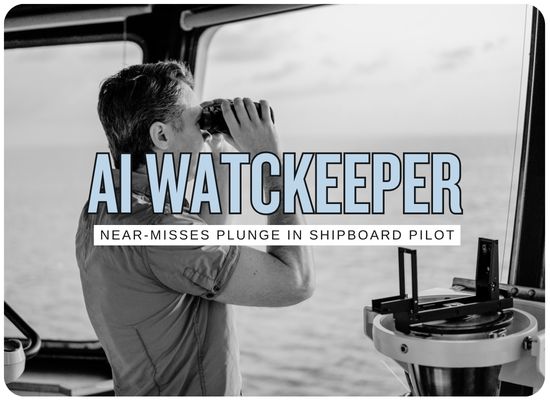
AI Cut Bridge Near-Misses by Almost 20×: Is Machine Vision Ready to Become a Second Officer?

🔔 Subscribe to ShipUniverse Weekly →

AI Bridge Watchkeeping Stress Test

The Test Before AI Joins the Bridge Team

A one-vessel pilot produced an extraordinary safety signal. Independent trials now show maritime computer vision detecting nearly every relevant target. The harder test is deciding how much responsibility those numbers actually justify.

Pilot safety signal Reported
~20×
Fewer bridge near-misses
Deviation time before 8,839 min
Deviation time after 2,730 min
Reduction 69.1%
Pilot vessels 1

Acheon Akti has tested an AI-enabled video safety system aboard one managed vessel. The reported bridge result is difficult to ignore: near-miss events fell by almost 20-fold, while recorded deviation time dropped from 8,839 minutes to 2,730.

The technology watches through onboard cameras, detects configured hazards or deviations, and alerts people while there is still time to intervene. The video can be processed locally, so the safety loop does not depend on a continuous satellite connection.

But watching continuously is only one part of bridge watchkeeping. A qualified officer also interprets intent, hears sound signals, communicates, applies COLREGs, understands the passage plan, judges uncertainty, challenges other people and takes responsibility for the vessel. That is the gap this report tests.

Implied reduction
~95%
If “20× fewer” represents an approximately twenty-fold event-rate reduction.
Deviation minutes removed
6,109
Difference between the reported before and after totals.
LR vision recall
98.6%
Separate 2026 live trial of an AI navigation platform.
Fleet evidence
10.8M nm
Orca AI and NorthStandard 139-vessel safety dataset.

Translate the headline into what the data actually says

Procedure deviation
(8,839 − 2,730) ÷ 8,839
69.1%

The monitored vessel spent 6,109 fewer recorded minutes in the conditions classified by the system as deviations.

Near-miss factor
1 − (1 ÷ 20)
≈95%

A true twenty-fold reduction would leave only 5% of the original event rate. The public pilot description says “almost” twenty-fold, so 95% should be treated as an approximate interpretation.

Missing denominator
The published material does not disclose the underlying number of bridge near-misses, watch-hours observed, pilot duration, traffic exposure, vessel route mix, false alarms or statistical confidence. The result is therefore a strong pilot signal, not a controlled proof of causality.

Three datasets answer three different questions

Acheon Akti + EVI

Does behavior change?

~20×
reported bridge near-miss improvement

One-vessel operational pilot. Strong signal for procedure monitoring and intervention, but the public data is too limited to separate AI effect from training, crew adaptation or voyage differences.

Lloyd's Register + Orca AI

Can the machine see?

98.6%
recall across 739 relevant targets

Independent live-vessel assessment measured perception performance against radar, AIS, visual observations and recorded evidence across an 828-nautical-mile voyage.

Orca AI + NorthStandard

Does performance persist?

−52%
high-severity close encounters

The 139-vessel dataset covers more than 10.8 million nautical miles and compares safety performance through each ship's first year of AI-assisted watchkeeping.

The visual perception layer is already performing at serious numbers

Lloyd's Register live-vessel assessment

Mediterranean reality test

A feeder containership sailed Gioia Tauro to Marsaxlokk via Bar. The route included the Strait of Messina, port approaches, anchorage traffic and open water. Day and thermal cameras were assessed beside radar, AIS and human visual watchkeeping.

Relevant targets 739 Included small, unlit and weak-radar-signature objects.
Precision 94% Measures how often reported detections were correct.
Recall 98.6% Measures how many relevant objects were successfully detected.
System downtime 0 No downtime reported during the five-day assessment.
98.6% is excellent and still not 100%
At 98.6% recall, a purely mathematical extrapolation would imply about 14 missed detections for every 1,000 relevant targets if performance remained identical. Real-world risk depends heavily on which targets are missed, not simply how many.

A second officer is much more than another pair of eyes

The title becomes useful when the job is broken into functions. Machine vision is becoming strong in some of them and remains fundamentally incomplete in others.

Bridge-role capability test Current technology state
Watchkeeping function
What current AI can contribute
Readiness
Continuous visual scanning
Day and thermal cameras can maintain persistent coverage without fatigue, distraction or looking away from the window.
Strong
Target detection
Computer vision can detect and classify non-AIS targets, small craft and low-signature objects and maintain visual tracking.
Strong
Procedure monitoring
Video analytics can identify configured behaviors such as missing presence, distraction and deviations from defined operating procedures.
Operational
Sensor fusion
Advanced systems can correlate visual information with AIS and radar, but uncertainty management and conflicting sensor evidence remain critical.
Developing
COLREG interpretation
Software can calculate encounter geometry and support rule analysis, but interpreting intention, uncertainty and unusual multi-vessel situations is a much wider navigational task.
Assistive
Bridge communication
A watch officer coordinates with the master, lookout, pilot, engine room, VTS and other ships, and must recognize ambiguity that may not exist in structured sensor data.
Human
Command responsibility
Current assistive AI does not hold an STCW certificate, assume the officer's navigational responsibility or replace the master's authority.
Human

The strongest bridge team may be machine persistence plus human judgment

Where machine vision has an advantage

Persistent attention
No fatigue cycle or requirement to divide visual attention among paperwork, radios and bridge conversation.
Thermal perception
Can add a visual channel at night or when small targets have poor visible contrast.
Event memory
Video and metadata create a repeatable record for debriefing rather than relying entirely on memory and voluntary reporting.
Consistent monitoring
The same configured rule can be applied continuously across watches and crew rotations.

Where the officer still has the advantage

Context
A human understands the passage plan, pilot exchange, weather, machinery limitations, standing orders and the consequences of an unusual maneuver.
Hearing and communication
COLREG lookout is not visual only. Sound signals, VHF communication and bridge-team interaction remain part of the operational picture.
Novel situations
Unusual targets, unexpected behavior and ambiguous intentions can sit outside what a perception model was trained to recognize.
Authority
The officer can challenge, communicate, maneuver, summon the master and take responsibility for the decision.

Six things have to be solved before the word “officer” becomes serious

01

Missed critical target

Average recall matters less if the rare missed object is an unlit fishing boat directly ahead.

02

Alarm fatigue

Persistent false or low-value alerts can train officers to ignore the system precisely when one warning matters.

03

Dirty or blocked optics

Salt, rain, spray, glare, icing, cargo stacks and physical obstruction can degrade a camera without disabling the rest of the bridge.

04

Unknown operating envelope

Performance measured in one route, weather range or traffic profile may not transfer unchanged to every ocean and vessel type.

05

Behavior changes because it is watched

A pilot crew may improve because procedures receive more attention during deployment, training and observation, not only because the algorithm intervenes.

06

Automation dependence

A successful digital lookout can create a new risk if the bridge gradually stops maintaining the independent human cross-check the system was meant to support.

The regulations currently treat AI as an additional means, not a certified deck officer

COLREG Rule 5

Lookout is multi-sensory

The vessel must maintain a proper lookout by sight and hearing and use all appropriate available means to appraise the situation and collision risk.

STCW

Watchkeeping carries responsibility

Navigational-watch arrangements must maintain a safe continuous watch, with the officer in charge responsible for safe navigation during the watch.

MASS Code 2026

Autonomy still retains accountability

IMO's new non-mandatory autonomous-shipping framework emphasizes risk assessment, system design and human oversight, with the master retaining overall responsibility.

The next useful benchmark is not another dramatic percentage

Before machine vision is given greater operational authority, fleets need repeatable performance metrics across the conditions in which bridge officers actually work.

Target recall
Measure missed relevant targets separately by daylight, night, rain, fog, clutter and target type.
Condition specific
False alerts
Report alarms per watch or operating hour rather than only aggregate precision.
Low enough to trust
Safety outcome
Normalize near-misses or high-severity encounters by nautical miles, watch-hours or comparable traffic exposure.
Exposure normalized
Human response
Measure whether alerts produce earlier action without increasing workload, distraction or inappropriate automation trust.
Human-factor tested
Independence
Repeat evaluation on different ship types, routes, crews and weather regimes with independent assessment.
Multi-vessel proof
Failure recovery
A bridge must remain safely operable when cameras, processing or AI assistance becomes unavailable.
Safe without AI

AI Watchkeeper Evidence Gate

Load the reported single-vessel pilot, the Lloyd's Register perception trial, the 139-vessel safety study or your own data. The tool separates perception quality, safety outcomes and evidence maturity instead of turning one percentage into a claim that AI can replace an officer.

ShipUniverse Bridge AI Evidence Model

How much bridge responsibility does the evidence justify?

Unknown data can be left blank. The model scores only published or entered evidence and always keeps legal command and certified watchkeeping outside the AI role.

Evidence model
Safety outcome evidence
Enter 20 for twenty-fold fewer events.
Number represented by the reported safety result.
Leave blank where not published.
Perception performance
Human and system architecture
Evidence-supported role ceiling
Real-Time Safety Monitor

The pilot supports continuous monitoring and earlier intervention, but public evidence is insufficient to establish full navigational-watch capability.

Implied near-miss reduction 95.0%
Procedure-time reduction 69.1%
Misses / 1,000 targets Unknown
Alarm load / day Unknown
Evidence maturity
Safety outcome
0
Perception
N/A
Evidence scale
0
Human safeguards
0
Hard boundary Officer replacement is not an output of this model.

Current regulations and the evidence entered here support an assistive safety role while navigational responsibility remains with qualified humans.

ShipUniverse analytical model only. It does not certify an AI system, alter minimum safe manning, replace COLREG or STCW obligations, or authorize autonomous navigation. A reduction observed after installation does not by itself prove causation. Different presets represent different technologies and datasets and should not be combined as if they were a single controlled experiment.
Research basis: Acheon Akti Navigation Argonaftis Volume 5 and subsequent company reporting on the one-vessel EVI pilot; EVI Safety Technology documentation describing local video processing, procedure monitoring and human-centred alerting; Lloyd's Register April 2026 live-vessel assessment of Orca AI computer vision; Orca AI and NorthStandard's 139-vessel Navigational Safety Report; IMO COLREG Rule 5; STCW watchkeeping requirements; and the IMO International Code of Safety for Maritime Autonomous Surface Ships adopted in May 2026. Pilot figures are company-reported operational results. ShipUniverse calculations and readiness scoring are analytical illustrations unless otherwise identified.
Feedback Welcome

We welcome your feedback, suggestions, corrections, and ideas for enhancements.

Please click here to get in touch
By the ShipUniverse Editorial Team — About Us | Contact


← Browse more ShipUniverse posts
MARITIME DECISION TOOLS

Practical tools for real vessel and commercial decisions

Browse the latest 24 tools or instantly search every published ShipUniverse maritime tool.

24 latest toolsView all 309 →
TOOL

Panama Canal Transit Slot Auction, Waiting Time, Draft Restrictions & Route Diversion Economics Tool

🔔 Subscribe to ShipUniverse Weekly → ShipUniverse / Canal Access &…

Open →
TOOL

Offshore Wind O&M Vessel Fleet, CTV/SOV Scheduling, Technician Transfers & Turbine Downtime Cost Tool

🔔 Subscribe to ShipUniverse Weekly → ShipUniverse / offshore wind operations…

Open →
TOOL

Vessel Sale & Purchase Closing, Escrow, Bunker ROB, Delivery Documents & Cash Settlement Tool

🔔 Subscribe to ShipUniverse Weekly → SHIPUNIVERSE / VESSEL TRANSACTION INTELLIGENCE…

Open →
TOOL

Harbor Tug Fleet Contract Tender, Utilization, Standby Fees & Towage Profitability Tool

🔔 Subscribe to ShipUniverse Weekly → SHIPUNIVERSE / PORT & TOWAGE…

Open →
TOOL

Marine General Average, Cargo Contribution, Security Deposits & Claims Settlement Exposure Tool

🔔 Subscribe to ShipUniverse Weekly → SHIPUNIVERSE / MARITIME CLAIMS &…

Open →
TOOL

Chemical Tanker Cargo Parcel Allocation, Tank Compatibility, Cleaning Turnaround & Voyage Margin Tool

🔔 Subscribe to ShipUniverse Weekly → SHIP UNIVERSE / CHEMICAL TANKER…

Open →
TOOL

Marine Insurance Claims Portfolio, Hull & P&I Loss Runs, Reserves & Renewal Negotiation Tool

🔔 Subscribe to ShipUniverse Weekly → SHIPUNIVERSE / FLEET INSURANCE &…

Open →
TOOL

Offshore Platform Decommissioning, Vessel Spread, Weather Windows & Removal Campaign Cost Tool

🔔 Subscribe to ShipUniverse Weekly → SHIPUNIVERSE / OFFSHORE ASSET RETIREMENT…

Open →
TOOL

Tanker & Bulker Commercial Pool, Fleet Earnings Distribution, Off-Hire & Pooling Economics Tool

🔔 Subscribe to ShipUniverse Weekly → SHIPUNIVERSE / COMMERCIAL SHIPPING INTELLIGENCE…

Open →
TOOL

Port Terminal Concession Bid, Throughput Guarantees, Tariff Escalation & Investment NPV Tool

🔔 Subscribe to ShipUniverse Weekly → SHIPUNIVERSE / PORT INFRASTRUCTURE INVESTMENT…

Open →
TOOL

Fleet Debt Covenant Headroom, Vessel Valuation Shock, Interest Rates & Refinancing Liquidity Tool

🔔 Subscribe to ShipUniverse Weekly → SHIPUNIVERSE / FLEET FINANCING INTELLIGENCE…

Open →
TOOL

Maritime Freight FFA Hedging, Bunker Price Risk, Margin Calls & Cash-Flow Protection Tool

🔔 Subscribe to ShipUniverse Weekly → SHIPUNIVERSE / FREIGHT DERIVATIVES &…

Open →
TOOL

Empty Container Repositioning, Depot Inventory, Leasing & Shortage Cost Tool

🔔 Subscribe to ShipUniverse Weekly → SHIPUNIVERSE / CONTAINER EQUIPMENT NETWORK…

Open →
TOOL

Subsea Cable Fault Repair, Vessel Spread, Restoration Timeline & Emergency Repair Cost Tool

🔔 Subscribe to ShipUniverse Weekly → SHIPUNIVERSE / SUBSEA EMERGENCY RECOVERY…

Open →
TOOL

Container Shipping Service Contract, Minimum Volume Commitment, Carrier Allocation & Shortfall Cost Tool

🔔 Subscribe to ShipUniverse Weekly → SHIPUNIVERSE / OCEAN FREIGHT PROCUREMENT…

Open →
TOOL

Fleet Retrofit CAPEX Prioritization, Fuel Savings, Decarbonization & Capital Allocation Tool

🔔 Subscribe to ShipUniverse Weekly → SHIP UNIVERSE / FLEET CAPITAL…

Open →
TOOL

Port Container Crane Fleet Replacement,Availability & Lifecycle CAPEX ROI Tool

🔔 Subscribe to ShipUniverse Weekly → SHIP UNIVERSE / TERMINAL ASSET…

Open →
TOOL

Maritime Counterparty Credit, Charter Hire Default, Payment Security & Recovery Exposure Tool

🔔 Subscribe to ShipUniverse Weekly → Charter Risk · Receivables ·…

Open →
TOOL

Cruise Ship Elevator Capacity, Passenger Flow, Outage Risk & Modernization ROI Tool

🔔 Subscribe to ShipUniverse Weekly → Cruise Operations · Hotel Engineering…

Open →
TOOL

Ship Lay-Up, Preservation, Reactivation & Return-to-Service Economics Tool

🔔 Subscribe to ShipUniverse Weekly → Shipowner Strategy · Vessel Preservation…

Open →
TOOL

Maritime Cyber Incident Recovery, OT Downtime, Business Interruption & Restoration Cost Tool

🔔 Subscribe to ShipUniverse Weekly → Maritime Cyber Resilience · Vessel…

Open →
TOOL

Vessel Technical Management Contract Tender, Fleet OPEX, Fees & SLA Comparison Tool

🔔 Subscribe to ShipUniverse Weekly → Ship Management · Fleet OPEX…

Open →
TOOL

Shipbuilding Refund Guarantee, Yard Credit Risk, Progress Payments & Delivery Default Tool

🔔 Subscribe to ShipUniverse Weekly → Shipbuilding Finance · Newbuilding Security…

Open →
TOOL

Port Waste Reception, MARPOL Delivery Notice, Disposal Logistics & Charge Verification Tool

🔔 Subscribe to ShipUniverse Weekly → Port Operations · MARPOL Waste…

Open →