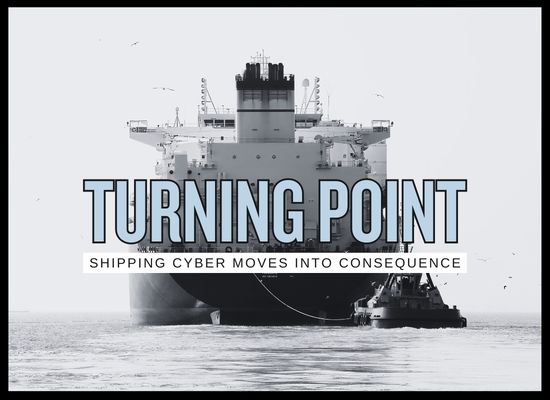
Maritime Cyber Is Surging and Why 2026 Feels Like a Turning Point
🔔 Subscribe to ShipUniverse Weekly →
Maritime cyber risk is moving into a different category in 2026 because the problem is no longer confined to isolated office IT incidents or abstract warnings about future digitalization. It is being shaped by three converging forces at once: a much more connected ship-and-shore operating model, a threat picture that now includes ransomware, DDoS, third-party compromise, and electronic interference affecting navigation and communications, and a regulatory environment that is moving from general awareness toward stronger cyber expectations for ships and port facilities. IMO’s revised maritime cyber risk guidance is now in place, MSC 109 said there is a need to further develop cybersecurity standards for ships and port facilities, CISA has been pushing resilience planning for the Marine Transportation System, and current Gulf advisories are reminding operators that electronic disruption can now affect navigation reliability in live trade corridors. That combination is why 2026 feels less like a continuation of the same cyber story and more like a threshold year for maritime owners, managers, ports, and technology buyers.
The industry is moving from cyber awareness to cyber consequence
Shipping has spent years talking about cyber hygiene, training, and preparedness. The 2026 shift is that cyber risk now sits closer to live operations, regulatory direction, contested waters, and business continuity. It is becoming harder to treat cyber as a separate office problem when ship systems, shore systems, ports, communications, and navigation reliability are all more digitally entangled than they were only a few years ago.
The sharper reading of 2026
The turning-point feeling does not come from one single spectacular attack. It comes from accumulation. Incident counts are rising, corporate cyber concern is at record levels, maritime cyber guidance has just been revised, IMO is openly discussing next steps toward stronger standards, and current Gulf advisories are reminding ship operators that electronic disruption can now degrade communications and navigation reliability in real operating corridors. That combination changes the tone from caution to urgency.
Five reasons 2026 feels different
The pressure is building from multiple directions at once, and each one reinforces the others.
-
① Cyber is rising while digital dependence is deepening
The maritime operating model is more connected than it used to be. Ships exchange more data with shore. Ports depend more on digital systems. Fleet management, compliance, route planning, maintenance, vendor access, and commercial coordination all rely on wider software and communications chains. The more connected that environment becomes, the more cyber risk shifts from a background IT concern to a business continuity issue.
-
② The threat mix is no longer narrow
Maritime organizations are not dealing with just one cyber pattern. The threat picture now spans ransomware, malware, phishing, DDoS, supplier compromise, access-control weakness, AIS anomalies, and GNSS or electronic interference affecting navigation and communications reliability. This makes the risk landscape harder to reduce to one checklist or one vendor solution.
-
③ Guidance is becoming more pointed
The revised IMO maritime cyber risk management guidance is now in place, and MSC 109 went beyond passive acknowledgment by agreeing on the need to further develop cybersecurity standards for ships and port facilities. That matters because it suggests the direction of travel is toward more concrete expectations, not less.
-
④ Corporate risk perception is now aligned with maritime reality
Cyber has become the top global business risk again in the Allianz Risk Barometer 2026, with its highest-ever score. Maritime is not separate from that climate. It is sitting inside it, while also carrying the extra complication of ships, ports, operational technology, and safety-critical functions.
-
⑤ Real corridors are showing electronic fragility
Current Middle East advisories are not merely abstract reminders about cyber hygiene. They are describing severe or significant electronic interference, AIS anomalies, and GNSS disruption affecting navigation and communications in high-importance waters. Even when the source is not labeled as a conventional ransomware-style event, the operational lesson is still cyber-relevant: digital trust can fail in live shipping conditions.
The practical signs that the risk is changing shape
- Cyber can now affect navigation confidence, communications reliability, and operational visibility, not only back-office systems.
- Ship operators must think about resilience across ship, shore, vendor, and port interfaces, not one isolated network.
- The consequences increasingly include delay, service disruption, safety degradation, claims exposure, and regulatory scrutiny.
- Boards and managers are less able to dismiss cyber as rare or purely technical when global business-risk surveys and maritime-specific incident reporting are both moving in the same direction.
- The distance between cyber preparation and operational reality is shrinking.
| # | Pressure source | Changing | 2026 Exposure | Commercial and operational consequence | Operator Alternatives | Board-level read | Impact tags |
|---|---|---|---|---|---|---|---|
| ① |
Incident tempo
The volume and visibility of cyber events are rising.
|
Industry reporting indicates a sharp increase in maritime cyber incidents in 2025, with ransomware, DDoS, and malware infections driving much of the growth. | A rising incident base changes planning assumptions. Organizations can no longer behave as though cyber disruption is an infrequent edge case. | More incidents mean more chance of downtime, higher insurance anxiety, more internal testing of resilience, and stronger customer questions about operational continuity. | Shift from awareness training alone toward tested resilience, response playbooks, vendor controls, and recovery discipline. | The threat is no longer easy to classify as low-frequency background noise. | Incident growth Downtime risk |
| ② |
Regulatory direction
Cyber guidance is being refreshed and standards discussion is moving forward.
|
IMO has revised its cyber risk management guidance, and MSC 109 said further development of cybersecurity standards for ships and port facilities is needed. | This makes 2026 feel different because the policy signal is not standing still. The direction is toward stronger expectations for governance and resilience. | Operators that lag may face more painful retrofitting later, while those that move earlier can align systems and procedures before expectations harden further. | Treat cyber readiness as part of management-system maturity, not a side initiative. | The cost of waiting may rise faster than the cost of preparing. | Governance Standards track |
| ③ |
Ship and shore integration
Digital efficiency also enlarges the cyber consequence surface.
|
More connected fleet operations, vendor access paths, cloud systems, APIs, remote services, and integrated decision tools create more dependencies across the operating chain. | The benefit of connection is speed. The risk is that one weak point can now affect wider workflow continuity or trust across multiple teams. | Business interruption, delayed decisions, degraded visibility, and higher recovery complexity become more plausible. | Map the critical chain end to end and decide which dependencies must fail safely. | More digital efficiency without stronger resilience can create fragile productivity. | Dependency risk Integration |
| ④ |
Electronic interference in live corridors
Operational trust in digital systems is under pressure in real trade routes.
|
Gulf advisories are describing AIS anomalies, GNSS disruption, and communications reliability problems that affect day-to-day navigation and situational awareness. | Even when these events are not framed as conventional office-network cyber incidents, they reinforce the same strategic truth: digital trust is now a frontline operational dependency. | Route confidence weakens, bridge workload rises, and the gap between cyber resilience and navigation resilience gets smaller. | Build redundancy, fallback procedures, stronger bridge skepticism, and cleaner response rules for degraded electronic conditions. | Cyber can no longer be kept conceptually separate from live operational assurance. | Operational exposure Navigation trust |
| ⑤ |
Port and infrastructure resilience
The wider Marine Transportation System is under resilience review too.
|
CISA has been emphasizing resilience assessment for ports and the Marine Transportation System rather than only narrow compliance or perimeter defense. | That framing matters because it shifts the conversation from preventing every incident to keeping operations functioning when incidents happen. | Ports and connected maritime stakeholders face more pressure to understand recovery pathways, not only protective controls. | Test continuity, dependencies, backup procedures, and incident coordination before a disruptive event forces the lesson. | Resilience maturity is becoming more important than checklist maturity alone. | Resilience Port systems |
| ⑥ |
Board and insurer concern
Cyber is sitting at the top of global corporate risk rankings.
|
Cyber incidents rank as the top global business risk again in Allianz Risk Barometer 2026, and by the highest margin yet. | Maritime decision-makers are operating in that same business climate while also carrying added exposure through ships, ports, OT, and safety-critical consequences. | Budget scrutiny, insurance questions, board attention, and vendor due diligence all intensify. | Express cyber resilience in commercial language such as downtime avoided, response speed, dependency reduction, and continuity protection. | Cyber is now easier to fund, but also harder to under-explain. | Board pressure Insurance lens |
| ⑦ |
Third-party and supply-chain paths
Maritime stacks are rarely owned end to end by one organization.
|
Fleet software, comms providers, OEM support access, classification interactions, port interfaces, and cloud tools create a wider third-party exposure map. | As digital workflows widen, supply-chain weakness becomes a more plausible route for disruption or trust erosion. | Recovery becomes slower and accountability blurrier when the weak point sits outside the direct owner perimeter. | Tighten vendor access governance, incident-notification expectations, segmentation, and testing across the wider chain. | The cyber boundary of the organization is now much larger than the internal IT team. | Third-party risk Access control |
| ⑧ |
The gap between policy and practice
Awareness is widespread, but execution quality still varies.
|
Many organizations know cyber matters, but actual maturity around segmentation, testing, backups, playbooks, OT understanding, and evidence-based response remains uneven. | A turning point year often exposes that gap sharply because incident tempo, operational dependence, and stakeholder scrutiny all rise together. | Companies that looked acceptable in lower-pressure conditions may find their preparation was thinner than they believed. | Move from policy ownership to exercised readiness, including tabletop exercises and cross-team drills. | The visible cyber program may still overstate real resilience. | Execution gap Exercise need |
What stronger operators are likely to do next
- Treat cyber as part of operational resilience, not only as an IT control framework.
- Test ship-to-shore response paths and vendor dependencies before a live event forces them.
- Review whether bridge, communications, and navigation teams know how to respond when digital trust degrades.
- Strengthen recovery discipline, not just prevention language.
- Translate cyber readiness into commercial metrics that boards and insurers can understand.
- Reduce avoidable complexity in the software and access environment wherever possible.
Bottom-line effect
2026 feels like a turning point because maritime cyber is no longer sitting at the edge of operations. It is moving closer to core trade routes, live fleet visibility, resilience planning, board attention, and evolving standards. The issue has become more layered, more visible, and harder to compartmentalize.
The strongest response is unlikely to be panic or a search for one perfect solution. It is more likely to be a more disciplined operating model: cleaner dependency mapping, better-tested response routines, tighter vendor governance, stronger segmentation, clearer bridge and shore fallback logic, and a shift from cyber awareness to cyber proof.
How exposed does your maritime operation look right now
This tool estimates how much cyber pressure may be building across a shipowner, manager, port-facing operator, or maritime service business. It is not a formal audit. It is a buyer-side and operator-side sense check built around the exact pressures discussed in this report: connected workflows, vendor dependency, incident exposure, and the growing gap between cyber policy and operational proof.
Move the sliders based on how the operation behaves in real life, not how the cyber program looks in a policy binder. The more dependency, weak visibility, and untested recovery you see, the more likely it is that 2026 already feels like a turning point inside the business even if nothing catastrophic has happened yet.
Estimated cyber consequence score
Simple pressure estimate for how exposed the operation may be to cyber-driven disruption and trust loss
This profile suggests the operation may already be feeling the 2026 turning-point effect. Cyber is likely no longer a side issue. The business may be carrying enough digital dependency and enough resilience uncertainty that a serious incident or electronic disruption could have wider operational and commercial consequences than leadership assumes.
- Connected workflows may be creating more operational exposure than management sees clearly.
- Recovery confidence may depend too much on people improvising well under pressure.
- Third-party access and system complexity may be enlarging the risk surface quietly.
What the score usually means
Use this as a practical read on how urgent the next resilience steps may be
We welcome your feedback, suggestions, corrections, and ideas for enhancements. Please click here to get in touch.