
🔔 Subscribe to ShipUniverse Weekly →
SHIPUNIVERSE / TECH · NOVEMBER 17, 2026 · POWER & ECONOMICS
Nuclear-powered cargo ships are getting closer. Eight questions about cost, safety and fuel savings.
Shipowners have heard plenty of big promises about nuclear propulsion. This one is worth following because the engineers plan to test an entire ship-power arrangement, not just draw a reactor on a vessel. Norway has committed NOK 20 million to a VARD-linked project aiming for an offshore-ship installation in 2031–32. That's a target, not a delivery date. The financial question remains straightforward: can purchased nuclear electricity beat a diesel power plant after installation, standby generation, insurance and port restrictions are counted?
What Norway is actually paying to develop
MarNuPS / Verified scopeEmerald Nuclear Norway
Developing the GEM microreactor and an electricity-as-a-service business in which the reactor provider retains nuclear ownership and fuel-cycle duties.
VARD + Vard Electro
Designing the marine installation, power management and automation interfaces, with Island Offshore supplying real operator requirements.
A full-scale cold test
The Stette shore facility will simulate reactor heat using electricity to test power conversion, energy storage and load changes. Nuclear operation would follow later.
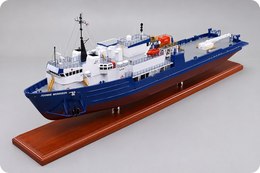
Not a nuclear cargo-ship order. MarNuPS targets an offshore service vessel. The cargo-ship connection is the wider technology and regulatory work, including a Maersk-linked Rotterdam port-call assessment and a conceptual transatlantic nuclear-container-ship corridor. No routine commercial nuclear cargo service has been announced.
Eight questions the shipowner should ask
Money, machinery, market accessDoes NOK 20 million buy a reactor or a credible test?
The award is roughly one-seventh of the project's reported NOK 150 million first-stage cost. The near-term deliverable is integrated, non-nuclear shore testing. A licensed, fuelled installation and operating vessel remain separate hurdles.
Owner's question: What evidence must be accepted before anyone commits to a shipyard slot?
Can 5 MWe propel a cargo ship?
Possibly a smaller, moderate-demand vessel or part of a hybrid arrangement. A high-powered cargo ship may need multiple modules and additional redundancy. Average electrical load, peak propulsion demand and safe-return requirements are different design numbers.
Owner's question: Show the hourly load profile and independently verified power balance.
Who pays for the reactor, fuel and servicing?
Emerald proposes to own and operate the reactor, manage its fuel cycle and charge the shipowner for delivered electricity. That may avoid reactor-purchase capital, but not hull integration, safeguards, site works or all vessel-specific costs. Commercial lease prices are undisclosed.
Owner's question: Does the tariff include swap-outs, outages, liabilities and minimum-use charges?
How much conventional fuel truly disappears?
Only the diesel or other fuel needed to generate the electricity actually supplied by nuclear power. Ships still need an approved backup strategy; power peaks, maintenance periods and port restrictions may leave conventional generation in use.
Owner's question: Compare cost per delivered MWh, not reactor nameplate MW against bunker tonnes.
What happens when the ship suddenly needs more power?
Dynamic positioning, thrusters and propulsion can change demand sharply. MarNuPS includes electrical storage, a power-conversion system, power management and integrated automation precisely to study transients and crew interaction.
Owner's question: Require tested load steps, redundancy, reserve generation and fault recovery.
Who is accountable if the nuclear system fails?
Reactor ownership does not settle nuclear liability, radiological protection, security or emergency response. The vessel, reactor operator, flag state, class, insurer and ports need enforceable responsibilities and arrangements.
Owner's question: Obtain written liability, insurance, decommissioning and incident-command terms.
Can a nuclear ship actually enter its ports?
The 1981 Nuclear Code and SOLAS Chapter VIII are under revision, with 2030 targeted for adoption. A Rotterdam study and the Charleston–Felixstowe Pink Corridor are assessments, not blanket port permissions. A technically workable vessel could still face route restrictions.
Owner's question: Secure an agreed trading corridor and port-by-port admission pathway.
What happens at the five-year survey and the end of life?
Emerald markets a 5–15-year energy period depending on load. Ulstein's separate retrofit concept assumes a five-year reactor-module exchange. Neither is an approved commercial maintenance interval. The vessel needs a plan for removal, waste, eventual dismantling and backup power.
Owner's question: Contract for module swap logistics, downtime guarantees and funded end-of-life obligations.
Why a cargo ship needs a different power calculation
5 MWe is not 5 MW of shaft powerThe GEM concept is a gas-cooled reactor feeding a power-conversion system. The public 5 MWe figure is electrical output per module.
Converters, drives, motors, hotel loads and auxiliary demands determine how much electricity reaches propulsion.
Available power, transient response, redundancy and maintenance outages must be demonstrated for the actual ship.
Useful rule of thumb, not a design approval: a ship needing 20 MW of continuous electrical power would require at least four nominal 5 MWe modules before redundancy, losses and peak-load margin. This does not establish that a four-module ship is technically or commercially feasible.
What belongs in the cost comparison
Same delivered energy, same duty| Cost line | Conventional diesel-electric | Proposed nuclear-lease vessel | Model treatment |
|---|---|---|---|
| Energy purchased | Fuel tonnes × delivered bunker price | Electricity MWh × reactor lease tariff, plus fallback fuel | Direct annual comparison |
| Main equipment | Engines, tanks, exhaust treatment and electrical plant | Module interface, conversion, storage, shielding, vessel integration | Net incremental integration capital |
| Routine upkeep | Engine maintenance, lubricants and overhauls | Provider's nuclear servicing potentially in lease; shipboard equipment still maintained | Only verified engine maintenance avoided |
| Specialist obligations | Standard crew, class, insurance and port compliance | Additional nuclear-security, radiological, liability, port and training obligations | Added annual vessel expense |
| Long-term exposure | Fuel-price variability and engine renewal | Lease escalation, reactor exchange, port access and decommissioning terms | Contract review; not automatically valued |
Unknown today: Emerald has not publicly disclosed a marine power tariff, guaranteed plant availability, vessel integration premium or standard commercial insurance terms. The calculator below uses illustrative assumptions to find the break-even tariff, not to predict a shipowner's actual savings.
Six documents to ask for before taking the idea to an investment committee
Procurement gateIndependent operating profile, equivalent delivered energy, peak loads, reserve margin, power losses and fault response.
$/MWh, fixed fees, capacity commitment, minimum take, inflation, shutdowns, module exchange and exit provisions.
Reactor and ship licensing, classification, safeguards, crew training, emergency planning and responsible authorities.
Intended ports, terminal protocols, insurer/P&I coverage, cargo contracts and alternative trading arrangements.
Incremental steel, shielding, automation, electrical gear, storage, space/weight tradeoffs and drydock downtime.
End-of-service module return, radioactive waste custody, ship recycling, funded obligations and insolvency protection.
INTERACTIVE / DIESEL VS NUCLEAR POWER LEASE
At what electricity price could nuclear beat diesel?
Enter a ship's average electrical demand and operating schedule, then test fuel price, diesel generator efficiency, reactor availability, leasing charges and extra vessel costs. All prices are USD planning assumptions, not supplier quotations or approved power configurations.
Illustrative model, USD. Total electrical demand (MWh/year) = average MW × operating days × 24. Nuclear electricity purchased = annual demand × selected nuclear energy share. Conventional fuel cost = demand × fuel kg/MWh ÷ 1,000 × fuel $/tonne. Nuclear case = lease tariff × nuclear MWh + fuel for remaining MWh + added annual vessel costs − diesel maintenance credit proportional to nuclear share. Annual saving is the difference versus diesel-only fuel expense. Break-even lease price = (fuel displaced value + maintenance credit − extra annual vessel costs) ÷ nuclear MWh. Simple payback = upfront integration premium ÷ positive annual saving; NPV discounts level annual saving over the selected years, minus upfront premium. No revenue premium, carbon credit, tax, financing, residual value, downtime or fuel/lease price escalation is assumed. *Nominal modules = ceiling(average electrical MW ÷ 5 MWe); this ignores redundancy, efficiency differences, peak load and plant design certification. The cost model assumes a pay-per-delivered-MWh contract with no fixed minimum charge, and treats all unserved energy as diesel-generated. Neither such lease terms nor 2031–32 availability have been verified commercially. This is not an engineering feasibility or nuclear safety assessment.
We welcome your feedback, suggestions, corrections, and ideas for enhancements.
Please click here to get in touch