

SHIPUNIVERSE
Maritime Intelligence, Tools & Live Industry Radars

One place for live maritime intelligence, practical decision tools, industry events and focused reporting.

RADARS
TOOLS
All Tools
Latest 20
Open to load latest items…
NEWS
All News
Latest 20
Open to load latest items…
REPORTS
All Reports
Latest 20
Open to load latest items…
TECH
All Tech
Latest 20
Open to load latest items…
CRUISE
All Cruise
Latest 20
Open to load latest items…
NAVAL
All Naval
Latest 20
Open to load latest items…
SHIPUNIVERSE REPORTING

Reports, news and industry coverage

Full analysis in the ShipUniverse intelligence layout.

← Back to latest posts ShipUniverse / TECH

3d Printing on Ships Made Simple: 2026 Update

🔔 Subscribe to ShipUniverse Weekly →

3D printing at sea is shifting from demo pieces to real downtime savers. By 2025–26, you’ve got naval ships and early commercial trials printing repair parts on board, while joint ventures like Pelagus 3D turn CAD files into spare parts near key ports instead of flying hardware around the world. The promise is straightforward: fewer days waiting on a $500 bracket that blocks a $50,000-a-day ship – as long as quality, class approval, and cyber/IP controls keep up.

What is it and Keep it Simple...

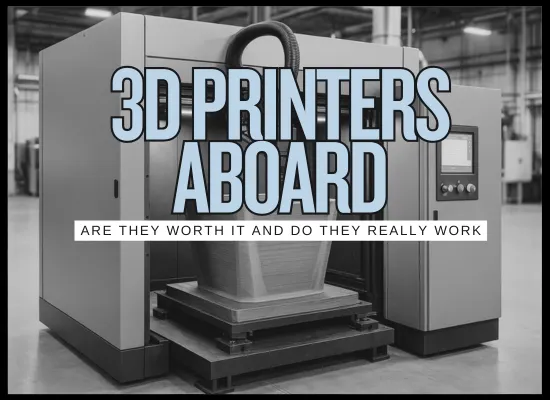
3D printing on ships is like putting a small, flexible machine shop in a box. Instead of waiting days or weeks for a spare part to arrive from shore, the crew loads a certified design file into a printer and makes the part layer by layer on board. For metal, that might be a nozzle, bracket or small pump component; for polymers, it might be clips, housings, guards, or sensor mounts.

In practice, most maritime 3D printing still happens on land. Companies run digital spare part catalogues, print close to main hubs, and ship the finished part a short distance, cutting lead time and inventory cost. At sea, early adopters – from navies to a handful of commercial ships – are testing printers that make low-criticality parts under controlled procedures so they can keep systems running until a permanent repair is done in port.

The idea is simple: turn approved 3D models and powder or wire feedstock into spare parts on demand, instead of storing every possible item on board or waiting for a courier.

3D Printing on Ships: Advantages and Disadvantages
Category Advantages Disadvantages Notes / Considerations
Downtime and availability ✅ Cuts waiting time for selected parts by producing them on demand on board or near the route, reducing the risk that a minor failure causes days of delay. ❌ Not every part is printable or approved; many critical components still require conventional manufacturing and full logistics, so downtime risk is reduced, not eliminated. Start by targeting small, high-delay parts (spray nozzles, brackets, housings) where print lead time replaces long courier lead time.
Spare parts logistics ✅ Digital spare part libraries and on-demand printing reduce the need to store slow-moving inventory on board or in multiple warehouses, lowering working capital and scrappage. ❌ Requires disciplined data management, IP agreements and approved print parameters. Poor version control can lead to the wrong revision of a part being produced. Platforms such as Pelagus 3D show how OEMs can upload qualified designs and have them printed near major ports instead of shipping physical stock globally.
Emergency repair capability ✅ Enables “shop in a box” repairs at sea for certain components, helping ships stay on mission or on schedule instead of diverting to port for relatively simple hardware. ❌ Environmental conditions, vibration and limited inspection tools on board can affect print quality; follow-up work in port is often still required for long-term fixes. Naval programs have already demonstrated shipboard printers producing certified repair parts, but under strict process control and defined part lists.
Quality, class and certification ✅ Standards from DNV and others give frameworks for qualifying processes, machines and printed metal parts, improving confidence in safety-critical applications over time. ❌ Qualification is complex and part-specific; every change in material, machine or profile can trigger new testing, slowing down approval for wider part families. Use existing standards such as DNV’s AM guidelines and standards for metallic parts as a baseline for supplier and process qualification.
Capex and economics ✅ For the right parts, reduced lead time, lower inventory and fewer emergency shipments can more than offset printer, feedstock and training costs over the life of a vessel or fleet. ❌ Industrial metal printers, post-processing and inspection equipment can be expensive and difficult to justify if print volumes per ship are low or poorly selected. Many owners start with shore-based printers or third-party networks, adding shipboard systems only where mission-critical readiness or remote routes justify the spend.
Crew skills and operations ✅ Gives technical crew new tools and skills, turning machinists and ETOs into on-board makers who can solve practical problems without waiting for shore support. ❌ Requires training in AM processes, safety, file handling and inspection. Poorly trained operators can waste material or produce parts that appear sound but fail early. Early naval and commercial programs typically designate a small trained team per ship and keep the print catalogue focused on pre-qualified designs and materials.
Design flexibility and performance ✅ Enables redesigned parts with weight savings, integrated features or improved flow paths that are hard to make with traditional machining or casting. ❌ Design freedom is limited by qualification: radical redesigns often require extensive testing before class and OEMs will accept them in safety-critical systems. Use AM first to reproduce existing qualified designs; then gradually introduce improved geometries where the business case and risk profile justify the engineering effort.
Cybersecurity and IP ✅ Secure digital part libraries, if well managed, let OEMs control designs while still supporting on-demand printing close to the vessel. ❌ Design files, build parameters and monitoring data are valuable IP and can be cyber targets; tampered files could lead to defective parts or liability disputes. Treat AM data as operational technology: use authenticated updates, secure links and clear contracts on design ownership, liability and traceability.
Adoption status (2025–26) ✅ Multiple navies now operate shipboard printers; commercial trials include container ships testing onboard 3D printing of maintenance parts in real conditions, and networks of shore-based AM hubs are live. ❌ Still early-stage for wide commercial fleets; most owners rely on third-party AM providers rather than installing printers across their own ships. Examples include U.S. Navy programs, metal printers on amphibious and carrier vessels, and HMM’s 2025 onboard trial, alongside global spare-parts platforms such as Pelagus 3D.
Summary: 3D printing on ships turns approved digital designs and feedstock into spare parts when and where they are needed. In 2026 it is proven for selected parts and routes, especially in naval fleets and early commercial pilots, but it remains a targeted tool rather than a universal replacement for traditional manufacturing. The wins come from smart part selection, solid quality control and close cooperation between owners, OEMs, class and AM specialists.

2026 3D Printing on Ships: What’s Really Working

  • Onboard pilots are live, but selective: Container carriers and yards are now running real shipboard pilots. HMM’s 9,000 TEU HMM GREEN operates an onboard 3D printing center for maintenance parts, while HD Hyundai has announced an on-ship “3D Printing Digital Workshop” concept for MRO during voyages. Navies have installed metal printers on amphibious ships and LPDs to make repair parts at sea.
  • Most volume is still on shore: The bulk of maritime 3D printing happens in hubs and AM centers, not on the vessel. Joint ventures such as Pelagus 3D and similar networks take OEM part files, qualify them, then print near major ports so ships get parts in days instead of weeks.
  • Standards have caught up enough to move beyond demos: DNV’s additive manufacturing standards and guidelines give owners and OEMs a framework to qualify metallic parts and processes. That makes it easier to trust a printed bracket or impeller coming from a certified workflow.
  • Best results come from small, high-impact parts: Trials focus on items that are cheap but delay-critical: sensor brackets, small valves, covers, clips and housings that can stop a system or force a slowdown if you do not have a spare.
  • Where owners are seeing value: Reduced lead times on older or long-tail parts, fewer emergency air shipments, and lower inventory for slow movers. For navies and remote trades, the main win is resilience: fewer mission or service impacts because of missing hardware.
  • What still blocks scale-up: Part-by-part qualification effort, tight cyber/IP control needs, limited onboard space and power for metal printers, and the fact that most fleets have not yet built the internal processes (and skills) to treat digital spare parts as seriously as physical ones.
3D Printing on Ships: Downtime, Inventory & Payback
Training numbers — replace with your fleet data
Current Delays, Logistics and Inventory
Where 3D Printing Helps
3D Printing Setup Cost (Per Ship)
Finance Assumptions
One-time CAPEX
—
Annual OPEX (printer, materials, licenses)
—
Annual downtime days avoided
—
Annual downtime savings
—
Annual emergency logistics savings
—
Annual inventory carrying savings
—
Net annual benefit
—
Payback (years, discounted)
—
NPV / IRR (vs. CAPEX)
—
This model is a training tool. It assumes that suitable spare parts can be identified and qualified for additive manufacturing, that shipboard print quality and safety procedures are properly managed, and that downtime, logistics and inventory data are available per vessel. Use your own part catalogue, OEM/yard quotes and class requirements before making investment decisions.

Taken seriously, 3D printing on ships is not about printing everything on board; it is about shrinking the list of parts that can stop a voyage or a mission. The real wins come when you line up your delay data, emergency shipment history and slow-moving inventory against a qualified part catalogue and a realistic shipboard (or hub-based) print setup. Used that way, additive manufacturing becomes another reliability and cost-control lever alongside better maintenance and smarter spare-parts planning, and the calculator above gives you a first pass at what that might be worth per ship.

We welcome your feedback, suggestions, corrections, and ideas for enhancements. Please click here to get in touch.

By the ShipUniverse Editorial Team — About Us | Contact


← Browse more ShipUniverse posts
MARITIME DECISION TOOLS

Practical tools for real vessel and commercial decisions

Browse the latest 24 tools or instantly search every published ShipUniverse maritime tool.

24 latest toolsView all 325 →
TOOL

PCTC Vehicle Cargo Mix, Deck Capacity, Port Rotation & Voyage Profitability Tool

🔔 Subscribe to ShipUniverse Weekly → SHIPUNIVERSE / VEHICLE CARRIER COMMERCIAL…

Open →
TOOL

Shipyard Change Orders, Scope Growth, Subcontractor Claims & Newbuild Cost Recovery Tool

🔔 Subscribe to ShipUniverse Weekly → SHIPUNIVERSE / NEWBUILD COMMERCIAL CONTROL…

Open →
TOOL

Alternative Fuel Bunkering Network, Port Availability, Fuel Supply Contracts & Voyage Deviation Economics Tool

🔔 Subscribe to ShipUniverse Weekly → SHIPUNIVERSE / MARINE FUEL &…

Open →
TOOL

Maritime Cloud Service Outage, Backup Communications, Fleet Downtime & Business Continuity ROI Tool

🔔 Subscribe to ShipUniverse Weekly → SHIPUNIVERSE / FLEET DIGITAL RESILIENCE…

Open →
TOOL

Bulk Terminal Stockpile, Conveyor & Shiploader Capacity, Vessel Queues & Demurrage Cost Tool

🔔 Subscribe to ShipUniverse Weekly → SHIPUNIVERSE / BULK TERMINAL COMMERCIAL…

Open →
TOOL

Offshore Cable-Laying Vessel Fleet, Installation Scheduling, Weather Downtime & Project Delay Cost Tool

🔔 Subscribe to ShipUniverse Weekly → SHIPUNIVERSE / OFFSHORE CONSTRUCTION ECONOMICS…

Open →
TOOL

Port Electric RTG & Terminal Tractor Fleet, Charging Infrastructure, Grid Capacity & ROI Tool

🔔 Subscribe to ShipUniverse Weekly → SHIPUNIVERSE / TERMINAL ELECTRIFICATION INTELLIGENCE…

Open →
TOOL

Cruise Private Island Investment, Berth Capacity, Guest Spending & Destination Profitability Tool

🔔 Subscribe to ShipUniverse Weekly → SHIPUNIVERSE / CRUISE DESTINATION INVESTMENT…

Open →
TOOL

FSRU Regasification Capacity, LNG Send-Out, Gas Offtake Contracts & Conversion ROI Tool

🔔 Subscribe to ShipUniverse Weekly → SHIPUNIVERSE / FLOATING LNG REGASIFICATION…

Open →
TOOL

Offshore CO₂ Shipping Supply Chain, LCO₂ Carrier Fleet Sizing, Terminal Slots & Transport Economics Tool

🔔 Subscribe to ShipUniverse Weekly → SHIPUNIVERSE / OFFSHORE CARBON TRANSPORT…

Open →
TOOL

Shipyard Production Capacity, Critical Supplier Bottlenecks, Workforce Allocation & Newbuild Delay Cost Tool

🔔 Subscribe to ShipUniverse Weekly → SHIPUNIVERSE / SHIPBUILDING OPERATIONS &…

Open →
TOOL

Cruise Shore Excursion Capacity, Tour Operator Revenue Share, Cancellation Risk & Port-Day Profitability Tool

🔔 Subscribe to ShipUniverse Weekly → SHIPUNIVERSE / CRUISE & DESTINATION…

Open →
TOOL

Maritime GNSS Jamming & Spoofing, Backup Navigation Readiness, Voyage Delay & Retrofit ROI Tool

🔔 Subscribe to ShipUniverse Weekly → SHIPUNIVERSE / BRIDGE RESILIENCE &…

Open →
TOOL

Fleet Vessel Deployment, Ballast Positioning, Charter Opportunities & TCE Optimization Tool

🔔 Subscribe to ShipUniverse Weekly → SHIPUNIVERSE / COMMERCIAL FLEET DECISION…

Open →
TOOL

Port Terminal Operating System Upgrade, Automation Tender, Operational Downtime & CAPEX ROI Tool

🔔 Subscribe to ShipUniverse Weekly → SHIPUNIVERSE / PORT SYSTEMS &…

Open →
TOOL

Floating LNG Storage Unit Investment, Bunkering Slots, Open-Access Fees & Charter ROI Tool

🔔 Subscribe to ShipUniverse Weekly → SHIPUNIVERSE / LNG INFRASTRUCTURE &…

Open →
TOOL

Panama Canal Transit Slot Auction, Waiting Time, Draft Restrictions & Route Diversion Economics Tool

🔔 Subscribe to ShipUniverse Weekly → ShipUniverse / Canal Access &…

Open →
TOOL

Offshore Wind O&M Vessel Fleet, CTV/SOV Scheduling, Technician Transfers & Turbine Downtime Cost Tool

🔔 Subscribe to ShipUniverse Weekly → ShipUniverse / offshore wind operations…

Open →
TOOL

Vessel Sale & Purchase Closing, Escrow, Bunker ROB, Delivery Documents & Cash Settlement Tool

🔔 Subscribe to ShipUniverse Weekly → SHIPUNIVERSE / VESSEL TRANSACTION INTELLIGENCE…

Open →
TOOL

Harbor Tug Fleet Contract Tender, Utilization, Standby Fees & Towage Profitability Tool

🔔 Subscribe to ShipUniverse Weekly → SHIPUNIVERSE / PORT & TOWAGE…

Open →
TOOL

Marine General Average, Cargo Contribution, Security Deposits & Claims Settlement Exposure Tool

🔔 Subscribe to ShipUniverse Weekly → SHIPUNIVERSE / MARITIME CLAIMS &…

Open →
TOOL

Chemical Tanker Cargo Parcel Allocation, Tank Compatibility, Cleaning Turnaround & Voyage Margin Tool

🔔 Subscribe to ShipUniverse Weekly → SHIP UNIVERSE / CHEMICAL TANKER…

Open →
TOOL

Marine Insurance Claims Portfolio, Hull & P&I Loss Runs, Reserves & Renewal Negotiation Tool

🔔 Subscribe to ShipUniverse Weekly → SHIPUNIVERSE / FLEET INSURANCE &…

Open →
TOOL

Offshore Platform Decommissioning, Vessel Spread, Weather Windows & Removal Campaign Cost Tool

🔔 Subscribe to ShipUniverse Weekly → SHIPUNIVERSE / OFFSHORE ASSET RETIREMENT…

Open →