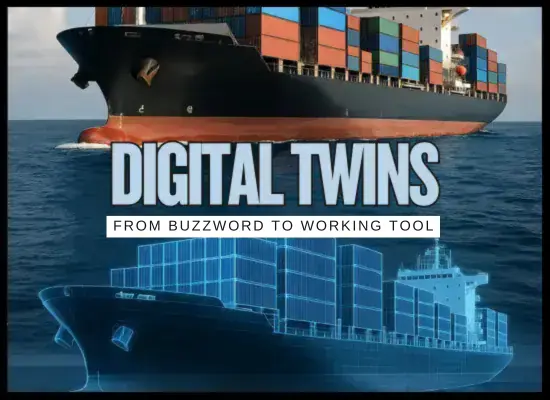
Digital twins have moved from buzzword to working tool on real ships and in real ports. Into 2026, owners are using “performance twins” of hull and machinery to trim fuel use and monitor fouling, ports like Singapore and Rotterdam are standing up full port digital twins to test traffic and berth plans, and class/engine makers have published formal guidelines on how to build and assure trustworthy twins for safety-critical uses.
|
Maritime Digital Twins: Advantages and Disadvantages
|
| Category |
Advantages |
Disadvantages |
Notes / Considerations |
| Vessel performance & fuel |
✅ Uses real voyage and weather data to estimate true hull and propeller condition, not just noon reports.
✅ Supports trim, speed and route optimisation to cut fuel and CO₂ across the life of the ship.
✅ Makes it easier to compare sister vessels and spot outliers that need attention.
|
❌ Needs trustworthy input data (speed, power, draft, weather); poor sensors produce misleading “insights”.
❌ Models must be re-calibrated after modifications, fouling or major repairs or they drift from reality.
❌ If the twin is a black box from a vendor, owners may struggle to challenge or validate results.
|
Ask vendors to explain model assumptions and show how they validate the twin against real performance after each drydock.
|
| Maintenance, reliability & safety |
✅ Enables condition-based maintenance by monitoring vibration, temperatures and loads on critical equipment.
✅ Can simulate “what if” failures and emergency scenarios for training and risk assessment.
✅ Structural twins can track fatigue and loads on hulls, offshore units and key components.
|
❌ Over-reliance on a twin without conservative margins can create a false sense of security.
❌ Building high-fidelity structural or machinery twins requires detailed design data that may be hard to access from yards.
❌ Advanced models and dashboards can overwhelm crews if not simplified for day-to-day use.
|
Start with a small number of high-value assets (main engine, propulsion, critical auxiliaries) and simple KPIs before going fleet-wide.
|
| Design, newbuilds & retrofits |
✅ Links design-stage simulations to real operating data, improving future hull forms and machinery selection.
✅ Helps evaluate retrofit options (new propeller, air lubrication, scrubbers, OCCS) virtually before committing to yard work.
✅ Supports “lifecycle” thinking: design, build, operate and recycle around a shared data model.
|
❌ Requires cooperation and data sharing between shipyards, designers, owners and class that may not exist today.
❌ Intellectual property concerns can block sharing of detailed 3D models or engine maps.
❌ If each project builds its own twin from scratch, costs and complexity escalate quickly.
|
Look for frameworks and guidelines (e.g. class and industry digital twin guidance) that promote standardised data formats and interfaces.
|
| Ports, terminals & traffic |
✅ Port digital twins can simulate traffic, berth plans and yard operations to reduce congestion and waiting time.
✅ Supports just-in-time arrivals, shore power planning and tug allocation.
✅ Helps stress-test future layouts, channel deepening and terminal expansions before construction.
|
❌ Bringing together AIS, terminal systems, customs and pilotage data often means integrating many legacy IT systems.
❌ Governance questions arise: who owns the data, and who can see which part of the twin?
❌ Smaller ports may find it hard to justify cost and complexity compared to simpler tools.
|
Corridor and hub projects (e.g. between major ports) often move first; smaller ports can plug into common standards later.
|
| Data, integration & cyber |
✅ Forces owners to map sensors, networks and data flows, which also benefits general digitalisation and reporting.
✅ Once data pipelines are in place, the same feeds can support multiple tools (twinning, routing, emissions reporting).
✅ Clear assurance practices for twins make it easier to trust automated insights.
|
❌ Poor-quality or intermittent data is the main reason early digital twin projects disappoint.
❌ More connectivity and cloud integration increase cyber risk if not managed carefully.
❌ Multiple vendors may create overlapping dashboards and models that do not agree.
|
Treat the digital twin as part of OT/IT cybersecurity and data governance, not a separate “app” living on its own.
|
| Commercial & adoption |
✅ Can support transparent performance-based contracts with charterers, yards and engine makers using agreed KPIs.
✅ Helps quantify savings from energy efficiency and maintenance, strengthening the case for green loans or subsidies.
✅ Fleet-level twins enable benchmarking across ships and trades, revealing best practices and weak performers.
|
❌ Benefits are often spread across departments (operations, technical, chartering), while costs show up in one budget line.
❌ Culture and change management can be harder than the technology; some crews and managers remain sceptical.
❌ Vendor lock-in risk if data formats and APIs are closed or highly proprietary.
|
Start with a clear business case: which decisions will the twin improve, who will use it, and how will savings or risk reductions be measured?
|
|
Summary: Maritime digital twins are shifting from slides to everyday tools for performance, safety and port planning.
The upside is better decisions backed by live data and simulations; the downside is the effort needed to build reliable twins,
secure data sharing and embed them in real-world workflows instead of treating them as one-off dashboards.
|
Digital twins are now moving from trials into day-to-day tools on selected ships and corridors, but they still live or die on data quality and how well they are woven into real decisions. For an owner, the practical next step is to treat a twin project like any other technical investment: run the numbers with realistic savings, include change management and license costs, agree who shares in the benefit, and start with a small set of vessels where you can prove value and refine the playbook before scaling.