
🔔 Subscribe to ShipUniverse Weekly →
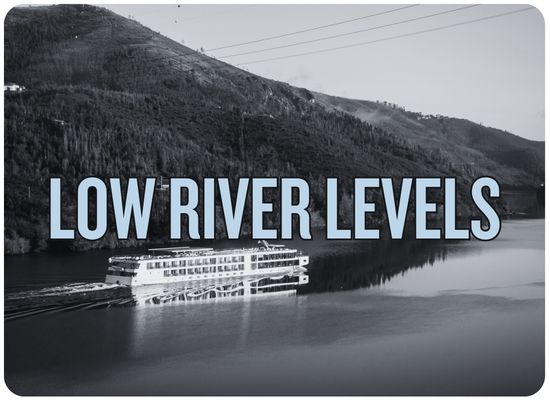
Low River Levels Just Cost $100 Million.
The ship does not have to cancel for the operator to lose the booking. Viking kept every scheduled cruise on its calendar during Europe's historic low-water quarter, yet altered itineraries, moved guests and watched some passengers cancel. The result: approximately $100 million in lost third-quarter revenue and another way to measure the same shock in adjusted gross margin. For river operators, the expensive question is no longer just how shallow the water gets. It is how many guests still want the vacation once the original route is no longer possible.
Two $100 million figures. One low-water disruption.
Viking's November 17 SEC-filed results estimate a reduction in both revenue and adjusted gross margin. They are not two separate losses to add together. The affected operations were parts of its European river network; Viking did not assign the $100 million to any single river.
Guests canceled after itinerary changes and the company earned less cruise revenue than otherwise expected.
Adding revenue impact and adjusted margin impact would double-count the same event.
Reflects foregone margin and extra direct spending for disrupted itineraries.
Q3 consolidated revenue still rose 9.2% to $2.184 billion. The estimated low-water revenue hit equals roughly 4.6% of that actual quarterly revenue, a scale comparison rather than a published margin or sales ratio.
Viking explicitly says it canceled no scheduled cruises. It modified itineraries and faced increased guest cancellations, with occupancy falling to 91.3% across the company, not just the river fleet.
The depth that matters is the shallowest safe route ahead
Water-level headlines are not a ship's available under-keel clearance. Controlling channel depth, vessel draft, the latest survey, notices and an operator-approved safety margin decide whether a reach is passable.
| European waterway / reference | Documented 2026 conditions | Operational consequence |
|---|---|---|
| Danube, east of Vienna | Austria's August 4 report said only 1.8 m of navigable channel water was available. | Highly constrained draft and fewer viable river passages. This is not a universal ship draft limit. |
| Danube, Wachau | Same report cited 2.0 m of navigable channel depth. | Different reaches of one itinerary can have different controlling depths. |
| Middle Rhine, Kaub | Germany's official Kaub gauge uses an equivalent low-water reference of 77 cm, not a direct under-keel depth reading. | A gauge must be interpreted with fairway geometry, current surveys and safe clearance. |
| Danube / Elbe / Rhine | Viking's November 11 sailing advisory said sections of all three still had abnormally low water and some modified itineraries. | Guest notices, flexible berths, ship swaps and road connections remain part of the operation. |
Insufficient channel clearance can force a ship swap, bus trip or skipped port. Some guests accept the replacement itinerary and incur additional handling expense. Others cancel, reducing revenue and occupancy. Goodwill credits, extra crew work and advance-booking consequences can persist after river levels recover. The available public filing does not disclose a complete split of Viking's $100 million among cancellations, transportation, compensation and other costs.
What every cruise operator should change
Read the failure mode first. Open an item for the documented evidence and an operating control worth adopting.
01Measure usable river depth, not the gauge headlineThe ship navigates through its shallowest controlling section, not the average river level.+
Use official station readings, short-range forecasts, Notices to Skippers, and survey data for the exact reach. Rhine gauge values are referenced to a datum; 77 cm at Kaub is the 2022 equivalent low-water level, not the depth under a vessel.
Compare charted and latest available channel depth with actual loaded draft, under-keel clearance and vessel-specific restrictions. Trigger a documented go / modify / no-go decision.
02Separate Rhine, Danube and Elbe exposureA disruption on one river cannot be generalized to every itinerary or quarter.+
Viking’s November 11 notice cited abnormally low levels on sections of the Danube, Elbe and Rhine. Austria identified just 1.8 m available east of Vienna and 2.0 m in the Wachau in August.
Maintain a daily corridor matrix by itinerary, week, critical river reach, alternative docking site, and feasible guest-transfer route. Use a different threshold for each hull and river.
03Design ships for tolerance and fleets for substitutionHull draft and the ability to exchange near-identical ships are both resilience investments.+
Viking says it can position identical sister ships on opposite sides of a low-water reach and transfer guests to the same stateroom category. Its annual filing cites these transfers in 2018 and 2022.
Evaluate draft, machinery arrangement, hotel capacity and spare inventory together. Standardize stateroom numbering, manifests and baggage workflows across swap-compatible vessels.
04Price the bus-and-hotel plan before the water fallsA modified river cruise can still be expensive to deliver even without a ship cancellation.+
Moving 180 guests by coach creates transport, baggage, guide, meal and sometimes hotel costs. Viking explicitly attributes part of its approximately $100M adjusted-margin impact to incremental mitigation expenses.
Negotiate standby coaches and accessible vehicles, hotel blocks, guide contracts, shore meeting points and emergency guest-care service levels before a drought week.
05Treat guest cancellation as its own risk channelRunning the ship does not protect revenue if guests decide the modified vacation is not worth taking.+
Viking said no scheduled cruises were canceled, yet itinerary disruptions prompted guest cancellations and lower occupancy. Groupwide Q3 occupancy was 91.3%, down from 96.0%.
Forecast cancellations after each itinerary-change notice, separate pre-departure attrition from no-shows and track whether saved capacity can be resold without heavy discounts.
06Tell guests early, but disclose what is still uncertainLate and ambiguous itinerary changes can turn navigational limits into customer churn.+
Viking’s published river voyage guarantee typically aims to notify guests seven days before embarkation when it determines a qualifying river-navigation disruption, with later warnings when conditions change quickly.
Communicate a time-stamped itinerary A / B / C with what is known, likely transfer hours, docking changes, accessibility issues and a named decision deadline. Avoid promising a specific gauge recovery.
07Separate goodwill vouchers from legal entitlementsA voucher is a customer-retention instrument, not a universal replacement for a refund right.+
Viking says it issued goodwill vouchers to certain guests who traveled on impacted itineraries; its guarantee also provides voucher options. EU package-travel rules can require alternative arrangements, price reductions or refunds when legally applicable.
Use a jurisdiction-specific decision tree distinguishing voluntarily accepted travel credits from mandatory cash remedies. Track face value, redemptions, expiry and future cabin displacement.
08Build a revenue-to-margin loss bridgeA $100M revenue hit and a $100M adjusted-margin hit are not two bills to add.+
Viking estimated both the reduction in Q3 revenue and the adjusted-gross-margin impact at approximately $100M. The latter includes lost contribution plus incremental direct mitigation costs.
Reconcile lost departures or booked passenger days, guest cancellations, fare refunds, avoided costs, coach/hotel spending, incremental overtime and customer concessions. Report EBITDA and cash timing separately.
09Budget for weather as a recurring portfolio exposureThe risk may recur and be correlated across many ships in the same basin.+
Viking’s annual report identifies 2018 and 2022 low-water events. The Danube Commission described 2026 as an exceptionally severe year for navigation; Austria reported restrictions approaching 2018 conditions.
Stress-test basin-wide rather than independent ship disruptions. Spread exposure by vessel draft, geography, season and itinerary length; consider liquidity reserves and the limits of weather/business-interruption cover.
10Run a readiness drill before selling the next seasonThe best contingency is one already costed, contracted and rehearsed.+
Viking says its operation uses a large river fleet and more than 100 owned or controlled docking locations. Its November 11 public notice describes same-room ship swaps, showing the value of asset and berth flexibility.
Conduct tabletop exercises with nautical, revenue management, legal, shore operations and customer care. Audit partner capacity, luggage transfer, accessibility and voucher accounting, then recalibrate the itinerary promise.
A rerouted cruise, a canceled booking and a refund are different events
| Case | What Viking disclosed or offers | What not to assume |
|---|---|---|
| Operator maintains sailing; route changes | Viking says sister-ship swaps and adjusted itineraries can keep journeys operating. | The guest receives exactly the original routing or a guaranteed cash payment. |
| Guest declines affected cruise before embarkation | Under Viking's qualifying river-voyage guarantee, a guest can choose a future cruise voucher for 100% of paid cruise fare, subject to conditions. | That the guarantee describes all mandatory statutory refund rights. |
| Guest travels on modified itinerary | Viking may provide a future voucher or shipboard credit depending on the specific impact; it reported issuing goodwill vouchers to certain Q3 guests. | Every modified itinerary receives the same voucher percentage, or a voucher is cash. |
| Applicable EU/EEA package-tour rules | Depending on booking jurisdiction and facts, substantial contract changes may trigger alternatives, price reductions, cancellation or refund rights. | That a weather clause always extinguishes consumer rights; legal obligations must be assessed separately. |
Validate current official gauges and depth forecasts, list likely restricted reaches, confirm standby shore transport and notify guest-service leads.
Approve a route, sister-ship transfer or safe no-go decision. Record alternatives, direct costs, contract implications and the complete passenger communications plan.
Reconcile bookings lost, services actually delivered, compensation and voucher liabilities, avoiding double-counting revenue and expense impacts.
Primary research sources and definitions
Research verified November 17, 2026. Financial data refer to Viking's three months ended September 30, 2026 unless otherwise stated. River-specific depths are from Austrian authorities in August; they are snapshots of selected reaches, not current navigation advice. The $100 million effect is a management estimate and not an independently audited route-level loss schedule. Consult current official notices for any passage decision.
Viking Holdings / SEC, Q3 2026 earnings release, November 17 Viking public current-sailings advisory, November 11, 2026 Viking published river voyage guarantee and FAQs Viking 2025 Form 20-F, low-water risk and past ship-swap examples Austrian Ministry BMIMI, Danube navigable depths, August 4, 2026 Danube Commission, 2026 drought and navigation assessment, November 3 Central Commission for the Navigation of the Rhine, September 2026 low water Germany ELWIS, Kaub official gauge and forecasts EU Commission / EUR-Lex, package travel consumer rights under Directive 2015/2302How much can a low-water season really cost?
Stress-test a fleet's seasonal exposure and compare a reactive operation with a pre-contracted ship-swap, coach and guest-care plan. The calculator measures illustrative contribution and extra operating costs, not gross refund checks and not Viking's actual $100 million bridge.
Expected avoided cancellation and response costs, less preparation spend.
Illustrative single-season expected-value model. Disrupted departures = planned departures × probability; affected guest bookings = disrupted departures × booked guests. In each response case, loss = canceled share × fare × contribution margin plus continuing share × extra guest service cost. The prepared case also pays an annual program cost. Extra guest cost includes coaches, hotels, customer credits and other direct response expenses so do not separately add them again. Avoided costs on canceled bookings are reflected in the contribution margin. Does not model lost future demand, credit redemptions, group fixed operating costs, tax, insurance, price elasticity or correlated fleet-wide disruption probability; real severe drought events can affect many departures at once. The 2026 Viking impact is a disclosed corporate estimate, not output of this model.
We welcome your feedback, suggestions, corrections, and ideas for enhancements.
Please click here to get in touch