
🔔 Subscribe to ShipUniverse Weekly →
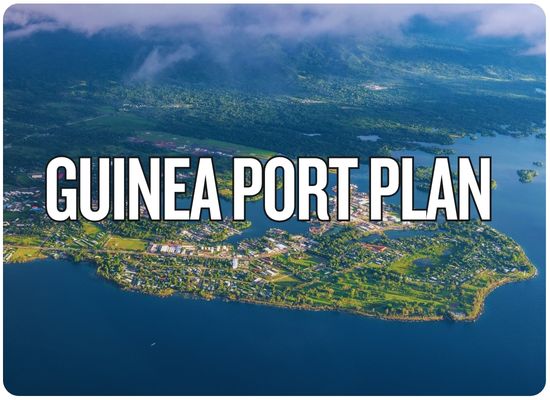
Guinea is seeking approximately US$1.9 billion to develop a multi-user deepwater port at M’Bottiny in the Kouffin area, south of Kamsar in Boké prefecture. Mines and Geology Minister Bouna Sylla said on November 16, 2026, that feasibility studies had been completed and the government was engaging U.S., Chinese and multilateral financing institutions. The proposed port is designed to accommodate vessels of up to approximately 200,000 deadweight tonnes at a planned vessel draft of 20 meters. Authorities have not announced committed construction financing, a date for selecting investors or a construction start date.
$1.9 Billion for a New Gateway.
Built Around 200,000-DWT Bulkers.
A multi-user development, not a single-mine export jetty
The four-berth plan was presented during Guinea's November 2025 preliminary design validation. Its components are proposed facilities, not existing operational capacity.
The government has also described a possible petroleum terminal and industrial park. The published four-berth figure does not establish that all four berths could simultaneously accommodate fully laden 200,000-DWT carriers.
Operating arrangements vary by mining company and terminal. Guinea already has both direct-loading berths and offshore transshipment facilities.
The simplified concept could remove some offshore transfer stages for users of the future terminal. Actual savings depend on port charges, transport links, cargo flow, loading rates and vessel utilization.
Seven years of preparation, one unresolved financing hurdle
Guinea's reported 2025 national bauxite export volume, approximately 25% above 2024. This is cargo shipped across the country's export system, not the planned M’Bottiny port's capacity.
Planned long-run combined iron ore export capacity associated with Simandou's rail and port system. It must not be added to M’Bottiny's capacity, which has not been publicly quantified.
A $1.9 Billion Port Plan.
Six Funding Channels.
No Construction Date.
Financing status in perspective
Study funding is not construction funding
The African Development Bank's 2019 grant supported feasibility work. It should not be confused with financing for the port's $1.9 billion construction program.
African Development Bank grant agreement for the project's preparatory studies.
Capital Guinea is seeking for development of the proposed port.
Participation in discussions does not establish a signed funding commitment.
A public-private partnership structure was recommended during the preliminary planning process. The final concession model, allocation of construction and demand risks, and the division between public and private financing have not been announced.
Potential shipping-market effects
These are conditional commercial implications, not confirmed contract awards or forecasts of future freight rates.
Additional direct-loading berths could alter port calls, loading time and vessel positioning if significant cargo volumes transfer to the new facility.
Shared access could create an alternative to dedicated terminals or offshore transshipment, subject to delivered logistics costs and available capacity.
Berth productivity, laytime, draft restrictions and port charges would determine whether direct loading reduces total voyage costs.
Some cargo could migrate from offshore transfer operations. Existing providers may also adapt services or retain volumes at other terminals.
A funded construction phase could generate tenders for shiploaders, cranes, conveyors, dredging, tugs, rail systems and port technology.
The container and industrial-park concepts could extend the port's customer base beyond bulk minerals, but commercial demand remains to be demonstrated.
Nimba Mining Company's published operating profile describes barging bauxite approximately 40 kilometers to a deepwater transshipment area. It reports that loading a Capesize by this process takes about four and a half days. These figures apply to that operation, not all Guinean exports.
M’Bottiny's proposed direct-loading concept does not yet have published commercial loading rates or port tariffs sufficient to calculate vessel-day savings, terminal cost per tonne or return on investment for a particular cargo contract.
Signals to watch
Guinea is seeking $1.9 billion to develop the proposed M’Bottiny multi-user deepwater port south of Kamsar, with facilities intended to handle large bulk carriers, bauxite exports and commercial cargo. Feasibility and preliminary design work have progressed, but construction financing, the final port specifications and a start date remain unconfirmed. Until those milestones are reached, the announcement represents a potential future change to West African shipping logistics, not new operational Capesize capacity.
We welcome your feedback, suggestions, corrections, and ideas for enhancements.
Please click here to get in touch