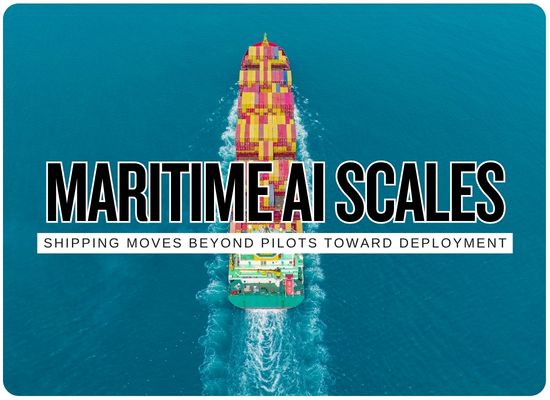
Artificial intelligence is moving deeper into day-to-day maritime operations as shipping companies, ports and shipbuilders shift from isolated trials toward fleet deployment, autonomous decision support and AI-enabled machinery control. Lloyd's Register says 420 organizations were active in maritime AI development during the latest year, up from 276 a year earlier, while research commissioned by LR valued the maritime AI market at $4.13 billion in 2024 and projected 23% annual growth over the following five years. PwC separately reports that more than 81% of maritime companies are piloting AI, although many remain unable to scale those projects because of fragmented data, legacy systems and weak governance. The regulatory environment is also beginning to catch up: IMO's first non-mandatory Maritime Autonomous Surface Ships Code took effect July 1, 2026, creating a formal global framework for autonomous commercial vessels while development of a mandatory regime continues toward the next decade.
Maritime AI Outlook · 2026-2030
AI Is Moving From the Dashboard Into the Operating Loop
The next phase of maritime AI is less about producing another prediction or alert and more about connecting intelligence directly to navigation, voyage planning, machinery, port decisions and commercial workflows while keeping people responsible for critical decisions.
Maritime Companies Piloting AI
81%+
PwC says experimentation is widespread, but relatively few organizations have built the governance and data foundations needed to scale.
Maritime AI Market · 2024
$4.13B
LR-cited Thetius research forecasts roughly 23% compound annual growth over the following five years.
Organizations Active in Maritime AI
420
Lloyd's Register says the latest count increased from 276 organizations one year earlier.
Four AI layers are developing at very different speeds
Scaling Now
Prediction + Optimization
Weather routing, fuel optimization, ETA prediction, equipment health and emissions modeling are already embedded in commercial fleet platforms.
Fleet Deployment
AI Navigation
Computer vision increasingly supplements radar and AIS while autonomous route and speed control is moving onto operating ships and newbuild series.
Emerging Fast
Agentic Operations
AI systems are beginning to prepare voyages, reconcile documents, monitor changing conditions and initiate workflow actions instead of only displaying recommendations.
Longer Horizon
Full Autonomy
Technology is progressing quickly, but regulation, insurance, infrastructure, responsibility and mixed-traffic integration remain significant barriers to large-scale commercial deployment.
Live Navigation Validation
739
real-world vessel targets assessed
Lloyd's Register evaluated Orca AI computer vision during an 828-nautical-mile feeder containership voyage through congested Mediterranean waters.
94%
Precision recorded during the LR assessment.
98.6%
Recall, meaning the system detected nearly all relevant targets in the trial dataset.
63%
Of the trial observations were collected under congested navigation conditions.
0
System downtime recorded during the five-day trial.
2026-2032 Technology Runway
The Near-Term Winner Is Augmented Shipping, Not Crewless Shipping
AI is already commercially useful when it improves a specific decision. Fully autonomous international merchant shipping requires a much larger ecosystem of regulation, connectivity, ports, insurance, remote operations and clearly allocated responsibility.
Voyage + Fuel
Commercial
Route, weather, speed, ETA, emissions and bunker decisions are increasingly calculated continuously rather than once at departure.
VALUE NOW
Bridge AI
Scaling
Computer vision, collision-risk analysis and automated route/speed control are spreading across retrofit fleets and newbuild programs.
2026-2028 SCALE-UP
Machinery AI
Scaling
Predictive maintenance is progressing toward systems that optimize pumps, auxiliaries and machinery configurations automatically.
2026-2029
Ports + Terminals
Scaling
AI is being used for arrival prediction, berth and yard optimization, traffic planning, computer vision and digital twins.
VALUE NOW
Agentic AI
Emerging
Agents are beginning to prepare voyages, monitor exceptions, retrieve data and coordinate work across operational systems.
2026-2029
Full MASS
Early Market
Autonomous operation is technically credible in selected environments, but global commercial scaling still depends on regulation and ecosystem readiness.
2030s
Regulatory milestones are finally appearing beside the technology
2026
MASS Code Takes Effect
IMO's first non-mandatory autonomous-ship code became effective July 1.
2027
Digitalization Strategy
IMO intends to take its global maritime digitalization strategy to the Assembly.
2028
Mandatory MASS Work
IMO roadmap calls for development of the mandatory code using experience from the voluntary framework.
2030
Target Adoption
IMO expects adoption of the first mandatory MASS Code by July 2030.
2032
Target Entry Into Force
Current IMO roadmap targets January 1, 2032 for mandatory rules to enter into force.
Autonomy R&D Commitment
71%
Roland Berger respondents whose companies now devote more than 10% of R&D spending to autonomy, up from 34% in 2025.
Respondents identifying Asia as the likely center of gravity for autonomous shipping.
2040 Adoption View
63%
Respondents expecting more than 10% of commercial vessels on the water in 2040 to be autonomous.
The technology curve is running ahead of the ecosystem.
Roland Berger's 2026 survey found that confidence in autonomy increased even as dissatisfaction with current market penetration rose. Respondents increasingly identified regulation, standards, insurance, infrastructure and coordination rather than core technology as the barriers to scale.
Ship Universe Maritime AI Value Tool
Fleet AI Opportunity & Readiness Analyzer
Estimate where AI could create the largest economic opportunity across fuel optimization, predictive maintenance and administrative automation, then discount that opportunity based on the organization's data, systems and governance readiness.
USD/year
days/year
USD/day
hours/week
USD/hour
1-5
1-5
1-5
Rate the organization's ability to validate, supervise and audit AI-supported decisions.
%
%
%
Gross Annual AI Opportunity
$2.09M
modeled fuel, downtime and administrative opportunity before readiness adjustment
Readiness-Adjusted Opportunity
$1.11M
gross opportunity discounted using entered data, integration and governance maturity
Fuel Opportunity
$1.50M
annual fuel spend multiplied by the selected optimization assumption
Downtime Opportunity
$120K
modeled avoided downtime under the entered maintenance assumption
Administrative Opportunity
$468K
labor value represented by the selected automation assumption
Readiness Score
53%
simple average of data quality, integration and governance maturity
Where the Modeled Value Sits
AI programs should start where measurable operating value and organizational readiness overlap rather than where the technology sounds most advanced.
Voyage / Fuel Optimization$1.50M
Predictive Maintenance$120K
Workflow / Agentic AI$468K
Deployment Readiness
53%
Build the foundation first
There is enough digital maturity to run targeted pilots, but broad automation should remain supervised until data quality, system integration and governance improve.
Data3 / 5
Integration3 / 5
Governance2 / 5
Scenario only:
This tool does not claim that AI will automatically produce the entered fuel, downtime or labor reductions. Those percentages are user-adjustable assumptions. Actual results depend on vessel type, operating profile, data quality, implementation, crew adoption, contract structure and the specific technology deployed. Readiness-adjusted value is a simple planning metric, not a financial forecast.
Feedback Welcome
We welcome your feedback, suggestions, corrections, and ideas for enhancements.