Anduril and Navy Commit $6.6B to New Submarine Industrial Yard as Virginia Production Lags Target
🔔 Subscribe to ShipUniverse Weekly →
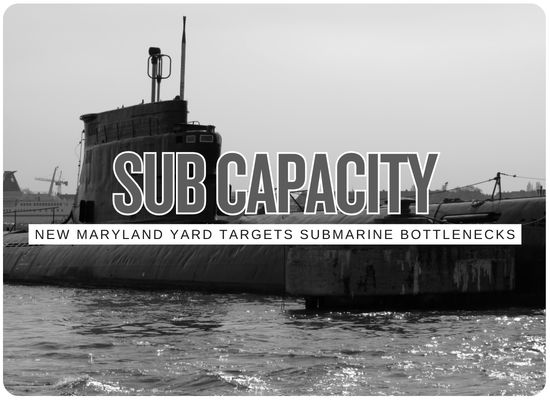
Anduril Industries will build a new 187-acre, more than 2-million-square-foot submarine manufacturing complex at Sparrows Point, Maryland, backed by $3.7 billion of Anduril private capital and an up-to-$2.9 billion U.S. Navy production contract, creating a combined $6.6 billion commitment to expand the Virginia-class submarine industrial base. Called Arsenal-2, the facility is expected to begin initial operations in 2030 and eventually manufacture large submarine components and assemblies for delivery to General Dynamics Electric Boat and HII Newport News Shipbuilding rather than assemble complete nuclear submarines itself. Anduril plans to start with constrained components such as torpedo tubes and progressively move toward larger modules, potentially including complete bow and stern sections. The facility is expected to add about 9 million production labor hours per year, which administration officials characterized as roughly a 15% increase in Virginia-class industrial capacity.
This Is Not Another Expansion Inside Electric Boat or Newport News
The Navy is adding an entirely new industrial node to the Virginia-class production system. Anduril will manufacture components and large submarine assemblies in Maryland, then ship that work to the two established nuclear-submarine prime yards for final assembly.
Arsenal-2 Is Being Built Into a Production System Already Running Behind
The Navy's challenge is not procuring two Virginia-class submarines in a budget year. It is physically completing them at that pace while simultaneously increasing Columbia-class ballistic-missile submarine construction.
| Constraint | Current Problem | Arsenal-2 Response | Timing | What It Could Free Up | What It Does Not Solve Automatically |
|---|---|---|---|---|---|
| Torpedo Tubes Immediate gating component | Administration officials say torpedo-tube availability is currently holding up progress on some Virginia-class submarines already under construction. | Anduril is establishing a second production source and beginning prototype work before the Maryland yard opens. | California production qualification first; Arsenal-2 initial operations in 2030. | Prime-yard labor and floor space currently consumed by delayed or constrained components. | Other supplier shortages, nuclear-qualified manufacturing, workforce shortages and schedule problems elsewhere in the submarine enterprise. |
| Skilled Labor Welders, pipefitters, electricians | GAO has repeatedly identified shortages of experienced workers as a cause of submarine production delays. | 3,100 direct jobs at Arsenal-2 plus an earlier workforce pipeline through Anduril's California component facility. | Hiring begins before full Maryland production; Anduril targets more than 3,100 jobs by 2034. | More industrial labor outside Electric Boat and Newport News. | National competition for nuclear-qualified welders, engineers, inspectors and skilled trades. |
| Large Assemblies Distributed construction | The two prime shipyards face finite physical space and labor capacity while handling both Virginia and Columbia programs. | Fabricate and outfit large sections in Baltimore before shipment to the prime yards. | Progressive expansion after Arsenal-2 begins operating. | Allows more submarine construction work to proceed in parallel instead of occupying prime-yard resources. | Final nuclear submarine integration, testing and delivery remain highly specialized operations at the prime yards. |
| Production Control ArsenalOS | Complex submarine production requires thousands of controlled fabrication, inspection and documentation steps. | Digital work instructions, material tracking, embedded inspection controls, automation and real-time production visibility. | Methods tested in California before broader implementation in Maryland. | Potential reductions in staging delays, training time and disconnected production records. | Digital systems cannot remove SUBSAFE certification standards or substitute for skilled trade knowledge and nuclear-quality controls. |
| Fleet Demand Navy + AUKUS | U.S. requirements already call for two Virginia-class boats annually, while planned transfers to Australia create additional replacement pressure. | Creates a substantial new source of components and production hours outside the existing two-yard system. | Maryland production starts around the same decade in which AUKUS Virginia transfers are expected to begin. | Adds industrial depth before those additional obligations peak. | Overall AUKUS feasibility still depends on the entire U.S. submarine industrial base reaching and sustaining higher construction rates. |
Arsenal-2 Industrial Capacity Analyzer
Test how a new production node changes industrial capacity under simplified assumptions. The model treats Anduril's announced 9 million annual labor hours as additive manufacturing capacity rather than directly assuming it produces a specific number of submarines.
We welcome your feedback, suggestions, corrections, and ideas for enhancements.
Please click here to get in touch