Four Frigates, First Steel Already Cut: How Fast Can Europe Actually Rebuild Its Surface Fleets?
🔔 Subscribe to ShipUniverse Weekly →
Steel in 31 Days: Can Europe Turn Hot Frigate Lines Into Real Fleet Growth?
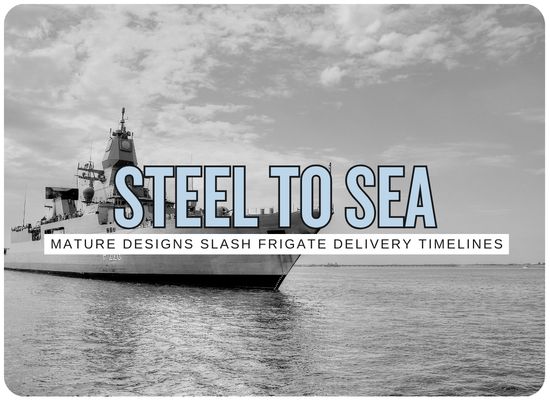
Sweden signed for four FDI frigates on August 31. Naval Group began cutting steel for HMS Luleå on October 1. The first ship is planned for delivery in 2030.
The 31-day interval is eye-catching, but it does not mean Europe can design a modern frigate in a month. Sweden reached the production floor quickly because it deliberately selected a warship that had already passed through design, industrialisation, construction, sea trials and delivery for two other NATO navies.
The FDI production system at Lorient is already building French and Greek ships. Its workforce, suppliers, hull-production sequence, combat-system integration process and shore-test infrastructure already exist. Sweden is joining a moving production line rather than creating one.
That distinction sits at the center of Europe's naval rearmament problem. European governments increasingly have the money and requirement to order more surface combatants. What they do not automatically have is time. First-of-class warships can still consume most of a decade between contract and operational service. Mature designs coming off hot production lines can compress that interval dramatically.
The design clock started years before Sweden signed the contract
Sweden's contract was signed on August 31, 2026. The steel-cutting ceremony followed on October 1 at Naval Group's Lorient yard.
That interval is real. It is also only the final step in a much longer industrial sequence.
France's original FDI programme created the baseline design and funded first-of-class development.
FMV entered detailed negotiations after an earlier market evaluation.
Physical production could start immediately because the design and line were already mature.
FMV had conducted its market survey during 2025. When formal negotiations opened in May 2026, the agency stated that its objective was to procure a catalog vessel with as few modifications as practical.
The FDI also already existed physically. The French Navy had received the first ship, Amiral Ronarc'h, in October 2025. Greece received HS Kimon two months later. Other French and Greek units were already moving through the Lorient production cycle when Sweden signed.
FDI is becoming a multinational serial-production programme
Marine Nationale
Five FDIs form part of France's planned force of 15 first-rank frigates.
Hellenic Navy
Three original ships plus a fourth unit ordered in November 2025.
Royal Swedish Navy
Luleå-class air-defence frigates joining the same industrial family.
The combined orderbook now stands at 13 vessels across three NATO navies.
This matters industrially because a shipyard does not have to shut down and restart its workforce between national batches. French, Greek and Swedish ships can occupy different points in the same production cycle while suppliers continue manufacturing equipment for the broader family.
The result resembles commercial serial production more closely than the traditional model of building a small national warship class, ending the run, losing experienced personnel and then attempting to recreate the production system years later.
Lorient's production system
Fast first steel does not mean four frigates arrive together
The delivery pattern exposes the difference between production-line capacity and customer delivery rate.
Naval Group says Lorient can build up to two FDIs per year. Sweden is not receiving two ships annually because it does not own the entire production line. French and Greek ships occupy the same industrial system, and the Swedish configuration requires its own equipment, acceptance work and scheduling.
The first Swedish hull therefore begins quickly, but the four-ship force still takes several years to assemble.
Sweden is limiting redesign without buying an identical French ship
FMV has described the FDI as a mature design already in serial production, but the Swedish vessels will not simply reproduce the French configuration.
| System area | Swedish Luleå-class direction | Integration implication |
|---|---|---|
| Area air defence | Aster 30 | Uses an established FDI weapon family and reduces the amount of new integration work. |
| Additional air defence | CAMM-ER | Adds a Swedish-specific missile configuration that must coexist with the wider combat system. |
| Anti-ship warfare | RBS15 | Retains an important Swedish weapon within the imported platform. |
| Anti-submarine warfare | Torped 47 | Requires national weapon integration while preserving the FDI's ASW mission architecture. |
| Additional radar | Giraffe 1X | Adds Swedish sensor content to an existing digital combat-system architecture. |
| Naval guns | 57 mm and 40 mm | Creates additional national-system integration without redesigning the entire platform. |
| Remote weapon station | Trackfire | Further expands Swedish industrial participation and commonality with national equipment. |
This is the central compromise behind rapid acquisition: freeze as much of the ship as possible while customizing the systems that matter most to national doctrine, weapons stocks and logistics.
Seventy percent of the combat system can be tested before it reaches the hull
The FDI production process does more than fabricate steel quickly.
Naval Group's Panoramic Sensors and Intelligence Module, or PSIM, contains approximately 70 percent of the ship's combat system. The integrated mast, sensors, electronic-warfare equipment and combat-system elements can be assembled and tested on land while the hull is being built separately.
This attacks one of the most persistent warship-production problems: a hull can be structurally complete while the combat system remains months or years from acceptance.
Parallel construction shifts technical risk earlier in the schedule. Software bugs, sensor interfaces and equipment failures discovered on the shore integration platform are cheaper to correct than the same problems discovered after a ship enters sea trials.
France paid the first-of-class time penalty so later customers do not have to
The first French FDI did not move at Swedish speed.
The original French programme dates to 2017. Manufacturing of the first ship began in 2019. Amiral Ronarc'h was finally delivered in October 2025.
That ship absorbed the engineering work associated with a new platform, a new digital architecture, shore integration, sea testing and maturation of the production process.
Greece then entered the same programme in March 2022 and received HS Kimon in December 2025, less than four years after contract signature.
First-of-class burden
Design development, new industrial process, first combat-system integration, qualification and initial sea-test learning.
Series-production benefit
Later customers inherit a tested hull, trained workforce, existing suppliers and accumulated construction experience.
This is one of the strongest arguments for cross-European common platforms. The first navy carries much of the non-recurring engineering burden. Later navies can purchase capacity from the mature part of the learning curve.
Four years is possible. So is eleven.
European frigate programmes now show very different construction clocks. The comparison below deliberately separates physical production start from contract award where possible because those milestones can be years apart.
| Programme | Industrial model | Physical production start | First planned delivery / service | Approximate production-to-fleet interval |
|---|---|---|---|---|
| Sweden FDI | Mature design already in serial production | October 2026 | Delivery 2030 | ~3-4 years |
| Germany MEKO A-200 DEU | Mature derivative, accelerated procurement | February 2026 | Delivery December 2029 | ~3.8 years |
| Italy FREMM EVO | Evolution of an established FREMM production family | April 2025 | Delivery June 2029 | ~4.2 years |
| Netherlands / Belgium ASW frigate | New joint design with distributed hull construction | Physical build planned from 2025 | First ship operational 2029 | ~4 years from build start |
| Poland Miecznik | Arrowhead 140 derivative plus domestic yard expansion and technology transfer | August 2023 | First ship planned in fleet 2029 | ~6 years |
| UK Type 26 | New first-of-class high-end ASW frigate | July 2017 | First ship due in service by end-2028 | ~11 years |
The fastest group shares a pattern. Sweden's FDI, Germany's MEKO A-200 DEU and Italy's FREMM EVO all leverage designs or industrial families that already exist.
The longest schedule in the comparison belongs to a new first-of-class design that had to mature its engineering and production system while construction was underway.
A cancelled frigate programme has become Europe's most aggressive schedule test
Germany provides the clearest example of governments changing procurement strategy when the schedule becomes more important than preserving the original design.
The German Defence Ministry terminated the six-ship F126 programme in June 2026, citing major delays, substantial cost increases and risks it considered unacceptable.
The planned replacement is up to eight MEKO A-200 DEU frigates.
The unusual part is the production sequence. Germany authorized preliminary work before the full programme decision, allowing welding to start in February 2026. Full funding for the first four ships was approved in July. The first delivery is targeted for December 2029.
The industrial lesson is difficult to miss. Germany abandoned a larger customized programme and moved toward a smaller mature platform because waiting for the original solution had itself become an operational risk.
Europe does not have to choose only between foreign purchase and domestic construction
Several current programmes sit between those extremes.
Poland selected the British Arrowhead 140 design but is constructing its three Miecznik frigates at PGZ Stocznia Wojenna in Gdynia. The project required major investment in domestic production infrastructure and workforce capability. The first ship, Wicher, was launched in August 2026 and is planned to join the fleet in 2029.
The Netherlands and Belgium are using another distributed model. Damen is building major hull sections for their four ASW frigates in Romania, then transferring the ships to the Netherlands for outfitting, combat-system integration and commissioning.
Greece has already inserted its own industrial base into the FDI supply chain. Blocks for Greek FDIs have been manufactured by Salamis Shipyards, while dozens of Greek suppliers now participate in the programme.
Maximum first-ship speed
Buy a mature vessel from a yard already producing it and keep national modifications controlled.
Maximum industrial sovereignty
Develop national yards and skills, accepting additional ramp-up time and industrial investment.
The middle path is becoming increasingly important: common European designs combined with distributed block construction, national systems and local sustainment.
Cutting steel solves only one part of naval rearmament
Design maturity
A ship that already exists can enter production while a clean-sheet platform may spend years in requirements definition, detailed design and engineering reviews before the yard can repeat the design confidently.
Yard cadence
A single successful first hull does not rebuild a fleet. The decisive variable is how quickly the second, third and fourth hull move through the same facilities after the production system stabilizes.
Combat-system integration
Radars, missiles, electronic warfare, sonars, software and communications can delay a ship after the hull itself is substantially complete. Parallel shore testing can reduce that risk.
Supply-chain throughput
A shipyard cannot double output if propulsion equipment, missile launchers, radars, gearboxes or specialist electrical equipment remain available only at the previous rate.
Acceptance and crew generation
Delivery is not identical to operational capability. Sea trials, weapons acceptance, crew training, logistics preparation and national certification still sit between a finished ship and an operational fleet unit.
One successful production line cannot rebuild every European navy simultaneously
Two FDIs per year is a strong frigate-production rate for one yard. It is not large compared with the aggregate demand now emerging across European navies.
France, Greece and Sweden alone account for 13 FDI orders. Other yards are simultaneously producing Type 26, Type 31, FREMM EVO, Miecznik, MEKO A-200, Dutch-Belgian ASW frigates and other surface combatants.
The rebuild therefore depends on several European yards reaching serial production at the same time.
This becomes especially important for equipment shared across several classes. A missile launcher, radar module or propulsion component can become the continental bottleneck even when each individual yard still has physical room to build hulls.
A 13-ship family can preserve skills that four-ship national classes cannot
A four-frigate Swedish programme by itself creates a limited production run. After the fourth ship, the specialist workforce either needs another class to build or begins to disperse.
A multinational 13-ship family changes the economics.
Workers repeat the same structural details. Suppliers continue producing common equipment. Engineers accumulate fixes instead of rediscovering them. Sea-trial procedures mature. Maintenance feedback from the first navy can be incorporated into later hulls.
The effect is visible in Greece. Naval Group says experience gained on the French first-of-class allowed later Greek sea trials to proceed more quickly.
The industrial value of commonality therefore extends beyond unit cost. It preserves production memory.
A common hull can still become three separate ships
France, Greece and Sweden do not have identical operational requirements.
Different missile inventories, national radars, electronic-warfare preferences, communications systems and doctrine push each customer toward its own configuration.
If modifications remain modular and confined to established interfaces, the common production line retains much of its advantage.
If national requirements begin changing power generation, hull structure, propulsion, cooling, magazine layout or major combat-system architecture, the supposed catalog vessel can gradually become another custom design.
The serial-production rule
Commonality does not require every navy to operate an identical frigate.
It does require the differences to remain small enough that each new customer can move through the same industrial process without forcing the yard to rediscover how to build the ship.
The 2030s fleet outcome depends on which production model dominates
| Condition | Design strategy | First-ship speed | Serial-production effect | Likely fleet result |
|---|---|---|---|---|
| Mature-line expansion | Navies buy existing designs already in production | Potentially 3-5 years | Learning curve and supplier base already active | Fastest route to additional hull numbers. |
| Common design + local construction | Foreign baseline transferred into national yards | Moderate | Initial yard learning is slower but creates new capacity | More European production nodes become available later. |
| Repeated clean-sheet programmes | Each navy develops heavily customized national designs | Often longest | Non-recurring engineering repeats and runs remain small | High capability but slower aggregate fleet regeneration. |
| Hot lines with uncontrolled customization | Mature design selected, then extensively redesigned | Initially fast | Integration work erodes serial-production advantage | Steel starts early while final delivery begins slipping. |
European Frigate Rebuild Clock
This model separates first-ship lead time from serial-production cadence. It shows why cutting steel quickly matters less than maintaining a repeatable delivery interval across the entire class.