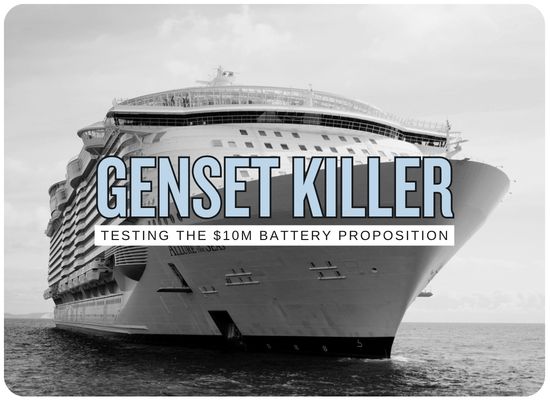
Can a $10M Battery Installation Eliminate a Cruise Ship Generator?
🔔 Subscribe to ShipUniverse Weekly →
When a Battery Becomes a Virtual Generator
A battery large enough to cost $10 million can hold several megawatt-hours of energy. That sounds like enough to replace a generator.
But cruise-ship electrical plants are not sized only around how much electricity the ship consumes. They are also sized around sudden generator failures, propulsion transients, hotel-load peaks and the requirement to keep enough reserve online to prevent a blackout.
That changes the investment case. The battery does not necessarily need to run the ship for hours. In some operating modes, it may only need to replace the generator that was running because the ship needed reserve for the next 30 seconds.
DNV says replacing generator capacity with batteries is already technically possible. Forty-five cruise vessels are currently operating with battery installations and another eleven are on order. The limitation on large ships is increasingly not whether the battery can supply power, but how much power it can supply, for how long, and what happens when its state of charge begins falling.
Large cruise ships can carry hotel loads of roughly 10 to 12 MW before propulsion demand is added. At that scale, even a 10 MWh battery cannot behave like a diesel generator indefinitely. But it can behave very differently from one.
Batteries respond almost instantly. They can absorb transient loads, shave short peaks and provide spinning reserve while another generator starts. That makes the most valuable question less about replacing a generator physically and more about whether one generator can remain switched off for thousands of operating hours each year.
Peak shaving and battery-backed spinning reserve can allow fewer engines to remain online during suitable operating conditions.
Possible where class, redundancy, battery power, energy capacity and charging strategy are incorporated from the beginning.
Existing redundancy philosophy, maximum sea load, battery-room integration and failure cases can make physical deletion unattractive even if the engine normally stays off.
What does $10 million actually buy?
There is no universal installed marine-battery price. Vessel integration can cost as much as the battery itself, particularly on retrofit projects. A published commercial study found approximately €1,100/kWh for a 4.5 MWh newbuild installation and approximately €2,600/kWh for a much smaller 500 kWh retrofit.
One number determines whether the idea works
Power determines whether the battery can replace the generator now
If losing a running generator creates an 8 MW deficit, the battery must be capable of delivering enough instantaneous MW to arrest that deficit.
Energy determines how long the replacement lasts
Once the battery has taken the load, its stored energy determines how much time the power-management system has before another generator must start or demand must fall.
Replacing spinning reserve requires surprisingly little energy
Assume the casualty the vessel must protect against is the sudden loss of an 8 MW generator. The battery does not necessarily need to provide 8 MW for several hours. It needs to hold the electrical system long enough for power management to reduce loads or start replacement generation.
One less engine
Remaining gensets operate at higher, more efficient loading while the battery holds reserve capacity.
Generator trips
Frequency begins to fall as generation suddenly disappears.
Battery takes load
Stored energy supplies immediate power before the diesel plant can respond.
Reserve is rebuilt
A standby generator starts, propulsion demand falls or non-critical loads are shed.
This is where the battery can genuinely eliminate a running generator
ABB describes battery spinning reserve as a way to operate with fewer generators online. Wärtsilä similarly uses energy storage for instantaneous load acceptance, peak shaving and automatic backup.
The fuel benefit does not come from creating free electrical energy. The battery allows the remaining engines to operate closer to efficient load points instead of keeping an additional diesel generator running lightly loaded simply to provide reserve.
But try running the hotel from batteries and the clock starts immediately
A battery that looks enormous when used for a 60-second contingency begins looking much smaller when asked to carry the normal electrical demand of several thousand passengers, cabins, kitchens, pumps, ventilation systems and public spaces.
These are modeled $10 million scenarios, not supplier quotations. Actual installed cost depends heavily on vessel design, retrofit access, converter rating, battery chemistry, cooling, ventilation, fire protection, switchboards, class approval and structural work.
Existing cruise projects show how wide the operating envelope already is
| Reference | Battery Scale | Application | What It Demonstrates | Important Constraint |
|---|---|---|---|---|
| AIDAprima | ≈10 MWh | LARGE CRUISE RETROFIT | Battery capacity near the scale examined in the $10M scenarios is already physically achievable on a large cruise vessel. | Installed cost has not been publicly established by the cited source. |
| Le Commandant Charcot | 4.5 MWh | HYBRID CRUISE NEWBUILD | Supports silent and emissions-free operation and hybrid power management. | Published operating analysis found fuel savings below original expectations. |
| Havila Castor | 6.1 MWh | PASSENGER HYBRID | Demonstrated more than three hours of battery-only sailing during a Norwegian fjord operation. | Smaller vessel and operating profile than a large resort-style cruise ship. |
| DNV cruise fleet | 45 ships operating | MARKET ADOPTION | Hybrid battery operation is no longer a laboratory concept in cruise. | Large ships still use batteries predominantly for optimization rather than replacing all conventional generation. |
| Current marine frontier | ≈40 MWh | VERY LARGE ESS | Marine battery installations are moving well beyond single-digit MWh scale. | Space, weight, charging infrastructure and integration become major design constraints. |
The uncomfortable real-world result is the 4.5 MWh cruise case
The published newbuild cruise installation cost nearly €5 million, equivalent to roughly €1,100 per installed kWh.
The installation was expected to deliver a meaningful fuel reduction through hybrid operation and optimized generator loading.
Over the first two years, published analysis estimated actual fuel savings at only about 1 to 2 percent, partly because of higher-than-expected conversion losses and lower battery utilization.
Turning off a generator is not the same as saving that generator's fuel
If a 6 MW genset is switched off, the vessel has not magically removed 6 MW of energy consumption. The remaining power still has to come from other generators, shore power or stored battery energy that was charged earlier.
The economic gain comes from improved engine loading, avoided low-load running, reduced generator operating hours, peak shaving, shore-charged energy where available, maintenance savings and potentially lower emissions-related costs.
Where the $10M investment is most likely to work
| Operating Condition | Battery Role | One Less Running Genset? | Energy Requirement | Main Constraint |
|---|---|---|---|---|
| Sea passage at stable load | Spinning reserve + peak shaving | STRONG CASE | Relatively low | Battery MW rating and contingency duration |
| Low-speed maneuvering | Transient support + propulsion peaks | STRONG CASE | Low to moderate | Thruster and propulsion peak power |
| Port hotel operation | Hotel load + zero-emission period | POSSIBLE | High | 10–12 MW hotel demand and charging access |
| High-speed transit | Peak shaving + reserve | CONDITIONAL | Potentially high | Propulsion demand and N-1 redundancy |
| Battery replaces physical genset | Main source of electrical power | DESIGN CASE | Potentially very high | Class, endurance, redundancy, SOC and charging strategy |
$10 million only works financially if the battery is actually used
A large battery parked at a high state of charge waiting for a rare contingency can improve resilience while producing relatively little direct fuel saving. The economics become stronger when the same asset performs several jobs during the same voyage.
Illustrative simple payback if annual fuel expenditure is $30 million and the battery saves 2%, ignoring maintenance, financing, carbon costs and battery replacement.
The same vessel at a 5% fuel saving would avoid approximately $1.5 million of fuel expenditure per year.
Reserve, peak shaving, port operation, maintenance avoidance and shore charging can combine to produce more value than fuel saving alone.
Payback examples are modeled illustrations, not forecasts. Fuel prices, actual vessel fuel consumption, degradation, replacement cycles, financing, maintenance and emissions costs materially change the result.
The hidden design constraint is not battery capacity
A battery assigned to spinning reserve must retain enough energy to perform that function. Operators cannot spend the final reserve megawatt-hour on routine peak shaving.
Cooling, ventilation, fire protection, segregation, cabling, converters and structural arrangement can dominate difficult retrofit projects.
A large battery only changes the energy equation substantially when the operating profile provides reliable opportunities to recharge it economically.
Could a $10M battery keep one genset offline?
Change the assumptions below. The model separates the two questions that matter most: whether the battery has enough MW to replace the generator instantaneously and whether it has enough usable MWh to hold that load for the required period.
Simplified screening model only. It does not determine class compliance or prove that a generator can be physically deleted from a vessel. Actual design requires load-flow, short-circuit, protection, transient stability, fault-tolerance, battery degradation, thermal-runaway, charging, FMEA and class analysis. Financial output excludes financing, battery replacement, electricity purchased ashore, carbon pricing and residual value.
Research basis
- DNV, Cruise ship batteries from what works today to what lies ahead, 2026.
- He et al., Lessons learned from the commercial exploitation of marine battery energy storage systems, Journal of Energy Storage.
- NEMOSHIP and European Commission CORDIS project material covering the 4.5 MWh battery aboard Le Commandant Charcot.
- Corvus Energy, AIDAprima large-cruise battery installation reference.
- Corvus Energy, hybrid-powered cruise ship and passenger vessel application material.
- ABB Marine & Ports, energy-storage operating functions including spinning reserve, peak shaving, strategic loading and zero-emission operation.
- Wärtsilä Marine, hybrid propulsion and energy-management operating modes.
- IMO GreenVoyage2050, hybridization guidance and marine battery cost framework.
- MARAD Energy Efficiency and Alternative Fuels Technical Guide, battery spinning-reserve applications in passenger and other high-redundancy vessels.
We welcome your feedback, suggestions, corrections, and ideas for enhancements.
Please click here to get in touch