The Unmanned Fleet Shift – 10 Ways USVs Are Changing Naval Procurement
🔔 Subscribe to ShipUniverse Weekly →
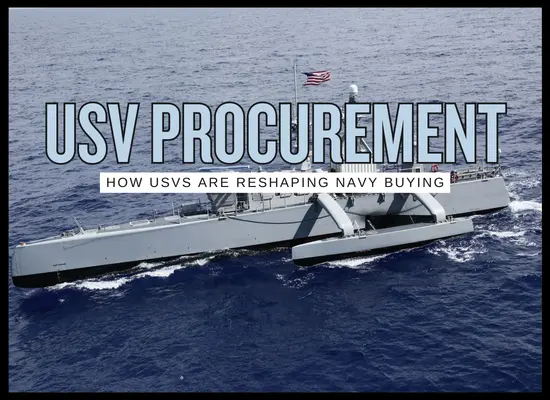
The unmanned fleet shift is no longer a future-leaning concept story. It is increasingly a procurement story about how the Navy buys for distributed presence, lower-cost mass, modular payloads, and faster fielding pathways than traditional combatants allow. That is especially visible right now because the FY 2026 Navy budget materials still describe Medium Unmanned Surface Vehicles as affordable, high-endurance, reconfigurable ships, while NAVSEA’s July 2025 Modular Attack Surface Craft announcement said the Navy is merging essential capabilities from its medium and large USV efforts into a modular platform using commercial designs, incremental development, and OTA-style acquisition logic to speed deployment and reduce cost. The Navy is also maturing the force-generation side, with Unmanned Surface Vessel Divisions 31, 32, and 33 standing up in early 2026 under USVRON 3.
| # | Procurement shift | Changing | Buyers | Market Implications | Impact tags |
|---|---|---|---|---|---|
| 1 |
The Navy is moving from separate MUSV and LUSV logic toward a modular attack craft model
The center of gravity is shifting from distinct unmanned hull categories to payload-flexible, commercially derived craft.
|
Instead of treating medium and large USVs as fully separate procurement lanes, the Navy has signaled a merged logic through the Modular Attack Surface Craft concept, combining essential features from both programs into a modular, multi-mission platform.
That is a major buying shift because it favors common architectures, modular payload integration, and faster iteration over highly bespoke one-off classes.
|
Buyers gain a path to lower-cost scale, easier refresh cycles, and more rapid fielding. It also gives the Navy a way to pursue distributed lethality without waiting on a perfect exquisite unmanned combatant design. | The addressable market tilts toward modular mission systems, open-architecture control stacks, payload interfaces, and commercial shipbuilders that can adapt proven hulls. | MASC Modularity Cost discipline |
| 2 |
Procurement is shifting from exquisite ships toward distributed affordable mass
USVs are influencing not just a new platform class, but the entire buying philosophy around fleet composition.
|
Current Navy messaging around unmanned craft emphasizes affordable endurance, reconfigurable payload space, and a more distributed force posture. That points procurement toward buying more nodes and more payload-bearing platforms rather than concentrating value in a smaller number of crewed hulls. | Buyers care because distributed mass changes how survivability, presence, and weapons distribution are purchased. USVs are becoming a mechanism for buying coverage and magazine extension without full destroyer-level cost. | Vendors that can offer lower-cost hulls, autonomy kits, modular payload bays, and scalable production gain relevance, while the procurement lens shifts from “best individual ship” to “best force package economics.” | Distributed fleet Affordable mass Force design |
| 3 |
Commercial designs and non-traditional acquisition pathways are gaining ground
The Navy is signaling that speed matters enough to use more flexible procurement structures.
|
The MASC approach explicitly references commercial off-the-shelf technology, commercial production capability, incremental development, and Other Transaction Agreement style flexibility. That is a meaningful departure from slow, all-at-once defense acquisition patterns.
It reduces the penalty for entering with a strong hull, payload, or autonomy subsystem rather than a full legacy prime profile.
|
Buyers care because acquisition speed and iteration rate are now competitive advantages. The more the Navy values spiral development, the more important it becomes to buy upgrade-friendly systems rather than frozen specifications. | The competitive field broadens to include commercial builders, autonomy firms, payload integrators, and software-heavy suppliers who previously sat outside the classic major-ship prime ecosystem. | OTA logic COTS Rapid fielding |
| 4 |
Mission payloads are becoming procurement drivers, not just the hull
The buy is increasingly about what the unmanned ship carries and connects to.
|
Navy language around MASC and MUSV points to anti-surface warfare, strike warfare, information operations, and future mission growth as central design logic. That means the procurement center of gravity is moving toward payload integration, command-and-control architecture, sensors, and modular mission packages. | Buyers care because the payload stack determines whether a USV is merely a demonstrator or a force multiplier. Procurement decisions are beginning to reward plug-and-play payload growth over single-mission lock-in. | Payload vendors, launcher integrators, EW and sensing firms, and autonomy-plus-mission software suppliers gain leverage as the Navy treats the hull as an enabler of adaptable combat effects. | Payloads Open architecture Mission growth |
| 5 |
USV procurement is now influencing force-generation and operating organizations, not just R&D lines
This is moving from experiment to man-train-equip reality.
|
The recent standing-up and command transitions of USV Divisions 31, 32, and 33 under USVRON 3 show the Navy is building organizational infrastructure around unmanned surface operations. That matters because procurement becomes more durable once real operators, force-generation demands, and maintenance responsibilities exist. | Buyers care because programs become stickier when they are tied to actual operating units instead of only prototypes and demonstrations. Organizational adoption is often the line between “interesting technology” and “fleet requirement.” | The market starts expanding beyond prototypes into training systems, sustainment, shore support, C2 tooling, maintenance concepts, and production-relevant fleet support contracts. | USVRON Force generation Sustainment |
| 6 |
Buyers are starting to value autonomy and control architecture as a core procurement layer
The software and control stack is moving from “subsystem” to buying criterion.
|
As USVs move from experimentation into operational units, procurement shifts toward reliability of remote control, navigation, mission autonomy, human-machine teaming, and integration into wider fleet C2. The platform is no longer just a hull with sensors. It is a networked node whose control architecture has to scale across multiple unmanned vessels. | Buyers care because autonomy maturity directly affects how many operators are needed, how safely the vessel can be fielded, and whether the Navy can actually use unmanned craft at meaningful scale rather than as one-off demonstrations. | The market expands for autonomy middleware, supervisory control interfaces, mission software, and secure communications vendors that can prove fleet-level scalability. | Autonomy C2 Scale |
| 7 |
USVs are changing how the Navy buys magazine depth and distributed fires
Weapons distribution is becoming a procurement question, not just a tactics question.
|
With MASC explicitly tied to anti-surface and strike warfare roles, unmanned surface vessels are becoming a pathway for buying more distributed launch capacity without having to buy another full crewed combatant. That changes the economics of how the Navy can extend fires across a wider formation. | Buyers care because USVs offer a way to add weapons-carrying nodes, complicate adversary targeting, and stretch magazine depth in a distributed fleet architecture. | Launcher integration, weapons-interface design, payload modularity, and fire-control networking become more important procurement lanes. | Distributed fires Magazine depth Strike |
| 8 |
The sustainment model is shifting toward shore support ecosystems for unmanned squadrons
Procurement does not end with the vessel. It expands into support infrastructure.
|
Once unmanned surface divisions stand up, the Navy has to buy more than hulls. It has to buy maintenance concepts, spare-parts logic, launch and recovery support, training systems, test infrastructure, and software sustainment pathways. That makes USV procurement a broader ecosystem buy. | Buyers care because sustainment cost and supportability will determine whether USVs scale cheaply or become maintenance-heavy niche assets. | Opportunities grow for shore systems, fleet support contracts, maintenance tooling, digital diagnostics, and training providers that can support unmanned squadrons at readiness tempo. | Sustainment Shore support Lifecycle cost |
| 9 |
USVs are pressuring procurement toward faster refresh cycles than traditional warships allow
The Navy is signaling more tolerance for iterative upgrades and shorter hardware relevance windows.
|
The MASC model and broader unmanned push favor incremental capability insertion instead of waiting for one perfectly mature, all-at-once program baseline. That is a meaningful shift because it aligns procurement more closely with software, payload, and autonomy refresh cycles than with classic decades-long shipbuilding timelines. | Buyers care because the value proposition of USVs improves when payloads, autonomy stacks, and mission systems can be upgraded on a faster cadence than major surface combatants. | Vendors that can support modular upgrades, software-defined capability growth, and fast insertion of new mission kits gain an advantage over rigid, closed-system offerings. | Spiral development Refresh cycle Upgrade path |
| 10 |
USV procurement is reshaping the vendor landscape beyond traditional naval primes
More of the value chain is moving toward software, payloads, integration, and commercial hull adaptation.
|
Because current Navy USV logic emphasizes commercial designs, modular payloads, faster acquisition, and distributed force architecture, the competitive field broadens. Traditional shipbuilders still matter, but they are sharing more procurement space with autonomy firms, mission-software providers, sensor companies, and non-traditional marine manufacturers. | Buyers care because a wider vendor base can accelerate innovation, reduce dependency on a narrow set of primes, and open more procurement pathways for specific capability slices. | The market becomes more segmented and more dynamic, with growing relevance for subsystem specialists and integrators that can plug into a modular unmanned fleet model. | Vendor shift Non-traditional Competition |
USVs are changing procurement because they reshape what the Navy is buying against. Instead of one ship equaling one large program decision, unmanned fleet logic pushes the Navy toward modular payloads, common control layers, faster refresh cycles, commercial production pathways, and a wider vendor base. That is why the shift matters even to readers who are not building the hull itself. The value is moving across the stack.
- It is tied to force design, not just experimentation.
- It is tied to real operating organizations, not just demos.
- It rewards modular upgrades and software-defined growth.
- It broadens the competitive field beyond classic naval primes.
The biggest reason this story matters is that USVs are not just adding another platform category. They are pushing the Navy toward a different procurement logic built around modularity, commercial adaptation, autonomy, payload flexibility, and faster iteration. In that model, the value does not sit only in the hull. It spreads across control systems, mission packages, shore support, software sustainment, and the vendors that can keep all of it upgradeable. That is why the unmanned fleet shift is best understood as a procurement architecture change, not just a new boat program. Those current signals are visible in the FY 2026 Navy budget, NAVSEA’s MASC approach, and the standing-up of dedicated USV divisions.
We welcome your feedback, suggestions, corrections, and ideas for enhancements. Please click here to get in touch.