Naval Logistics Under Fire and the Real Constraint on Combat Power
🔔 Subscribe to ShipUniverse Weekly →
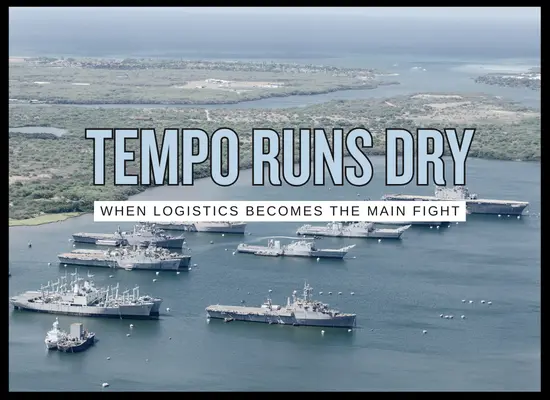
When naval forces operate under persistent threat, the hard limit is usually not the combat system. It is the logistics chain behind it. Fuel, ordnance, and repair parts determine how long ships stay on station, how often they can maneuver and fight, and how quickly damaged or depleted units return to useful service. That is especially relevant right now because the maritime security environment around the Gulf remains volatile, with official advisories warning of significant military activity and elevated electronic interference, while the Navy’s own logistics enterprise is explicitly focused on being ready to operate “at scale, speed and tempo” in a contested maritime logistics environment by December 2026.
Combat power at sea is only as durable as the force that keeps ships fueled, rearmed, and repaired forward. In contested waters, the logistics chain does not just support operations. It becomes the operation that determines tempo.
| # | Constraint | Critical under fire | Usually breaks first | Stakeholders watch | Impact tags |
|---|---|---|---|---|---|
| 1 |
Fleet oiler capacity and survivable fuel delivery
The fuel chain is what keeps escorts, carriers, and surface groups on station.
|
Under pressure, the issue is not just total fuel in theater. It is whether fuel can be moved forward, protected, and transferred on a usable schedule. Once replenishment windows tighten, warships start burning readiness simply to maintain position and cover.
Fuel becomes both endurance and maneuver budget.
|
Replenishment cycles stretch, escorts are diverted to protect the logistics leg, and operational planning starts revolving around tanker availability rather than ideal tasking. | Oiler utilization, days on station versus refuel demand, and how much tactical flexibility commanders lose to keep the fuel chain intact. | Fuel Endurance CLF |
| 2 |
Dry cargo and ammunition ship throughput
Ammo and spares move on the same vulnerable chain.
|
Ammunition, repair parts, food, and packaged fuel all compete for deck space, flight deck time, and transfer bandwidth. In a sustained fight, the ship that brings ordnance and critical parts often matters as much as the combatant receiving them.
When one logistics hull is late, multiple combat systems feel it at once.
|
Ordnance flow slows, spares wait behind other cargo priorities, and rearm or repair timelines lose predictability. | T-AKE availability, load mix, reload pacing, and whether the force is prioritizing munitions or repair parts in the next lift. | Ammo Spares T-AKE |
| 3 |
Underway replenishment windows in a contested picture
Transfer at sea becomes a timing and protection problem.
|
Replenishment is only useful if ships can safely meet, hold formation, and transfer without unacceptable exposure. As missile, drone, and interference risk rises, the number of clean transfer windows tends to shrink.
A delayed replenishment can force the entire force package to change tempo.
|
Windows are missed, transfer cycles bunch together, and commanders start trading tactical freedom for logistics certainty. | Missed UNREP events, spacing between cycles, escort demand per logistics leg, and whether transfers are being pushed farther from the threat axis. | UNREP Timing Protection |
| 4 |
Pier, magazine, and ordnance handling throughput
Reload capacity ashore still decides what gets back to sea armed.
|
Ammunition does not become combat-ready just because it exists in inventory. It must be moved, handled, staged, loaded, and documented through facilities that are often capacity-constrained even in peacetime.
In higher-threat conditions, pier vulnerability and handling speed matter even more.
|
Reload queues form, magazine throughput becomes the rate-limiter, and turnarounds ashore lengthen even if ships arrive on time. | Magazine availability, ordnance handling crew coverage, pier access, reload cycle time, and whether ports can support surge sequencing. | Reload Pier ops Magazines |
| 5 |
Forward spares positioning and repair-parts velocity
A single missing part can neutralize a much larger combat system.
|
In real operations, the decisive spare is often not the most expensive one. It is the specific item that keeps a radar, launcher, pump, generator, or flight-deck support chain functioning. Under fire, repair parts are harder to move and harder to prioritize correctly.
Repair velocity matters more than warehouse volume.
|
Cannibalization rises, ships defer fixes, and availability starts depending on whether the right part can reach the right hull before the next operational demand spike. | Not-in-stock rates for mission-critical items, forward positioning quality, repair turnaround time, and how often units are forced into workarounds. | Repair parts Downtime Readiness |
After stocks are allocated, the real bottleneck becomes geometry: the distance between replenishment ship and shooter, the number of usable transfer windows, the ports that can reload safely, and the repair nodes close enough to matter. Under fire, logistics loses efficiency before it loses inventory.
| # | Constraint | Becomes decisive | Force tempo | Stakeholders watch | Impact tags |
|---|---|---|---|---|---|
| 6 |
Forward fuel storage and theater distribution resilience
Not all fuel stocks are equally useful once the threat ring expands.
|
A force may have adequate theater fuel on paper and still struggle if storage, pumping, berthing, or onward movement to ships is constrained. Distribution resilience matters more than topline inventory once access risk rises. | Refuel plans become more conservative, support ships are pulled into longer shuttle patterns, and warships lose operational flexibility while waiting for the fuel chain to catch up. | Storage node survivability, berth access, pumping rate, and how quickly stock can move from shore to oiler to combatant. | Fuel node Distribution Shore support |
| 7 |
Ordnance reload geography
Where ships can safely reload matters as much as how much ordnance exists.
|
In a persistent-threat environment, the practical rearm question is whether ships can reach suitable ports, piers, and magazines without disrupting the fight. Reload geography often becomes the real limiter for missile-intensive operations. | Combatants stay out longer with lower magazines, or rotate farther to reload, which stretches station coverage and lowers pressure on the adversary only temporarily. | Distance to reload-capable sites, turnaround time, pier protection, crane and handling coverage, and magazine throughput under surge. | Reload path Magazine depth Port access |
| 8 |
Repair-node reach for battle damage and mission-essential faults
Minor damage becomes operationally major if the nearest fix point is too far away.
|
Ships do not need catastrophic damage to drop out of the fight. A sensor issue, launcher fault, aviation-system failure, or engineering casualty can become a campaign-level problem if there is no reachable repair node with the right people and parts. | Units stay forward degraded, withdraw early, or are cannibalized for readiness, all of which lowers usable combat power faster than headline force numbers suggest. | Repair-node capacity, afloat repair capability, deployable maintenance team availability, and time-to-fix for high-failure mission systems. | Repair reach Battle damage Mission capable |
| 9 |
Escort burden on the logistics force itself
The support fleet increasingly needs support of its own.
|
As risk rises, logistics hulls cannot be treated as low-signature background assets. They require routing discipline, surveillance, and often direct protection, which means the combat force has to spend capacity sustaining the sustainers. | More escorts and ISR are pulled toward logistics legs, reducing freedom to mass combatants elsewhere and making every support movement a deliberate operation. | Escort-to-logistics ratios, protected transit demand, ISR allocation to support legs, and how often logistics traffic forces combat-task reprioritization. | Protection tax Escort burden ISR pull |
| 10 |
The digital logistics picture under interference and compression
The network that tracks demand and delivery becomes a target and a bottleneck.
|
Contested logistics depends on clean visibility into inventory, demand, location, and timing. Under interference or degraded communications, the force can have supplies available but still lose tempo because it cannot confidently match the right item to the right platform quickly enough. | Orders slow, prioritization worsens, duplicate requests rise, and commanders begin making more conservative decisions because confidence in the logistics picture drops. | Data latency, message backlog, demand-signal quality, duplicate requisition rates, and the frequency of manual workarounds to close the loop. | Data chain Latency Decision drag |
Sustained naval operations under fire become a pacing contest between demand and replenishment. When missile expenditure, fuel burn, and fault rates rise faster than the support chain can cycle, fleets lose tempo even before they lose platforms.
We welcome your feedback, suggestions, corrections, and ideas for enhancements. Please click here to get in touch.