Panama Canal 2025: 8 Key Reasons That Explain the Rebound
🔔 Subscribe to ShipUniverse Weekly →
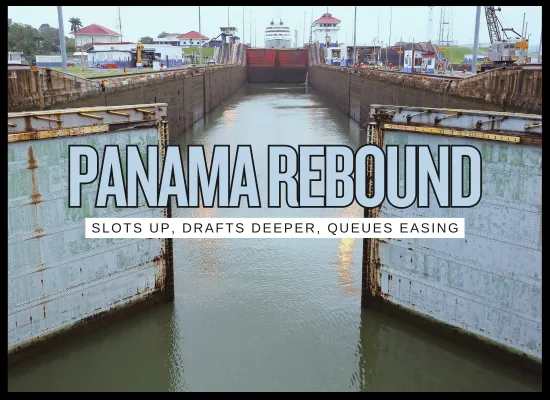
War risk, reroutes, and drought whiplash rewired 2024; but in 2025, rainfall finally gave the Panama Canal breathing room. Lake levels firmed, daily slots stepped up in stages, and maximum draft crept back toward normal, enough to turn schedule math from “avoid if possible” into “viable again” for many services.
1 Rain returned → lake levels stabilized Lakes up Slots up Draft ~49 ft
Better rainfall lifted Gatún/Alhajuela trends, easing freshwater constraints. The Canal raised daily transit slots in steps and restored deeper drafts, which pushed throughput and reliability toward pre-drought norms.
- Lake levels stabilized above 2024 troughs
- Daily booking slots stepped up in phases
- Max authorized draft increased for Neo-Panamax
- Re-test Suez vs Panama break-even with current slots
- Revisit load plans at restored draft limits
- Lock booking windows earlier on peak weeks
2 Daily Transits stepped up in stages Slots 20→24→30+ Shorter queues Better reliability
The Canal restored capacity with a sequence of slot increases rather than a single jump. Each step reduced booking friction and waiting time, improving on-time performance for scheduled services and making route choices easier to justify.
- Daily booking caps raised in several rounds
- One more Neopanamax slot added in peak periods
- Water management allowed higher sustained throughput
- Refresh booking strategies to match the latest caps
- Reprice schedule reliability against Cape and Suez
- Coordinate terminals for earlier window confirmations
3 Neopanamax slot added + operational water strategy Extra NPX capacity Water-saving ops Lake-driven triggers
Capacity improved not only from rain but from policy. The Canal opened an additional Neopanamax booking slot in peak periods and leaned on a tighter operating playbook: cross-filling where possible, coordinated lockages, and slot calendars linked to lake thresholds. The result is more big-ship throughput with better predictability.
- One extra Neopanamax booking slot on select days
- Lock sequences optimized to reduce freshwater draw
- Slot calendars tied to hydrology and maintenance windows
- Target NPX-sized strings on weeks with added capacity
- Pre-book earlier to secure preferred cutoffs
- Align load plans with current draft and slot cadence
4 Draft restored for bigger payloads Neo-Panamax ~49 ft Heavier lifts Fewer light-load detours
Higher authorized draft let operators load closer to plan. That reduces split calls and trims Cape detours that were only taken to avoid heavy lightening. The gain shows up as better slot economics per transit and tighter schedules.
- Draft limit raised for Neopanamax transits
- Payload per transit increased on key strings
- Lightening and extra feedering reduced
- Refresh stow plans against current draft advisories
- Reprice Cape vs Canal with higher lift per transit
- Coordinate terminals for fewer partial-load moves
5 Booking system refinements improved planning certainty LoTSA cycles Clearer slot cadence Fewer rollovers
The Canal’s booking framework moved to shorter, more predictable cycles with clearer long-term and daily slot guidance. Operators can line up strings earlier, reduce last-minute reshuffles, and coordinate terminals with higher confidence.
- Shorter LoTSA cycles with defined release windows
- Rebalanced long-term vs. auction/short-term slots
- Transparent calendars aligned with hydrology thresholds
- Map string ETAs to the current release cadence
- Hold a plan B for auction days with high demand
- Sync terminal windows earlier to cut rollover risk
7 Water-savings playbook stayed in gear Cross-filling Tandem lockage Water-saving basins
The Canal kept its conservation toolkit active even as rains improved. Cross-filling between chambers, tandem lockages where dimensions allow, and reuse via water-saving basins lowered freshwater draw per transit. That helped sustain higher slot counts without over-relying on lake levels.
- More consistent cross-filling between adjacent chambers
- Tandem lockages to pair compatible hulls and drafts
- Reuse cycles via water-saving basins on expanded locks
- Declare beam/air-draft early to remain tandem-eligible
- Stage ETAs to align with batched direction windows
- Confirm tug and mooring plans that speed pairings
8 Forward guidance signaled stability Draft & slot notices Clearer lead times Better ETA planning
Regular guidance on drafts, daily slots, and release calendars reduced uncertainty. Operators could price reliability into schedules, confirm windows earlier with terminals, and commit services without last-minute detours.
- More frequent, date-stamped draft and slot advisories
- Release cadence communicated further ahead
- Q&A and FAQs clarified thresholds and exceptions
- Map string ETAs to the published release windows
- Publish internal cutoffs that match notice timings
- Pre-agree stow alternatives for tighter draft periods
A steadier lock cadence, deeper drafts, and a supportive cargo mix are shaping a more reliable Panama option in 2025. Hydrology and maintenance still set the ceiling, but the operating pattern favors scheduled services and time-sensitive gas flows when notices trend stable.
We welcome your feedback, suggestions, corrections, and ideas for enhancements. Please click here to get in touch.