The New Navigation Redundancy Playbook
March 17, 2026
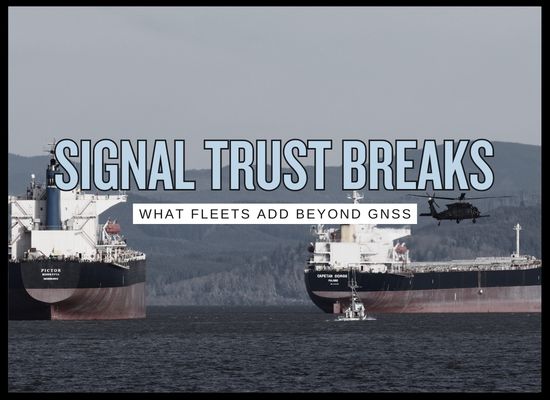
Satellite navigation has not stopped being essential, but it has stopped being sufficient on its own. The change is no longer theoretical. In March 2025, IMO, ICAO, and ITU jointly warned about the rising safety impact of jamming and spoofing and explicitly called for stronger resilience in RNSS-dependent systems, better interference reporting, and continued support for conventional navigation infrastructure. Since then, the practical fleet response has become clearer: owners and managers are widening the bridge stack with multi-system receivers, better PNT integrity handling, authenticated signals, stricter downgrade procedures, and more serious use of dissimilar fixes when the satellite picture no longer deserves automatic trust.
Navigation resilience
The bridge stack is being rebuilt around distrust, not convenience
The old model treated GNSS as the answer and conventional methods as fallback seamanship. The new model treats GNSS as one input inside a wider position, navigation, and timing stack that must keep working when the satellite picture is wrong, degraded, or simply not believable.
The operating picture fleets are reacting to
Source anchors behind the stack now showing up in procurement and bridge procedures
IMO ICAO ITU joint statement
Growing jamming and spoofing pressure pushed the call for RNSS resilience, interference reporting, and continued conventional navigation support. IMO multi-system receiver standard
The standards framework already supports multi-system shipborne receivers rather than a single-source GPS mindset. Galileo OSNMA operational service
Authenticated open-service messages became operational in July 2025, giving equipped receivers a live trust layer against spoofing. IALA resilient PNT guidance
Major international aids-to-navigation guidance is pointing fleets toward layered resilient PNT rather than sole reliance on one satellite-derived position source.
Growing jamming and spoofing pressure pushed the call for RNSS resilience, interference reporting, and continued conventional navigation support. IMO multi-system receiver standard
The standards framework already supports multi-system shipborne receivers rather than a single-source GPS mindset. Galileo OSNMA operational service
Authenticated open-service messages became operational in July 2025, giving equipped receivers a live trust layer against spoofing. IALA resilient PNT guidance
Major international aids-to-navigation guidance is pointing fleets toward layered resilient PNT rather than sole reliance on one satellite-derived position source.
The practical shift on board
This is the change in mindset behind the new redundancy playbook
Fleets are no longer buying one better GPS answer. They are building layered resilience across equipment, software, bridge practice, and reporting. That usually means better receivers at the bottom, integrity and authentication in the middle, dissimilar fixes and manual cross-checks around them, and bridge teams drilled to downgrade trust quickly when the position picture starts behaving strangely. In high-risk corridors, the key question is no longer “Do we have GNSS?” but “How long can we keep navigating safely when GNSS becomes suspect?”
The new stack fleets are adding
Eight layers now showing up in serious resilience plans
| # | Stack layer | Gear and practice showing up now | Failure it is meant to catch | Why fleets are spending on it | Procurement watchpoints | Impact tags |
|---|---|---|---|---|---|---|
| 1 |
Multi constellation and multi band receivers
The entry ticket is no longer a single-band, single-constellation mindset.
|
Fleets are prioritizing receivers that can work across multiple GNSS constellations and multiple frequencies, reducing vulnerability to some common single-signal weaknesses and improving robustness when one signal family is degraded. | Single-source dependence, weaker integrity confidence, and easier collapse of the position picture when one band or constellation is being interfered with. | This is the lowest-friction way to improve resilience while staying inside mainstream type-approved navigation architecture. It is also consistent with the existing IMO multi-system receiver framework and current resilient-PNT guidance. | Multi-frequency support, bridge integration, type-approval path, and whether the unit can feed downstream systems cleanly. | Receiver layer Integrity Baseline upgrade |
| 2 |
Dedicated PNT processing and integrity logic
The bridge needs data that says whether position can still be trusted, not just data that exists.
|
More fleets are focusing on systems and software that process PNT inputs, identify source status, attach integrity information, and avoid blindly passing suspect data into other shipboard functions. | Silent propagation of bad position data into ECDIS, AIS, timing, alarms, or other bridge functions that still look normal until the error gets operationally ugly. | The playbook shift is from raw position availability to trust-qualified position availability. | Source tagging, integrity display, time-to-alert behavior, and how clearly the bridge can see which input is being trusted. | Integrity PNT processing Data discipline |
| 3 |
Authenticated satellite signals
Spoofing pressure is pushing fleets toward signals that can be checked, not just received.
|
Galileo OSNMA-capable receiver roadmaps are now a real topic because authentication gives crews and systems a way to confirm that the navigation message is genuinely from Galileo and not altered. | Spoofing that aims to make the bridge accept a believable but false position picture. | Authentication does not solve jamming and it does not replace seamanship, but it makes spoofing harder and gives operators another trust layer that did not exist in practical form before 2025. | Receiver implementation, key handling workflow, vendor maturity, and whether the feature is operational or only marketing. | Authentication Spoofing defense Live service |
| 4 |
Interference detection on the bridge
The modern bridge needs to spot trust failure early, not after the track has already wandered.
|
Fleets are adding practical detection routines that use SNR or integrity display modes, alarm interpretation, suspicious-track recognition, and in some cases access to deeper analysis through service support. | Late recognition that GNSS is being jammed, spoofed, or disturbed by onboard or nearby interference sources. | Detection is becoming part of the live bridge routine rather than a shoreside engineering issue. | Readable interference indications, bridge alert quality, training burden, and reporting workflow when anomalies are found. | Detection Bridge alerts Reporting |
| 5 |
Dissimilar fixes and old-school cross-checks
Redundancy is not real if every backup depends on the same failing source.
|
Stronger fleets are reviving radar ranges and bearings, visual bearings, depth contour checks, dead reckoning, manual plotting, and in some cases astronomical observation as a deliberate cross-check layer rather than a ceremonial training relic. | The dangerous moment when every digital screen still looks populated but too many of them are being fed by the same suspect satellite input. | The point is not nostalgia. It is dissimilarity. | Radar integration, chart discipline, bridge-team proficiency, and whether officers can produce an independent fix under pressure. | Dissimilar backup Manual skills Cross-check layer |
| 6 |
Inertial continuity and sensor blending
Fleets want the bridge to degrade gracefully, not go blind instantly.
|
More resilience plans now include blending gyro, speed log, inertial inputs, and navigation processing so the vessel can hold a coherent motion picture long enough for the bridge to transition safely when GNSS confidence drops. | Hard drop-offs in position and motion continuity when GNSS quality fails abruptly. | This layer buys time. It does not replace a true independent external reference, but it helps stop a bridge team from moving directly from apparent certainty to total confusion. | Sensor quality, drift behavior, integration logic, and whether outputs are clearly marked as degraded rather than silently treated as normal. | Continuity Sensor fusion Transition time |
| 7 |
Terrestrial backup where geography allows it
The new playbook is bringing shore-based radio navigation back into serious conversation.
|
In some regions, operators are watching or piloting terrestrial complements such as R-Mode, DGNSS, and related shore-based resilience concepts, especially where authorities are actively testing them. | The single point of failure created by relying on one space-based layer without any terrestrial backup path. | The stronger long-term architecture is layered, with terrestrial support available where practical, not purely satellite-dependent. | Coverage reality, service maturity, regional availability, standards path, and bridge-system integration burden. | R-Mode Regional fit True backup |
| 8 |
Bridge drills, reporting, and downgrade rules
The weakest redundancy plan is the one that lives only in hardware brochures.
|
Serious fleets are writing explicit downgrade triggers, interference reporting steps, manual-navigation drills, and corridor-specific bridge instructions for known hotspots. | Slow, confused response when the bridge sees suspicious position jumps, false AIS geography, unreliable timing, or inconsistent sensor behavior. | The live commercial shift is to make interference response procedural, not improvised. | Drill frequency, hotspot overlays, incident logging, reporting chain, and whether crew actions are timed and testable. | Procedures Training Execution |
Bridge signs that satellite trust is breaking
The point is to downgrade confidence early, not debate it too long
Position jumps that make navigational sense only if you ignore the rest of the bridge
If the reported position looks clean but radar picture, visual scene, depth trend, or expected motion do not line up, the problem is already bigger than a plotting nuisance.
AIS, ECDIS, and timing behavior that all feel wrong at once
A bridge full of populated screens can still be one common-mode failure.
Hotspot geography now matters in voyage planning
High-risk zones are changing the equipment conversation, the standing instructions, and the drill burden.
Redundancy gap planner
A practical screener for how far a fleet has moved beyond single-source satellite trust
Exposure setting
Fleet layers in place
Resilience score
0 / 100
The current setup still leans too hard on satellite trust. The next spend should probably go into receiver quality, integrity visibility, and a better dissimilar-fix drill rather than another comfort layer that depends on the same source.
Procurement filter for managers
Questions that separate real redundancy from nice-sounding overlap
1. Does this layer stay useful when GNSS is wrong, or does it simply consume the same compromised input in a more polished way?
2. Can the bridge see source and integrity status clearly enough to downgrade trust fast, or is the logic hidden in the background?
3. Is the equipment roadmap aligned with authenticated signals and better interference detection, or only with incremental accuracy marketing?
4. Can officers produce and trust a dissimilar fix under pressure, at night, in traffic, and in a corridor known for interference?
5. Does the company have a hotspot-specific reporting and drill routine, or does everything depend on ad hoc judgment on the bridge?
6. If a charterer or insurer asks what changed after repeated GNSS incidents, can the company point to a layered plan rather than one equipment swap?
Bottom-Line Effect
The new redundancy playbook is not a rejection of satellite navigation. It is a rejection of single-source trust. The fleets moving fastest are not waiting for one universal backup system to arrive. They are building a layered stack that combines better receivers, integrity processing, authentication, dissimilar navigation methods, and bridge procedures that treat suspicion as a trigger for action rather than a reason to debate the screen longer.
The new redundancy playbook is not a rejection of satellite navigation. It is a rejection of single-source trust. The fleets moving fastest are not waiting for one universal backup system to arrive. They are building a layered stack that combines better receivers, integrity processing, authentication, dissimilar navigation methods, and bridge procedures that treat suspicion as a trigger for action rather than a reason to debate the screen longer.
We welcome your feedback, suggestions, corrections, and ideas for enhancements. Please click here to get in touch.