Deck 7: Ignition Point
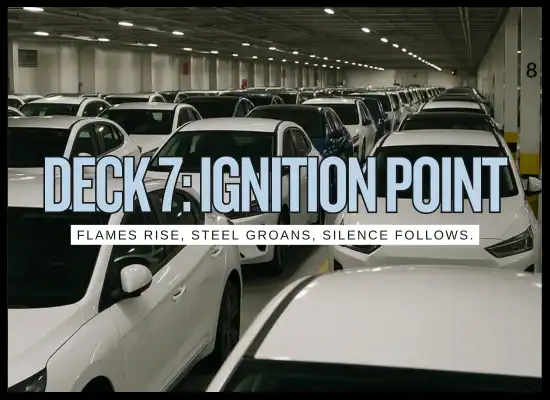
Aboard a RoRo ship in the mid-Atlantic, a single electric vehicle ignites deep in the cargo deck, triggering a race against time as the crew battles a spreading fire that no standard system can contain. Deck 7: Ignition Point is a harrowing look at what happens when cutting-edge cargo meets old-world steel at sea.
Ship Universe Note
- This post is part of our weekly ShipLog Stories series at Ship Universe
- We spotlight the human side of the maritime industry through fiction that is based on real-world scenarios.
- For questions, feedback, or to share your own story, please get in touch with us
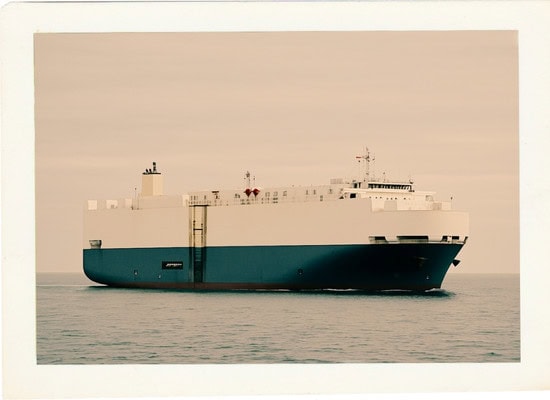
The MV Argonaut Sky moved steadily through a vast and empty sea, her steel frame groaning softly under the weight of her cargo: 1,240 electric vehicles strapped into seven cavernous decks. From the outside, the ship looked like a floating fortress. Inside, the air felt too still.
Captain Elias Ramires stood alone on the bridge, his eyes following the faint curve of the horizon. Cloud cover pressed low, gray and featureless, casting a dull shadow over the ocean. One hand gripped the railing. The other held a half-finished mug of black coffee. His fingers twitched slightly. Not enough to notice unless you were looking for it. He wasn’t ready to talk about it yet.
Twenty-nine years at sea had taken more from Elias than he ever admitted. A divorce that felt more like quiet resignation than heartbreak. A son he hadn’t spoken to in over a year. His last call had gone to voicemail, and Elias hadn’t tried again. He told himself there would be time later. There was always another crossing, another delay, another port. But the tremor in his left hand, the one he still tried to ignore, reminded him that time didn’t wait forever.
He was a good captain. Respected. Fair. His crew followed him without question. But lately, in the quiet moments between shifts and checklists, he’d begun to wonder if the ocean still had a place for him. Or if the Argonaut Sky would be his last command.
Below his boots, the ship vibrated with the low, constant thrum of its twin diesel-electric engines. Solid. Predictable. At least for now.
Behind him, the bridge crew murmured quietly. Systems green. Weather stable. Still, something about the quiet bothered him. Calm seas could trick you into forgetting what might be coming.
POSITION: 34.1987° N, 28.4113° W
COURSE: 060° ENE at 17 knots
STATUS: Green across all decks
NOTE: Repeating thermal alert - Deck 7
“Thermal alert, Deck 7 again,” said First Officer Leena Voss. Her voice was steady, but Elias caught the shift in her posture. She didn't like saying it. She liked hearing it even less.
“Same cluster?” Elias asked, turning halfway.
“Bay 714. Rear quarter. Same as yesterday.” Leena tapped the screen. “No smoke detected. Just elevated readings.”
Elias took a long sip and nodded. “Probably just another sensor glitch. Dust or vibration.”
But Leena didn’t look away from the screen. Her jaw was set tight. It wasn’t just about the reading. It was about what it reminded her of. The ferry fire. The hatch that never reopened. The noise. The silence that followed. She had never told Elias the whole story, but sometimes he saw it in her eyes when she looked at the deck layout.
He didn’t press her.
“Log it,” he said. “Send a team down to check it again before evening watch.”
Leena nodded. “Marco’s got Julian down there this week.”
“Julian? He’s green.”
“Marco’s watching him.”
Elias gave a small grunt. He liked Marco. Respected him. But he didn’t love the idea of a cadet poking around Deck 7 when thermal readings were misbehaving.
Outside the bridge windows, the ocean remained calm. But below, past layers of steel and silence, something had already begun to warm.
Below Deck 4, the engine monitoring room buzzed with low-level alerts and the rhythmic pulse of ventilation. The room was dim, lined with steel cabinets, blinking displays, and the faint smell of warm circuitry. Cadet Engineer Julian Peña leaned awkwardly over the fire control panel, trying to look like he understood it.
“Deck 7 again?” he asked without turning around.
Behind him, Marco Tanaka sighed and spun in his chair, boots propped on the edge of a low cabinet. He looked as if he hadn’t moved in an hour, but he had already checked the entire midship cooling circuit before Julian even finished logging in.
“Bay 714,” Marco said. “Same sensor. Probably nothing. Or something. Hard to say.”
Julian scratched behind his ear and stared at the schematic again, as if a different angle might unlock its secrets. He hated that he didn’t know what to do. He had graduated with honors. He’d passed every exam. But none of that mattered out here. This was his first long-haul crossing, and his first time on a ship that didn’t have a simulator reset button.
He tugged at the collar of his too-starched uniform and finally asked, “You think we should take another look?”
Marco raised an eyebrow, amused. “Let me guess. You’re trying to impress someone? Or just don’t want your name in the report if this turns out to be real?”
Julian flushed. “I just think it’s good practice.”
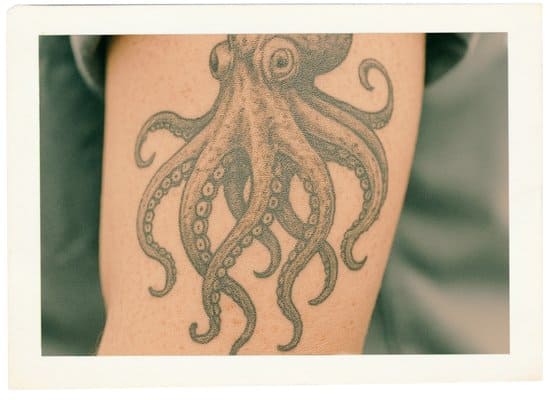
Marco stood and stretched his arms overhead, a faded tattoo of an octopus just visible under the rolled sleeve of his jumpsuit. “You know what I was doing at your age? Replacing crankshaft bearings in a Manila shipyard that didn't have running water. No uniforms. No fire panels. Just diesel fumes and one busted radio.”
He walked over and clapped Julian on the shoulder, then gestured toward the tool rack.
“Let’s go check it out together. Worst case, it’s nothing. Best case, you learn something before the ocean teaches it the hard way.”
Julian nodded, hiding his nervous smile. He didn’t want Marco to know how much it meant. How much he needed this to go right. His father had told him not to join the merchant fleet, said it was a dead industry, said he’d be broke by thirty. Julian didn’t believe that. He believed in steel ships, real engines, and the quiet pride of knowing your hands kept something big and dangerous from falling apart.
As they walked toward the access hatch for Deck 7, neither of them noticed the slight but steady uptick on the temperature graph still pulsing on the panel behind them.
The cargo deck smelled wrong.
It wasn’t smoke exactly. Not yet. But something acrid clung to the air as Julian and Marco stepped through the steel hatch onto Deck 7. The rolling doors sealed behind them with a mechanical sigh. Inside, the ceiling pressed low and the lighting buzzed with an uneven hum.
Rows of electric vehicles stretched in both directions, neatly strapped and secured. Most were new. Some were not. A few still had grime around the wheels, like they’d been driven hard before being loaded. Julian glanced at the manifest on his tablet again. There were vans, sedans, a few suvs, and a cluster of unknown brands from Eastern Europe. Several were retrofitted gasoline models with aftermarket lithium packs. He hadn’t paid much attention to that earlier.
Marco pulled a handheld thermal scanner from his belt and handed Julian a second one.
“Start with Row K. Look under the wheel wells and battery boxes,” he said. “Not the hood. You’re looking for heat clusters, not hot parts.”
Julian moved cautiously, the scanner whining as it came online. Deck 7 was oddly quiet. The steel grating beneath his boots carried every echo forward. About twenty paces in, the scanner chirped, then again. Faster.
Marco turned sharply.
“Julian?”
Julian knelt beside a matte gray sedan with a cracked rear window. His scanner showed a clear red spike in the corner of the battery compartment.
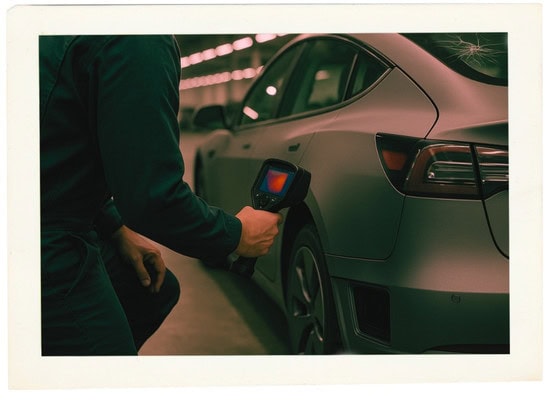
“It’s climbing,” Julian said. “Seventy-four. Seventy-eight. Eighty-two.”
Marco’s scanner beeped in sync. They exchanged a quick look. Then Marco stepped forward and touched the panel with his gloved hand.
Warm.
Too warm.
“Get back,” he said. “Now.”
They both backed away from the car as the system console in the upper corridor logged a new anomaly.
Location: Deck 7, Row K – Bay 714
Surface Temp: 96.4°C and rising
AI Notes: Potential thermal runaway event
Suggested Action: Immediate inspection and containment
Auto-alert dispatched to Bridge
On the bridge, Leena Voss stiffened at the tone.
She leaned in. “We’ve got a climb. Deck 7, Bay 714.”
Captain Elias Ramires stepped in beside her and read the alert. The slight twitch in his hand returned, but his voice stayed level.
“Trigger containment protocol. Get the crew out of that deck.”
Julian and Marco were already moving. Marco slapped the emergency alarm on the bulkhead. Red strobes pulsed overhead, and the massive deck fans kicked into high gear, roaring to life. But it was already too late to call it minor.
The gray sedan gave off a sharp hissing sound. A hairline fracture split open along the bottom seam. For a half-second, Julian thought he saw steam.
Then a soft pop. A bright white flash.
Then fire.
It wasn’t like a normal flame. It screamed to life in a sudden plume, violent and chemical. Sparks burst from the battery casing and licked up the vehicle’s side in seconds. One strap snapped loose. Another car caught.
Marco shoved Julian behind a steel column and pulled down a smoke hood from the wall compartment.
“This is going sideways fast,” he said. “We’re sealing the deck.”
The suppressant nozzles above them kicked in, fogging the air with CO₂ and mist. The fire hissed and flickered but didn’t die. Another cell erupted.
Julian looked at Marco, eyes wide through the mask.
“How do we stop it?”
“We don’t,” Marco said. “We try to slow it down.”
He pulled a wall lever to trigger the fireproof deck shutters. Slats began to close between vehicle bays, forming hard metal partitions. But the fire had momentum now.
They needed to get out before it turned the whole deck into a pressure cooker.
On the bridge, Leena’s eyes darted across the readout. Temperatures on Deck 7 were jumping in bursts. Pressure was climbing too.
“We’re losing sensors in Bay 715 and 716. Looks like a chain reaction,” she said.
Elias clenched his jaw. “Get them out. Seal that deck. We’ve got to contain it before it jumps the barrier.”
The comm system crackled. Marco’s voice cut through.
“Bridge, this is Tanaka. We’ve got a lithium fire spreading. Trying to get to exit 7B.”
Julian’s voice came next, shaky but controlled.
“We’ve lost visibility. Heat’s intense. Falling back to main corridor now.”
Elias closed his eyes for a moment and pictured the schematic. Deck 7 was a maze of metal lanes and choke points. Once fire took hold in one corner, it could trap a team in under two minutes.
Back on the deck, the air was thick, pulsing with heat. Julian could barely breathe even with the mask. Marco shoved open a service hatch with his shoulder and they spilled through it, coughing and drenched in sweat.
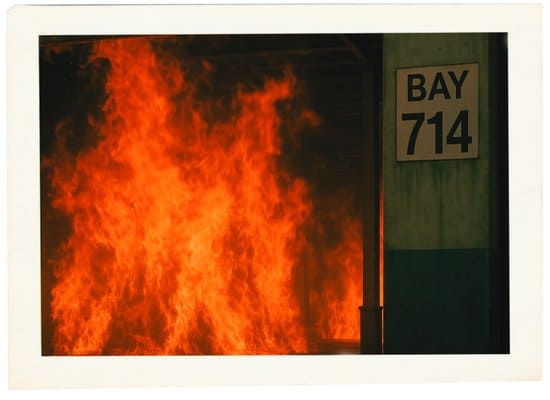
Behind them, the flames consumed Bay 714 entirely.
As the hatch sealed, the first sound of steel beginning to warp echoed through the bulkhead.
The bulkhead slammed shut behind Marco and Julian with a deep, vibrating clang. Julian dropped to one knee, gasping. His mask was soaked with sweat. Marco stood over him, one hand on the wall for balance, the other fumbling with the emergency override.
They had escaped Bay 714 by seconds. The fire had grown too fast, too wild to fight with anything onboard. From the other side of the sealed door, a muffled roar pushed against the steel, heat radiating through the metal like a living thing.
Julian looked back at it, chest heaving. “We left the others behind.”
Marco shook his head. “There were no others. We’re the only ones who went down.”
Julian tried to reply but said nothing. He watched Marco peel off his mask and run a hand through his damp hair. The ink of the octopus tattoo shimmered under the emergency light. Neither of them spoke for a long beat.
Deck 7 – Bay 714 to Bay 717
Structural Risk: High
Containment Shutters: 82% Deployed
System Note: Fire suppression failed to extinguish ignition source
Auto-lockdown complete
Leena scanned the report, her eyes pausing on the words “structural risk.”
“That’s a lot of spread for five minutes.”
Elias remained stone still at her side.
“They’re alive,” he said. “That’s what matters.”
“Barely. If the fire reaches the secondary cable run beneath Deck 6, we lose power to the comms hub and both radar arrays.”
Elias rubbed his temple. “We cut the draw from that section now. Pull power from the port-side storage cells. Then seal everything between 6 and 8.”
“But that means—”
“I know what it means. Cut it.”
Leena turned to carry out the order, but not before glancing back at the fire report. She had a sinking feeling it was going to get worse before it got better.
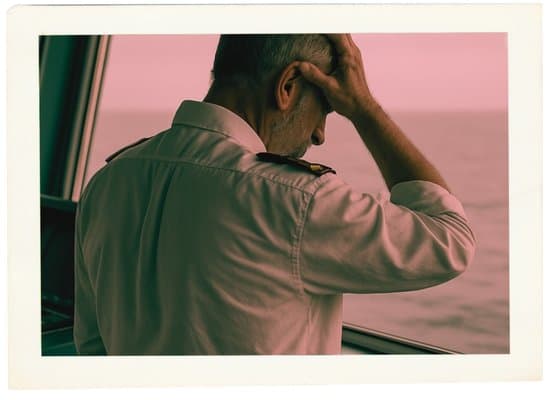
Elias stepped away from the bridge console and stood in silence by the window. Outside, the Atlantic stretched endless and gray. The ship kept moving, but slower now. Drag from heat deformation was affecting the rudder control, and even with propulsion throttled back, the vibrations beneath his feet were uneven.
They couldn’t outrun the problem. They had to hold the line.
The radio buzzed.
“Bridge, this is Engine Room. We’re seeing thermal bleed in the conduit shafts above Deck 6. Vent fans are tripping off-line. Could be secondary fire points building.”
Leena replied, “Copy. Divert coolant loop four to the upper tier.”
Elias turned. “Where’s Marco now?”
“Just reached the aft fire chamber corridor with Peña. Trying to isolate the heat from jumping laterally into Row M.”
Elias gave a small nod. “Tell him he’s got fifteen minutes. After that, we seal all cross-deck routes, and no one reopens them until we’re in tow range.”
Down in the aft corridor, Julian adjusted his heat hood, voice shaky but determined. “If we flood the adjacent row with cold brine from the utility tanks, we might stall the next battery group from going up.”
Marco knelt beside the access panel, wrench already in hand. “You’re thinking like an engineer now.”
“I learned from the best.”
Marco cracked a smile, just barely. “Don’t make this sentimental.”
Julian helped lift the panel off the wall. Saltwater lines hissed as pressure equalized. The pipes weren't meant for cooling EV batteries. But nothing on the ship was. They were making it up one step at a time.
Julian hesitated. “If this doesn’t work…”
“It will.”
They stared at each other for a moment, neither speaking.
Then Marco tapped the valve. “Let’s cool this damn thing down.”
Julian gripped the valve wheel with both hands and turned it hard. There was a groan of aged metal, then the line released with a hiss. Cold brine surged through the pipe, rushing down into the deck grid under Bay 716.
“Pressure holding,” Marco said, watching the inline gauge. “You just might save this ship, rookie.”
Julian let out a breath and leaned against the bulkhead, drained. “It’ll hold?”
“For now. But we can’t cool every bay. We’re running out of moves.”
Julian nodded, chest rising and falling. “What’s next?”
Marco looked at him, about to answer, then paused.
Something was wrong.
He stepped to the wall console and tapped the interface. An adjacent compartment was flashing red.
“Deck 6?” he muttered.
Before he could call it in, the deck trembled beneath their boots, just for a moment. A low-frequency vibration, the kind you felt in your spine more than your ears.
Julian froze. “What was that?”
Marco’s eyes widened. “That wasn’t fire. That was battery compression.”
On the bridge, Leena stared at the panel. A warning had just appeared on the secondary diagnostics screen. She didn’t speak. Just tilted the monitor toward Elias and pointed.
Zone: Deck 6 – Forward Battery Support Grid
Analysis: Compromised bracket alignment
Stress Index: 88% of max tolerance
Collapse Risk: Imminent if fire breaches current zone
Elias leaned forward, face hardening.
“If the grid fails, those batteries drop right onto Deck 7.”
Leena didn’t look away from the screen. “And with it, the fire spreads three decks up.”
Elias stood straight. “Get Marco on comms. Tell him we’re sealing the containment corridor in ten minutes. After that, the fire zone becomes off-limits.”
Down on Deck 6, Julian’s voice crackled through Marco’s comm unit. “We can’t leave. Not yet. I can see the vent gate holding. If we shut it manually, it might block the battery drop.”
“You’re not going near that gate,” Marco said.
Julian stepped forward anyway, sweat cutting lines through the grime on his face. “It’s right there. Thirty seconds.”
Marco grabbed his shoulder. “No. You don’t get to be brave. You get to survive. That’s the deal.”
Julian shook his head. “You already used your second chance. I haven’t earned mine yet.”
Marco stared at him. Then, quietly, he took out the emergency remote transponder from his vest pocket, the last one they had and shoved it into Julian’s hand.
“If you get stuck, hit this. It’ll light up on every scanner on this ship.”
Julian nodded once, jaw clenched, then turned and ran.
Marco stood there, just long enough to watch him disappear into the smoke. Then he turned and activated the override to manually open the compartment’s pressure shutter. The red light flashed three times, then the steel wall began to lower behind him.
As it closed, he whispered under his breath, “Just thirty seconds.”
Behind him, the fire crept closer.
It took six more hours for the fire to stop growing.
Not because it was fully extinguished. But because there was nothing left in Bay 714 to burn. The containment shutters held. The power cutoffs worked. The cold brine slowed the chain reaction. It wasn’t elegant, but it was enough.
MV Argonaut Sky limped north at half-speed, escorted by a Portuguese coast guard vessel that had finally reached them just after dawn.
The crew rotated through in shifts, checking bulkhead temperatures, pumping out waterlogged compartments, logging structural deformation. The damage was significant. But the ship would survive.
Julian Peña sat in the infirmary, his arms wrapped around his knees, a thermal blanket draped over his shoulders. His face was soot-streaked. His eyes were red. He kept glancing at the door, waiting.
Every few minutes, he reached into his pocket and pulled out the blackened transponder Marco had given him. He hadn’t needed to press it. But now it felt like a weight.
The door opened. Leena stepped in, holding a clipboard.
“They stabilized the forward battery grid,” she said. “You did that. You gave us a chance.”
Julian nodded, barely.
Leena sat down beside him. For a long time, they didn’t speak.
Finally, she asked, “Did he make it to the other side?”
Julian swallowed hard.
“He made sure I did.”
Later, Captain Elias Ramires stood at the foot of the galley wall, where the crew had posted a laminated photo of Marco, the only one they had, next to a strip of orange cloth torn from a fire hood.
Below it, someone had scribbled in black marker:
“When the alarm sounds, you go toward it. He did.”
Elias reached out and touched the edge of the photo. His fingers trembled again. This time, he didn’t hide it. Outside, the Atlantic shimmered in the early light. The sea was quiet once more.
But inside Argonaut Sky, nothing felt still.
The Dock and the Letter
Rotterdam – Four days later
The MV Argonaut Sky eased into her assigned berth under overcast skies, her hull streaked with blackened runoff and fire suppression residue. The crew stood rail-side, watching the dockworkers and inspectors gather below. No one spoke. Not really. Everyone knew this arrival wasn’t the end of the voyage, just the beginning of the next chapter.
Down in the engine control room, Julian sat on a short crate with a small envelope in his hand. The captain had given it to him that morning. It was addressed in neat, deliberate handwriting: Elena Tanaka – Osaka.
Julian hadn’t asked why Marco carried it. He already knew.
He rose and stepped onto the main corridor, boots echoing against the deck plating. His hand tightened around the envelope. Elena would get it. She’d know who her father really was. Not the man who missed birthdays or lived between ports, but the one who stayed behind so a kid like Julian could keep going.
On the bridge, Captain Elias Ramires watched the mooring teams finish the tie-downs. His uniform was pressed, his voice steady. But in his hand was Marco’s old thermal scanner, scorched and useless, edges curled from the heat.
He had placed it on the bridge shelf, next to the ship’s weather log, no ceremony, no explanation.
Leena joined him quietly.
“You gonna tell Command everything?” she asked.
“I’ll tell them the truth,” Elias said. “Even the parts they won’t want to hear.”
“About the battery retrofits?”
“About all of it.”
She nodded. “And after that?”
He looked out at the cranes overhead, then down to the sea.
“I don’t know,” he said. “Maybe I’m done chasing quiet.”
He let go of the scanner, turned from the bridge, and walked off without looking back.
The ship would be cleaned. The systems repaired. Her name would sail again.
But some echoes stay in the steel.
And some stories, like Marco’s, never leave the water entirely.
🔍 ShipLog Debref
The story of MV Argonaut Sky is fictional, but the threat it portrays is very real. As shipping fleets adapt to transport thousands of electric vehicles across oceans, the maritime world faces a new kind of risk: lithium-ion battery fires. These fires behave differently from traditional combustion-based vehicle fires. They burn hotter, longer, and can re-ignite even after appearing fully extinguished.
Deck 7: Ignition Point highlights this danger through the eyes of a seasoned crew forced to make impossible choices. From the first false alarm to the desperate containment measures, it reveals how thin the margin is between control and catastrophe aboard a RoRo.
The story teaches us that:
- EV fires cannot be treated like conventional fires. CO₂ systems alone won’t stop them.
- Time is everything. Once thermal runaway begins, minutes matter.
- Ship design must evolve. Traditional RoRo compartments and safety systems are not built for battery fires.
- Training and sacrifice are still the final line of defense.
Ultimately, Argonaut Sky survived, barely. But the loss of Chief Engineer Marco Tanaka reminds us that behind the cargo manifests and technical manuals are people who risk their lives every day to keep our world moving.