Bigger Cruise Ships Bigger Service Contracts
🔔 Subscribe to ShipUniverse Weekly →
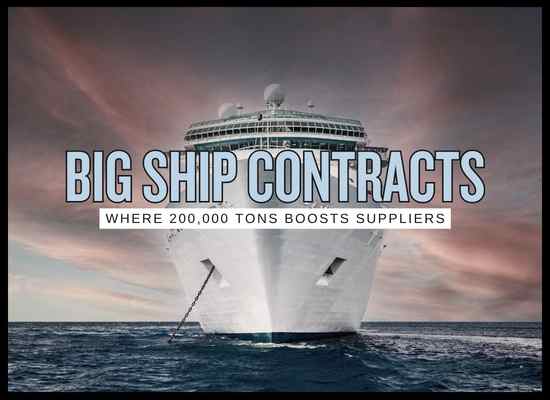
The commercial story behind the newest mega-cruise ships is not only about waterparks, neighborhoods, or passenger counts. It is also about the supplier layers that quietly grow with ship scale. Royal Caribbean’s Icon of the Seas is listed at 248,663 GT with 2,805 staterooms and 2,350 crew, while MSC World America is listed at 216,638 GT with 2,614 cabins and 2,138 crew. Once ships move into that range, the vendor opportunity expands far beyond original equipment supply. Larger vertical transportation fleets, more doors and credentials, more wastewater and food waste, more chilled space, more connected devices, more life-saving gear, and more guest-facing digital systems all create longer and deeper service tails after delivery.
Once a cruise ship crosses into true megaship territory the aftermarket story gets broader deeper and more contract driven
The biggest newbuilds do not just buy more equipment once. They create larger installed bases that need more uptime, more monitoring, more preventative maintenance, more spares, more software support, and more global service response over the life of the ship. That is why certain supplier niches start to scale disproportionately when vessel size and passenger complexity rise together.
The size effect is not linear
As ships move into the 200,000-ton class, the commercial opportunity does not only rise because the vessel is larger. It rises because operational complexity compounds. More public decks mean more elevators and escalators. More cabins mean more locks, doors, and credential events. More passengers mean more wastewater, more food storage, more life-saving gear, and more connected devices that must stay working at sea.
Passenger flow systems become more critical because megaships depend on constant people movement between decks and zones.
HVAC, refrigeration, water, waste, access, and network systems all behave more like resort infrastructure than standard marine systems.
The most attractive suppliers are often the ones that can turn installation into recurring inspection, maintenance, software, and spare-parts business.
The ten supplier niches growing with megaships
These are not just the biggest line items in a shipyard invoice. They are the niches where installed-base complexity can keep creating service revenue after delivery.
1️⃣ Propulsion and integrated electrical control
On very large cruise ships, propulsion is not simply a one-time equipment choice. It becomes a lifecycle service category because the ship’s maneuverability, bridge control, power distribution, and operating efficiency all stay under constant commercial pressure. The bigger the ship, the more valuable predictive support, remote expertise, and software updates can become.
Large vessels create bigger uptime risk and higher consequence from propulsion or control disruptions.
Support increasingly extends beyond hardware into software, control integration, and operational optimization.
A megaship makes integrated propulsion and control support easier to sell as a long-run reliability package.
2️⃣ Marine HVAC and refrigeration support
Few niches scale more naturally with huge cruise ships than HVAC. Large passenger volumes, public spaces, theaters, dining zones, galleys, and cabin blocks turn climate control into a mission-critical hotel system. Once that scale is installed, service, health checks, spare parts, and performance tuning become recurring business rather than occasional repair work.
More decks and more enclosed public space create a larger and more sensitive cooling network.
HVAC performance affects guest comfort, food handling, hotel operations, and energy use simultaneously.
Preventive maintenance and lifecycle programs become easier to justify at megaship scale.
3️⃣ Water wastewater and vacuum systems
Bigger cruise ships do not just carry more people. They create more intense water and waste streams that must be managed continuously and with less tolerance for upset conditions. Vacuum collection, wastewater treatment, freshwater generation, food waste, and dry waste all become broader integrated systems rather than isolated utility boxes.
Passenger count and hotel intensity raise both throughput and consequence when systems underperform.
Training, harmonized maintenance, and parts support help avoid highly visible onboard failures.
Fleet agreements work well because operators want predictability and standardization.
4️⃣ Access control guest credentials and door systems
Megaships multiply the number of doors, packages, access privileges, staff zones, suite combinations, and guest credentials that must be managed cleanly. That pushes access-control suppliers closer to core operations rather than leaving them in the background as simple lock vendors.
More cabins and more segmented onboard products create more permissions to manage.
Software support, credential integration, audits, and remote troubleshooting matter more over time.
Recurring support becomes easier to sell when the platform touches embarkation, cabins, spas, and crew areas.
5️⃣ Elevators escalators and people-flow hardware
On giant cruise ships, vertical transportation stops being a background convenience and starts becoming a service-sensitive flow system. More decks, bigger neighborhoods, and more mobility-sensitive guest profiles mean that elevator and escalator uptime directly shapes guest experience and operational smoothness.
Megaships depend on smooth movement between deck zones all day long.
Inspection, maintenance, modernization, and rapid repair have clear passenger consequences.
The bigger the installed base per ship, the stronger the case for structured service agreements.
6️⃣ Connectivity and managed onboard networks
Larger ships mean more devices, more apps, more crew communications, more streaming, and more guest expectation around constant digital availability. Connectivity suppliers increasingly sell managed service rather than just bandwidth, because cruise lines want resilience, support, and revenue-enabling digital plumbing.
More guests and more digital services multiply demand quickly on larger vessels.
Ongoing optimization, bandwidth management, and support are central to the value proposition.
Managed multi-orbit agreements fit the cruise segment well because experience quality depends on continuity.
7️⃣ Galleys provision stores and food-handling systems
Once ships reach megaship scale, galleys and provision stores behave like industrial hospitality infrastructure. More restaurants, more pantries, more refrigeration points, and more crew feeding complexity turn catering systems into a large lifecycle niche rather than a one-off fit-out.
More dining venues and more guests drive bigger and more specialized food systems.
Maintenance and spare support matter because food handling cannot tolerate long downtime.
Lifecycle service fits well when the supplier already delivered turnkey catering scope.
8️⃣ Laundry and back-of-house hotel systems
The laundry niche grows quietly with ship scale because passenger textiles, crew operations, hospitality standards, and turnaround speed all depend on it. Large newbuilds push laundry design toward workflow optimization, energy use, water use, and service continuity, which supports recurring supplier involvement.
More cabins and more premium service levels create more textile throughput.
Large laundry systems need calibration, maintenance, and operational optimization over time.
Support contracts become more attractive when the whole hotel side depends on reliable throughput.
9️⃣ Food refrigeration and cold-chain support
Bigger ships with more dining concepts also create bigger refrigeration networks. That means more heat exchangers, more compressors, more stores, more inspection points, and more service sensitivity in a niche that sits directly under guest satisfaction and food safety.
Large cruise food operations need extensive onboard cold storage and refrigeration machinery.
Uptime and maintenance are critical because cold-chain failures create immediate operational pain.
Suppliers with equipment installed deep in the galley and stores gain natural aftermarket openings.
🔟 Safety and evacuation equipment service
Megaships carry very large numbers of passengers and crew, which naturally expands the safety-equipment footprint. That creates recurring demand for inspections, certifications, servicing, exchanges, and downtime-sensitive coordination with port schedules. In pure service-contract terms, this niche can be highly durable because regulation forces the recurring cycle.
More persons onboard means more survival craft, evacuation systems, and certified equipment to maintain.
Compliance windows and drydock coordination make recurring service unavoidable.
Global service networks become especially valuable when ships operate on fixed schedules and cannot absorb delays.
The supplier map by contract quality
Some niches scale because the installed base is bigger. Others scale because the ship cannot operate comfortably without them. The strongest service niches usually have both advantages at once.
| Niche | Main growth driver | Installed-base growth | Service intensity | Downtime sensitivity | Best contract profile | Commercial read |
|---|---|---|---|---|---|---|
HVAC and refrigeration Floating-resort climate complexity. |
Huge hotel load and public-space cooling demand. | High | Very high | Very high | Preventive maintenance and lifecycle support. | One of the clearest megaship service niches because comfort failures show up fast. |
Water and waste systems Passenger scale plus regulation. |
More wastewater, food waste, freshwater, and vacuum collection. | High | Very high | Very high | Fleet framework agreements and annual visits. | Large vessels strengthen the case for standardization and proactive service. |
Access control More doors, packages, and credentials. |
Cabin count and onboard access complexity. | High | High | High | Software support plus hardware maintenance. | This niche grows because modern cruise access is now operational infrastructure. |
Elevators and escalators People-flow dependency. |
More decks and more passenger movement. | High | High | High | Global maintenance and modernization contracts. | Megaships make vertical transportation a service-sensitive guest-experience system. |
Connectivity Digital density. |
More guests, devices, apps, and onboard digital services. | High | Very high | High | Managed network services. | Recurring value comes from performance management, not bandwidth alone. |
Galleys and provision stores Hospitality scale. |
More venues and bigger food-handling systems. | High | High | High | Lifecycle service and spare-parts support. | The bigger the ship, the more industrial the food-service hardware becomes. |
Laundry systems Textile throughput. |
More cabins, crew, and hospitality standards. | Medium to high | High | Medium to high | Planned maintenance and workflow optimization support. | Quiet niche, but one that scales steadily with ship size and service level. |
Food refrigeration Cold-chain dependency. |
Larger storage and galley refrigeration networks. | Medium to high | High | Very high | Maintenance, monitoring, and component replacement. | Food safety and uptime make this niche commercially sticky. |
Propulsion and electrical control System complexity and uptime risk. |
Bigger power and control systems with high consequence of failure. | Medium | Very high | Very high | Remote support and integrated lifecycle packages. | Premium service logic strengthens as vessels get larger and more software-driven. |
Safety and evacuation Mandatory recurring compliance. |
More equipment and more persons onboard. | High | Very high | Very high | Inspection, exchange, and compliance service bundles. | Regulation helps turn this into one of the most durable recurring niches. |
Megaship supplier tail tool
Adjust the sliders to estimate how strong the recurring service opportunity looks in a cruise supplier niche once ship size and complexity move upward. The score rewards large installed base, high downtime sensitivity, software or lifecycle dependence, and repeatable fleet standardization.
Higher values mean the ship creates many units, components, or service points in the niche.
Higher values mean breakdowns quickly affect guest experience, compliance, or core ship operations.
Higher values mean the niche supports preventive maintenance, spare parts, software, or managed service over time.
Higher values mean the supplier can benefit from multi-ship harmonization across a cruise group.
Higher values mean the niche increasingly depends on platforms, analytics, or connected support, not just hardware.
We welcome your feedback, suggestions, corrections, and ideas for enhancements. Please click here to get in touch.