Which Maritime Sectors Feel Like They Are Drowning in Regulation… and Which ones Don’t?
July 4, 2025
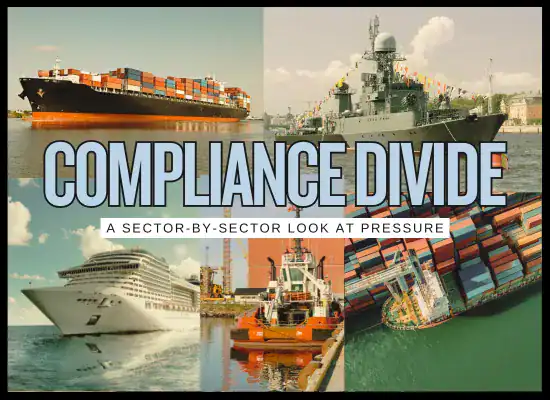
To some in the industry, it may feel like everyone’s drowning in regulation, no matter the vessel or mission. Whether you're pushing containers across oceans, navigating cruise compliance, or managing a naval fleet, the rising tide of rules can feel overwhelming. But the reality is, not all maritime sectors are regulated equally. While your segment might feel like the worst hit, it might not even crack the top three. In this breakdown, we compare five key sectors: Commercial Shipping, Cruise & Passenger, Offshore Energy Support, Naval & Government, and Port Operations, to see who’s really sinking under the weight of regulation… and who’s managing to stay afloat.
Note: Scores reflect total regulatory complexity, including scope, enforcement intensity, inspection frequency, and compliance cost in 2025. Rated from 0 (none) to 10 (maximum).
Commercial Shipping: Heavily Regulated and Still Tightening
From environmental rules under MARPOL to safety under SOLAS, labor conditions via the Maritime Labour Convention, and growing geopolitical compliance tied to sanctions and “dark fleet” crackdowns, commercial ship operators must navigate a dense thicket of overlapping global, regional, and port-specific rules and in 2025, the tide is still rising, not falling.
Recent developments like the IMO’s Carbon Intensity Indicator (CII), the EU ETS carbon pricing system, and amendments to the MLC 2006 are pushing compliance into new territory. There's no letup in oversight, just more reporting, more inspections, and more financial and operational consequences for falling short.
Below, we break down the key regulatory areas impacting commercial shipping today:
Commercial Shipping – Regulation Analysis
Regulatory Area
Details
Impact & Notes
Environmental Compliance
Governed by MARPOL (Annex I–VI), CII & EEXI (IMO), EU ETS, and regional emission control areas (ECAs).
Ships must reduce sulfur emissions, manage ballast, limit CO₂ via efficiency ratings, and buy carbon credits in the EU. Compliance costs rising, especially for older vessels.
Safety Regulations
Overseen by SOLAS and enforced through flag State inspections and Port State Control.
Detailed construction, stability, and onboard safety equipment rules. Non-compliance can lead to detentions, fines, or blacklisting of vessels.
Labor Compliance
Governed by the Maritime Labour Convention (MLC 2006), with recent amendments taking effect in Dec 2024.
Mandates crew contracts, hours of rest, medical care, onboard internet, and fair compensation. Inspections have increased post-COVID.
Geopolitical Compliance
Includes U.S., EU, and UN sanctions, "Know Your Cargo" checks, and vessel tracking for illicit trade avoidance.
Heavy fines or blacklisting for sanction violations. Recent crackdowns on deceptive shipping practices (e.g., AIS spoofing) have increased due diligence costs.
Digital & Reporting Requirements
Includes CII reporting, DCS (Data Collection System), EU MRV (Monitoring, Reporting, Verification).
Data-driven compliance is growing. Poor performance on carbon metrics can impact charterability and insurance premiums.
Note: Based on IMO regulations, EU maritime climate directives, MLC 2006 amendments, and global sanctions guidance as of mid-2025. Regulatory impact is expected to tighten further as new climate goals are enforced.
Cruise & Passenger: A Floating City Under a Microscope
From stricter safety standards than cargo ships to zero-discharge zones, emissions caps, and now inclusion in carbon pricing schemes like the EU ETS, cruise lines are facing pressure from all sides. Health regulations, public scrutiny, and labor rights enforcement have also sharpened dramatically post-COVID. While the sector is booming again in terms of passenger numbers, it’s doing so under intensifying compliance expectations, particularly in ports and regions with aggressive climate agendas.
Here’s a breakdown of the key regulatory areas shaping the cruise and passenger shipping sector in 2025 and beyond:
Cruise & Passenger – Regulation Analysis
Regulatory Area
Details
Impact & Notes
Passenger Safety Compliance
Governed by SOLAS, including Safe Return to Port rules, crowd control training, and stricter damage stability requirements.
Cruise ships face higher safety thresholds than cargo ships. Mandatory drills, redundancy systems, and evacuation analytics increase build and operational complexity.
Environmental Regulation
MARPOL (Annexes IV–VI), special area restrictions, zero-discharge zones, shore power rules, and now EU ETS for carbon pricing.
Waste discharge is tightly controlled; emissions are capped by law. Cruise ships often operate near coastlines, so local air and water quality laws hit hard. Compliance costs rising fast.
Labor & Crew Welfare
Regulated under MLC 2006; includes medical care, crew repatriation, accommodations, work-hour limits, and PPE standards.
With large multinational crews and intense workloads, cruise lines must rigorously document compliance. Post-COVID updates to MLC now mandate additional rights, including repatriation safeguards.
Health & Sanitation Oversight
National agencies (e.g., CDC in U.S.), WHO recommendations, plus internal protocols for infectious disease control and outbreak response.
Cruise ships must now meet stricter health protocols (ventilation, medical facilities, isolation cabins). These are not IMO-mandated but often required to access ports.
Geopolitical & Port Access Compliance
Destination-specific rules (e.g., Cuba restrictions), sanctions, visa/passenger processing laws, and port security via ISPS Code.
Cruise lines must adjust itineraries rapidly in response to geopolitical shifts. Port access may depend on health, emissions, or bilateral policy changes.
Note: Compliance information based on IMO, MARPOL, MLC updates, EU climate policy, and global health regulations as of 2025. Cruise regulation is rising steadily, especially in emissions and health safety enforcement zones.
Offshore Energy Support: From Loopholes to Lockdowns
Once lightly regulated compared to deep-sea shipping, the offshore energy support sector is now firmly on the radar of global and regional regulators. Vessels serving oil rigs, wind farms, and offshore construction projects are no longer skating by under piecemeal oversight, they are being brought under the same scrutiny as commercial cargo ships.
With the new IMO Industrial Personnel Code now mandatory, offshore vessels that carry specialized workers must meet stricter safety and design standards. Meanwhile, the sector is increasingly caught in the environmental spotlight, especially as support vessels begin servicing offshore wind projects tied to emissions reduction targets. What was once a gray zone in maritime compliance is now a highly monitored space and it’s only getting tighter.
Offshore Energy Support – Regulation Analysis
Regulatory Area
Details
Impact & Notes
Personnel Safety Standards
Governed by the new IMO Industrial Personnel (IP) Code, now mandatory for vessels carrying more than 12 offshore workers.
Requires new construction, transfer equipment standards, and operational limits. Non-compliance could prevent vessels from serving high-value offshore projects.
Environmental & Pollution Control
MARPOL Annex I, V, and VI apply, with added national rules on spill response, chemical use, and emissions for oil & gas and wind projects.
Must maintain oil spill plans, control graywater and garbage discharges, and avoid non-compliance in environmentally sensitive coastal zones. Pressure growing in wind sectors.
Dynamic Positioning & Equipment Safety
Governed by IMO DP guidelines, class society rules, and coastal authority requirements for vessels operating near platforms.
DP failure can result in incidents or project shutdowns. Redundancy and emergency procedures are now a compliance requirement, not just best practice.
Labor & Training Compliance
Crew must comply with MLC standards and often require additional offshore-specific certifications (e.g., crane ops, HLO, marine transfer).
Crewing for these vessels is more specialized. Regulatory bodies now check for both general seafarer standards and offshore-specific safety roles.
Carbon Emissions & Efficiency
Offshore support vessels are being phased into regional carbon trading schemes like the EU ETS and must prepare for future carbon reporting.
Not historically a focus, but now required to monitor CO₂ emissions and prepare for market-based penalties in carbon-regulated jurisdictions.
Note: Based on the latest IMO regulations, regional offshore safety codes, and emissions policy changes now targeting support vessels in active offshore fields and wind projects.
Naval and government-operated vessels sail in a world of their own, legally exempt from most international maritime regulations like SOLAS, MARPOL, and the Maritime Labour Convention. But that doesn’t mean they operate without structure. Instead of global enforcement, these ships follow internal defense protocols, political treaties, and voluntary alignment with civilian maritime norms.
While the commercial world faces growing emissions caps and labor audits, naval fleets are governed by sovereign rules, national legislation, and military doctrine. That said, geopolitical tensions, environmental optics, and voluntary green initiatives are nudging navies to align more closely with the international standards they’re not obligated to follow.
Naval & Government – Regulation Analysis
Regulatory Area
Details
Impact & Notes
International Regulation Status
Legally exempt from IMO conventions like SOLAS and MARPOL. Covered broadly by UNCLOS, with no enforcement from civilian maritime bodies.
Warships and auxiliary vessels are not required to carry safety or pollution certificates. They operate under national military law and policy.
Safety & Equipment Protocols
Developed internally by naval commands. Often modeled on SOLAS principles but adapted for combat, stealth, and resilience priorities.
No external safety audits. Protocols emphasize survivability, weapons systems, and damage control over civilian evacuation or redundancy requirements.
Environmental Policies
Voluntary alignment with MARPOL standards for waste, emissions, and fuel. No formal compliance obligation under international treaties.
Many navies avoid plastic discharge and reduce sulfur use when near coastlines. Some have adopted hybrid propulsion and green fuel pilots.
Labor & Welfare Oversight
Governed by military law. Not subject to the Maritime Labour Convention or civilian work/rest regulations.
Sailor rights, training, and rotation schedules are controlled by national defense departments. Welfare standards vary by country and funding levels.
Geopolitical & Legal Constraints
Governed by UNCLOS for conduct at sea, especially in territorial waters, EEZs, and straits. Port visits subject to host country rules.
Must observe rules of engagement, innocent passage laws, and national restrictions on access. Political optics increasingly influence naval port behavior.
Note: Naval vessels remain exempt from global maritime regulation, but voluntary environmental practices and geopolitical diplomacy are reshaping expectations at sea.
Port Operations: Where Every Regulation Collides
Unlike ships, which are often governed by single flag states, ports must answer to local, national, and international mandates all at once. From ISPS Code security drills to shore power installation requirements, and from cybersecurity upgrades to the handling of sanctioned cargo, today’s ports are among the most complex compliance zones in the maritime industry. The port of 2025 isn’t just moving cargo, it’s managing regulations at every gate, crane, and terminal server.
Port Operations – Regulation Analysis
Regulatory Area
Details
Impact & Notes
Security Compliance
Governed by the IMO ISPS Code, Maritime Transportation Security Acts, and national port security laws.
Requires perimeter control, surveillance, access restrictions, and coordination with national authorities. Inspections are routine, especially in high-traffic ports.
Environmental Responsibility
Obligated under MARPOL to provide waste reception and comply with local air and water protection regulations.
Ports must accept ship waste and prevent local discharge pollution. Increasing pressure to offer shore power and emissions-controlled berth zones.
Labor & Safety Compliance
Governed by ILO conventions (C152, C137), national labor law, and OSHA/HSE regulations.
Requires PPE, union coordination, safe handling of hazardous cargo, and training. Dockworker injuries or labor disputes can lead to shutdowns or fines.
Digital Compliance & Documentation
Required to implement digital clearance systems under the IMO Facilitation Convention (Maritime Single Window).
All ports must now support electronic ship and cargo data exchange. Delays in implementation can impact international rankings and throughput.
Cybersecurity & Infrastructure Risk
Subject to national cyber directives (e.g., US Coast Guard, EU NIS2) and risk disclosure protocols for IT and crane systems.
Ports are increasingly required to secure terminal operating systems and crane software. Cyber audits and mandatory risk mitigation are becoming standard.
Note: Based on IMO codes, ILO safety conventions, EU infrastructure regulations, and national cybersecurity directives now impacting major ports globally.
When it comes to maritime regulation, perception doesn’t always match reality. While every sector feels the weight of compliance, the burden isn’t evenly shared. Cruise and Commercial Shipping are navigating some of the most complex regulatory waters, driven by public scrutiny, multilayered environmental rules, and international safety mandates. Meanwhile, Naval and Government fleets largely operate under sovereign control, facing a very different set of pressures, often geopolitical rather than procedural.
Understanding where your sector sits on the regulatory spectrum can help you prepare, adapt, and even find competitive advantage. Whether that means investing in compliance automation, adjusting operational strategies, or pushing for more tailored policy frameworks, clarity is power.
Ship Universe will continue to track how regulation evolves across these five core segments, spotlighting which ones are navigating smoothly and which are hitting strong headwinds.
Note: Summary table reflects regulatory focus, compliance burdens, and strategic adaptation trends in each maritime segment based on 2025 operational insights.