What Happens to Abandoned Seafarers that No One Talks About
April 23, 2025
The ship hasn’t moved. Not an inch.
Edric Malu scratches the number into the wall near the galley door, right under yesterday’s mark, and the one before that. It’s a habit now. Something to do. Something to count. As the metal flakes beneath his makeshift blade, his mind drifts, just for a second, to the sound of a screen door slapping shut back home. His youngest son used to slam it every time he ran outside to chase their dog through the sugar palms. Edric would yell from the kitchen window to close it gently, pretending to be annoyed. But he liked hearing it. It meant the house was alive.
He hasn't heard that door in almost a year.
ShipUniverse Note
This article is part of our Wednesday Shiplog Stories series at ShipUniverse
We spotlight the human side of maritime shipping through fiction based on real and inspired accounts
They don’t talk much anymore. Not because of anger, just because there’s nothing new to say.
The Lorana Belle floats 11 miles off the coast of Meruna, a sparsely monitored shipping corridor between Eastern Africa and the Gulf. Close enough to see lights from shore on a clear night. Far enough to be ignored by everyone who could help.
No port will take them. No one’s been paid in almost a year.
They boil pasta in rainwater and sleep in three-hour shifts to conserve power. The sat phone battery died two weeks ago. The last flare didn’t get a response. Food is nearly gone.
The company stopped answering messages three months ago. The shipping agent’s latest response—two weeks prior—offered the same line he’d used back in November:
From: Shipping Agent <ops@olysianmarine.com> To: Edric Malu <chief@loranabelle.vsl> Date: January 8, 2025 Subject: Status Update - MV Lorana Belle
Dear Edric,
Thanks for the follow-up. We’re still working on a solution for port access. Things are taking longer than expected due to paperwork delays and flag coordination. Please advise crew to remain calm for now. I will keep you posted as soon as I hear anything new.
Best regards,
Markos
Ops Coordinator
Olysian Marine
Edric steps outside and leans on the railing. A fishing boat passes in the distance, too far to wave down. He doesn’t bother trying. They are stranded.
But this isn’t a rescue story. It’s what happens when no one comes.
Flashback — First Departure
📢 Immediate Openings – Deck Crew for International Cargo Run
Position: General Deckhand Vessel: MV Lorana Belle (Dry Cargo) Contract Length: 6 Weeks Salary:$800/month (USD) + food + lodging Flag: Registered – South Carran
Requirements:
✅ Valid seaman's book
✅ Basic STCW certificate
✅ Willing to travel immediately
Departure: Port Calvessa, March 1
Limited slots available. Apply now for priority assignment.
The crew boarded the Lorana Belle at Port Calvessa, a humid, noisy terminal in Southern Lentzia. Rust bled down the vessel’s white-painted hull, and the gangway creaked under the weight of their duffel bags. No one said it, but most of them saw the ship for what it was: tired, patched-up, and too old for this route.
But the money was decent. Six weeks, dry cargo, no rough weather expected.
Edric, experienced and quiet, gave the usual once-over — bridge check, navigation equipment, engine room status, safety drills. Everything barely passed. But the promise was firm: clean paperwork, two port calls, and full pay on the 15th of each month.
Each man received a thin contract on loose-leaf paper. The signatures were fresh, but the company stamp looked faded, copied too many times.
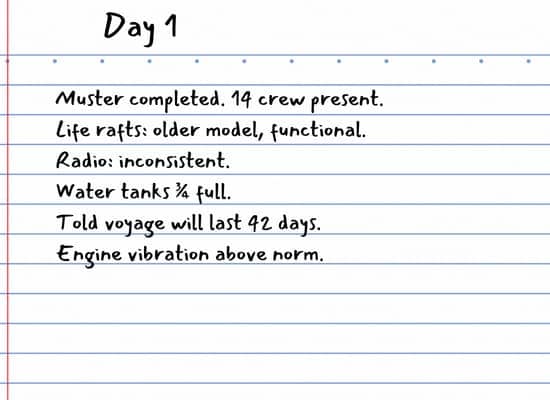
Note written on Edric’s notepad:
The chief cook, a wiry man from Barika named Meso, joked that the ship’s kitchen knives looked more like machetes. Spirits were high. Even the deckhands were smiling. Most of them had sailed together before. This was just another contract.
On their second night aboard, Edric received a welcome email from the operator’s port logistics coordinator.
From: Alenko Rivera <logistics@olysianmarine.com> To: Edric Malu <chief@loranabelle.vsl> Date: March 2, 2024 Subject: Welcome Aboard - MV Lorana Belle
Dear Chief Malu,
Wishing you and your crew a safe and successful voyage. Please note your next scheduled port call is Yandala, ETA April 14th. Crew salaries to be issued monthly via Olysian Direct, as per contract. If you have any documentation or provisioning needs, don’t hesitate to reach out.
Welcome aboard.
Regards,
Alenko Rivera
Port Logistics
Olysian Marine
⚠️ Warning Signs
The first sign was subtle.
They were two days out from Yandala when the course changed—no warning, no reason. Edric got the new coordinates in a brief email from operations. When he asked why, the reply came six hours later:
“Routing adjustment due to local congestion. Proceed to alternate anchorage.”
The new port — Kovari East — refused them entry before they even finished anchoring.
Two days later, they tried refueling using the vessel’s digital fuel card at a contracted barge off the coast. It was declined—twice.
Transaction Time
Location
Status
Remarks
04:18 UTC
Bunker Station #31
Declined
Insufficient Authorization
04:21 UTC
Bunker Station #31
Declined
Card Suspended
Edric made a note in the log:
“Fuel barge refused delivery. Card inactive. No alternate payment available.”
Then, the cook disappeared.
No one saw him leave. The galley door was open. His gear was gone. They assumed he jumped ship when they’d last docked near Belzur. He had complained about stomach problems. But his cabin was clean, bedding folded.
The next morning, they received a message from Olysian Marine. No apology. No explanation.
From: Crew Coordinator <hr@olysianmarine.com> Date: April 26, 2024 Subject: New Crew Assignment - MV Lorana Belle
Please welcome crew member Javed E. (Cook) aboard, scheduled to join via tender tomorrow morning. Replacement approved.
No further action required.
That was it. No mention of the missing man. No one ever followed up.
Edric didn’t ask questions. Not because he didn’t want answers—because he was beginning to understand he wouldn’t get them.
🌍 Reality Sets In
They passed the six-month mark sometime last week. No one mentioned it.
What began as a 42-day voyage now felt like a year-long sentence—with no end date, no apology, and no accountability.
The operator vanished from all channels. Emails bounced. Voicemails rang and rang, then disconnected. The company’s website redirected to a holding page: “This domain has been temporarily suspended.”
One local port agent still replied, though sparingly.
From: Port Liaison (Yadra Services) <ops@yadraservices.net> Date: July 17, 2024 Subject: Re: Request for Shore Resupply - MV Lorana Belle
We understand your concerns. Please do not worry. Our regional team is working to coordinate assistance. In the meantime, recommend strict water conservation protocol. Await further instruction.
— Yadra Port Ops
The engine room started leaking oil around Day 182. Edric noted it in the log, but with no parts and no backup engineer left aboard, the best he could do was mop and pray.
The air conditioning failed a week later. Metal doors radiated heat. The mess deck hit 41°C by midday.
By Day 203, meals were down to pasta, flour and rice—no salt, no oil. Water rations shrank to 1.2 liters per crewman per day. They boiled it twice. Some started drinking it warm to save fuel.
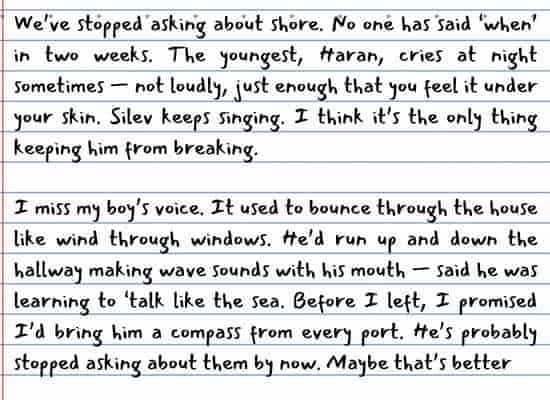
Edric’s Notebook – Entry (Handwritten, torn page taped to wall)
By the time the crew began recording messages to their families, most had already stopped believing they’d be heard.
They sat in corners of the ship, backlit by old LED lanterns, recording into phones that hadn’t connected to a signal in months. Some deleted the messages immediately. Others saved them, whispering names, updates, apologies—like echoes into deep water.
⚖️ A System That Lets It Happen
Edric had once told his crew, “We have rights. Someone will come.”
But after six months, rights meant nothing if no one would enforce them.
He tried the flag state first—a registry office in a country none of them had ever stepped foot in. After three transfers and one full hour on hold, he was routed to a voicemail that simply repeated an email address. He sent five messages. No reply.
From: Flag Administration <registry@navreg.gov.xx> Date: August 2, 2024 Subject: Re: URGENT - MV Lorana Belle Crew Welfare
Thank you for your inquiry. Due to a high volume of requests, responses may be delayed. If your request involves safety, labor, or operational concerns, please submit through our online maritime affairs portal and refer to case ID #3491178. This case is currently marked Pending Review.
— Maritime Vessel Services, Flag Admin Unit
The maritime labor board offered only a tracking number and a generic update.
Case Number: #MCC-52281 Subject: Non-payment and Stranded Crew – MV Lorana Belle
Status: Under Review Last Activity: “Forwarded to Regional Officer” – Aug 18, 2024
Please allow 6–8 weeks for administrative processing and verification.
A freelance journalist responded to Edric’s message on Day 144. She asked for voice recordings, crew photos, log entries. He sent them all.
Two weeks later, an article appeared in a small international trade outlet. It ran under the title:
“Stranded Crew Awaits Aid as Legal Questions Swirl Around Rusting Cargo Vessel”
It got 37 comments. Some angry. Some sympathetic.
But nothing changed.
The article sank like a coin in deep water. The journalist never replied again.
Edric’s Leadership
When systems failed, Edric became the system.
He posted a crew schedule on the mess wall using electrical tape and torn notebook pages. Sleep was rationed in three-hour blocks. Each man rotated between rest, heat patrol, and manual water duty. The patrols weren’t for pirates—they were to check on each other. Make sure no one collapsed.
The emergency fuel drum, buried behind rusted panels in the auxiliary hold, was tapped carefully. Edric used it only once every other day—for ten minutes—just long enough to chill their stored drinking water and run the fan in the bunk corridor.
⚠️ Health Log (Unofficial – Edric's Personal Notes)
Crew
Condition
Last Seen
Notes
Lorenzo (3rd Officer)
Infection – Upper Jaw
Day 276
Swelling; administering warm salt rinse
Jae-Min (Oiler)
Collapse – Heat Stress
Day 280
Revived with wet cloths + sips water
Edric didn’t yell. He didn’t bark orders. He listened, even when no one had the words. When someone snapped, he nodded. When someone wept, he looked away so they could keep their pride.
He taped over the busted radio so no one would keep trying it.
Every night—after checking on the generator, logging the water levels, and setting the night watch—he’d climb up to the old radar mast.
It hadn’t worked in months. Salt had chewed through the boards. The scanner was still, lifeless. But Edric went up anyway, sat cross-legged in the darkness, and pressed his hands together.
He never spoke aloud. Not anymore.
But he prayed.
Not for rescue.
Not even for answers.
Just that they’d all wake up in the morning. And that somehow, some way, he’d live to see his boy run barefoot through the kitchen again—chasing nothing, smiling like nothing in the world could sink him.
💥 The Breaking Point
It happened quietly.
Dano was always the first awake—an early riser even before the voyage began. The kind of kid who volunteered for morning duty without being asked. He used to hum while wiping down the galley counters.
That morning, just after sunrise, his bunk was empty. The galley untouched.
Silev said he saw him at the stern rail just before the light came in, barefoot, standing still.
They searched for hours. Circle sweeps. Shouting. Flashing mirrors into the sea. No sign of him. No splash. No note.
Just absence.
Edric stood at the stern for a long time, staring at the water like it might speak back. The others waited near the lifeboat deck, unsure what to do. No one cried. Not yet.
Later that night, Edric opened his notebook.
He drew a single black line across the page.
Then he closed it.
He hasn’t written in it since.
🚢 Rescue That Isn’t
On Day 302, a ship appeared on the horizon.
White hull. Blue stripe. Foreign coast guard insignia painted clean across the bow. For a brief moment, the Lorana Belle didn’t feel like an island anymore.
The crew stood at the railing in their cleanest shirts, faces sunburned, knuckles white around the rusted rails. Edric tightened his collar. Even Silev tucked in his shirt.
A small crew boarded. Two officers. A medic. Clipboard in hand. They took notes, nodded, didn’t sit.
One of them smiled.
“Help is coming,” he said. “We’re aware of the situation.”
They left two crates: one filled with expired antibiotics and basic first aid supplies. The other had canned peaches, stacked neatly in rows.
No fresh water. No fuel. No timeline. No confirmation of anything.
That night, the ship sailed away without fanfare—back toward the mainland.
The port refused them again. “Not our jurisdiction,” the message read.
From: MCC Regional Office <support@mcc.int> Date: November 28, 2024 Subject: MV Lorana Belle – Status Request
Our team has acknowledged the humanitarian concern involving MV Lorana Belle. Please note that the vessel remains outside designated enforcement zones, and intervention authority rests with the flag state or chartering party. We recommend continued outreach through diplomatic or union channels.
Status: Monitoring only – no active enforcement initiated.
That night, Edric split the canned peaches into four bowls.
He didn’t say grace.
No one talked about the rescue. Because it wasn’t one.
⏳ 14 Months
Four men remain.
The Lorana Belle no longer floats — she lingers. Her hull is painted in salt and rust. Seagulls have taken over the lifeboats, nesting in cracked seats where no one sat during drills.
Edric’s shirt hangs loose on his frame. His skin is dry, shoulders hardened by sun and silence. He doesn’t speak much now, except when counting supplies or giving night assignments. Even then, his words are quiet, like they're borrowed.
The days are slow and bright. The nights are bright and slow.
Then one day, the satellite uplink blinks green.
A video message arrives—recorded by a humanitarian group that had picked up one of the crew’s unsent logs. It made its way through a journalist, then a union contact, then someone with just enough pull.
We have confirmed arrangements for safe removal and repatriation coordinated with regional authorities and union partners. Your disembarkation will begin within 48–72 hours. Transit will follow via charter flight from Port Dasari.
Please prepare crew documentation for handover.
We cannot promise salary resolution at this time, but your safe return is prioritized.
In solidarity,
Advocacy Maritime Relief
There’s no cheering. No tears.
Just quiet packing. Stale clothes folded. Phones tucked in socks. The logbook, untouched since Dano vanished, stays behind in a drawer.
A tug arrives on Day 423. For the first time in over a year, the engine stirs. The ship shudders like a waking animal.
They are towed to shore under cloudy skies.
At the airport, they’re handed a form with no apology, no payout, and no timeline.
“Compensation inquiries must be filed with the employer.”
The employer no longer exists.
Edric spent the first two nights in a government shelter in the city — clean sheets, a lock on the door, and three meals a day. He kept waking up every two hours anyway, out of habit. Checking imaginary systems. Listening for alarms that never came.
The flight home was quiet. His duffel bag held everything he owned from the ship: a cracked toothbrush, a phone with no service, and one can of peaches he’d hidden in his bunk.
His son was beyond happy to see him — and taller now. He ran to Edric like no time had passed, arms wide, voice full of light.
But something in the house felt dimmer.
His wife smiled when she opened the door. A real smile. But her shoulders didn’t relax. She looked thinner. Worn. Like someone who had spent too long holding everything up with no idea when, or if, help would ever come.
Hope, she’d once told him, was something she could stretch a long way. But even that has limits.
They ate dinner with the lights off. No one asked about the ship.
🌍 The Global Problem of Seafarer Abandonment
Seafarer abandonment isn’t rare. It’s quiet.
While cargo moves across oceans and ports operate 24/7, some ships are simply left behind—along with their crews. Without pay. Without provisions. Without a way home.
The International Maritime Organization defines abandonment as occurring when a shipowner fails to meet obligations to cover repatriation, fails to pay wages for two months or more, or leaves crew without maintenance and support. As of early 2025, over 100 active abandonment cases are listed in global maritime records. Many more go unreported.
Often, these crews are citizens of developing countries, working under flags of convenience, on vessels owned by shell corporations with no enforceable accountability. Even when support arrives, it's late—and rarely includes back pay.
The human cost is devastating. Families go months without income. Sailors face physical and mental breakdowns. And still, the cycle continues.
ShipUniverse: Strategies & Solutions to Combat Seafarer Abandonment
Strategy
Details
Challenges
Mandatory Wage Insurance
Require shipowners to carry wage protection insurance to cover at least 3 months of unpaid salaries.
Difficult to enforce across all flag states.
Stronger Port-State Action
Authorize ports to detain or seize vessels that abandon crew until legal and wage obligations are resolved.
Port reluctance due to cost and liability exposure.
Unified Crew Reporting Platform
Centralized system for abandoned crew to report status in real time and trigger global support protocols.
Requires international cooperation and digital adoption.
Blacklist Repeat Offenders
Publish a global list of shipowners with abandonment records to block port access and charter eligibility.
Legal loopholes allow owners to hide behind shell companies.
Crew Contracts via Neutral Platforms
Digitally-managed contracts with escrow protections for wages and guaranteed repatriation support.
Limited adoption; pushback from low-cost operators.