The Digital Bunkering Era: 5 Key Ways Tech is Reshaping Fuel Supply
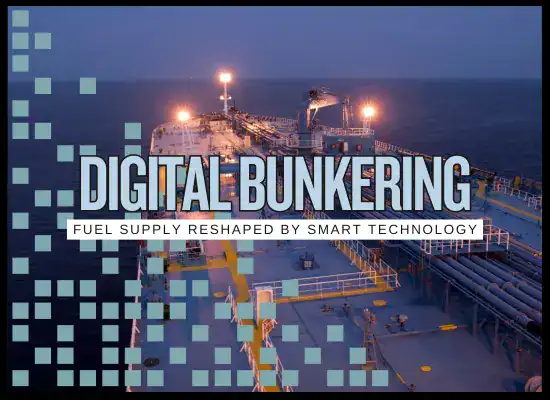
For more than a century, bunkering has been a business built on paperwork, manual checks, and trust at the dockside. Today, that picture is changing rapidly. Digital systems are transforming how fuel is bought, measured, and delivered, with new standards emerging in the world’s busiest ports. From electronic bunker delivery notes to mass flow meters and AI-driven planning tools, technology is redefining efficiency, compliance, and transparency across the supply chain. The companies that adapt quickly will not only avoid disputes and regulatory pitfalls, they will also position themselves at the front of a fuel market that is moving toward cleaner, smarter, and more accountable operations.
1️⃣ e-Docs & Digital Bunker Delivery Notes (e-BDN)
Paper slips and manual sign-offs slow bunkering and invite errors. Moving to e-BDN turns every delivery into structured data that can be verified, searched, and shared. The result is faster turnarounds, fewer disputes, and cleaner audit trails that line up with emissions reporting and quality control.
e-Docs & Digital Bunker Delivery Notes (e-BDN)
Moving bunker paperwork into structured, machine-readable records creates a single source of truth for custody transfer, quality, and compliance. The payoff is faster turnarounds, fewer disputes, cleaner audits, and data that flows directly into planning and reporting tools.
What it is
- Electronic bunker delivery notes with digital sign-off and time stamps.
- Standardized fields for parties, fuels, volumes, meter data, and seals.
- APIs for secure exchange with chartering, procurement, and MRV systems.
Data model essentials
Compliance anchors
- Traceable custody for audits and dispute resolution.
- Direct feed to emissions reporting and voyage records.
- Versioning and retention aligned with port and flag rules.
Operational impact
Implementation steps
- Map your paper BDN to a structured schema.
- Define validation rules and exception codes.
- Enable digital sign-off with role permissions.
- Integrate APIs with ERP, voyage, and MRV tools.
- Pilot on one bunker lane, then scale across ports.
Integration stack
2️⃣ Mass Flow Meters (MFMs) for Custody Transfer
Getting quantity right is the core of every bunker delivery. Mass Flow Meters provide direct mass measurement at the manifold, removing guesswork from volume corrections and tank ullage. With certified meters, sealed configurations, and tamper-evident logs, MFMs cut disputes, accelerate sign-off, and create a reliable record that links straight into quality and compliance workflows.
Mass Flow Meters (MFMs) for Custody Transfer
Certified Coriolis MFMs measure mass directly, capture temperature and density, and generate a tamper-evident audit trail. The output becomes the shared reference for delivered quantity, enabling faster closures and fewer claims.
What it is
- Coriolis-based meters installed on bunker barges and shore lines.
- Type-approved systems with lockable valves and sealed configurations.
- Data logger with time stamps, event logs, and exportable delivery reports.
How it works
Captured data
- Meter ID, calibration certificate, seal numbers.
- Start and stop totals, flow rates, temperature, density.
- Exceptions, alarms, and verified timestamps.
Operational impact
Implementation steps
- Select type-approved Coriolis MFMs sized for expected flow ranges.
- Install with straight-run and air elimination practices; seal the configuration.
- Enable calibrated data loggers with NTP time sync and user roles.
- Integrate meter output to e-BDN and evidence storage.
- Train crew on start–stop procedures and exception coding.
Pitfalls and mitigations
- Entrained air: use air eliminators and proper line conditioning.
- Clock drift: enforce time sync and tamper-evident logs.
- Bypass risk: seal valves and conduct random inspections.
3️⃣ AI-driven Planning, Price Transparency & e-Procurement
Fuel procurement has always been a mix of market timing, local availability, and supplier reliability. Today, AI platforms and digital marketplaces are changing the game. Real-time analytics track port fuel inventories, benchmark prices, and forecast demand, while e-procurement tools automate sourcing and supplier validation. The result is sharper buying decisions, stronger negotiating positions, and seamless alignment with chartering and voyage planning.
AI-driven Planning, Price Transparency & e-Procurement
Digital intelligence turns bunker buying from reactive to predictive. Platforms consolidate price feeds, inventories, vessel schedules, and emissions exposure to recommend when, where, and how much to lift — while e-procurement ensures traceability and cost control.
Core capabilities
- AI forecasting of demand based on vessel itineraries and trading patterns.
- Dynamic pricing dashboards comparing suppliers across multiple ports.
- Automated RFQ and e-bidding modules for procurement teams.
Data inputs
Decision outputs
- Optimal bunker port selection balancing price and timing.
- Recommended lift volumes to cover voyage legs with buffer.
- Supplier shortlists ranked by cost, reliability, and compliance.
Operational impact
Implementation roadmap
- Consolidate fuel procurement data into a central dashboard.
- Integrate AIS/voyage schedules with fuel forecasting models.
- Adopt e-RFQ tools for standardized supplier comparisons.
- Layer in carbon cost factors to optimize port choices.
- Refine algorithms using actual delivered vs. forecasted costs.
Pitfalls and safeguards
- Data gaps: mitigate with multiple price and inventory feeds.
- Over-automation: keep human validation on large contracts.
- Supplier pushback: use transparent scoring to build trust.
4️⃣ Quality, Traceability & Standards Modernization
Fuel quality disputes cost owners and suppliers millions each year in claims, off-hire, and engine damage. With ISO 8217 updates, digital lab records, and traceability solutions such as blockchain tagging and DNA markers, the industry is moving toward bunker deliveries that can be verified from refinery to manifold. This modernization strengthens confidence, reduces fraud, and helps shipowners manage compliance in a multi-fuel future.
Quality, Traceability & Standards Modernization
New specifications, enhanced lab testing, and digital traceability tools are reshaping how bunker quality is assured. The shift builds trust across the supply chain and reduces costly disputes.
Modern standards
- ISO 8217:2024 expands to cover biofuels, stability, and cold-flow properties.
- Testing protocols standardized with inter-lab comparison and digital certs.
- Sampling rules tightened with chain-of-custody controls.
Traceability innovations
Key data captured
- Sample IDs, seals, geotags, timestamps, and chain-of-custody sign-offs.
- Fuel properties: density, viscosity, sulfur, cold-flow, stability.
- Origin markers embedded in fuel or shipment documentation.
Operational impact
Adoption steps
- Update bunker contracts to reference ISO 8217:2024 specs.
- Work with accredited labs that issue digital certificates.
- Adopt tamper-proof seals and RFID-enabled custody controls.
- Pilot blockchain or DNA tagging schemes with suppliers.
- Train crew on proper sampling and evidence documentation.
Pitfalls & safeguards
- Inter-lab variation: standardize suppliers and require ring-testing.
- Sample loss: mitigate with sealed custody and geo-tagging.
- System silos: integrate lab certs with e-BDN and procurement tools.
5️⃣ Digital Compliance for GHG & “Green” Fuels
Fuel choices now carry a direct carbon price and a documentation burden. Digital compliance connects bunker records to emissions schemes like EU ETS and FuelEU Maritime, while certificate systems verify low-carbon fuels. When the data flows cleanly from delivery to reporting, owners control exposure, prove claims, and plan lifts with carbon cost in view.
Digital Compliance for GHG & “Green” Fuels
Turn bunker data into verified emissions records and certified sustainability claims. Link deliveries to ETS costs, FuelEU targets, and recognized certificates so commercial decisions reflect both price and carbon exposure.
Core frameworks
- EU ETS for maritime voyages with verified MRV data and allowance surrender.
- FuelEU Maritime carbon intensity targets and credits/penalties.
- IMO DCS & CII fleet efficiency ratings affecting charter and finance terms.
- Voluntary schemes like book-and-claim backed by ISCC or RSB certificates.
Data to capture
Outputs
- Verified emissions per voyage and per fuel type.
- Allowance and credit forecasts tied to itineraries.
- Attested claims for low-carbon or renewable fuels.
Operational impact
Implementation roadmap
- Map e-BDN and MFM data to an MRV schema with versioned factors.
- Integrate voyage legs and port calls to allocate emissions correctly.
- Adopt certificate management for book-and-claim and bio blends.
- Automate ETS allowance and FuelEU credit calculators in planning.
- Run monthly internal verification to catch gaps before audits.
Pitfalls & safeguards
- Factor mismatch: lock factor versions to reporting periods.
- Double counting: enforce unique IDs for certificates and lifts.
- System silos: connect procurement, delivery, and MRV databases.
As we’ve explored, the digital shift in bunkering is no longer a future concept, it’s happening now. From e-BDNs and mass flow meters to AI-driven procurement and carbon compliance, each step we take brings us closer to a more transparent, efficient, and sustainable fuel supply chain.
We’ve seen how technology reduces disputes, speeds up operations, and creates the trusted data backbone that regulators, financiers, and charterers increasingly expect. Just as importantly, we’ve recognized that every link, from quality control to carbon accounting, must work in sync if we’re to capture the full value.
At the end of the day, we believe the companies that lean into digital bunkering will not only cut costs and risk, but also gain a real competitive edge. We’ve committed ourselves to building and sharing solutions that make these gains tangible, and we invite our partners and peers to join us on this journey.
Because when we embrace digital together, we move the entire maritime industry forward.