HomeZero-Emission Tugboats Made Simple: 2026 Update
Zero-Emission Tugboats Made Simple: 2026 Update
December 22, 2025
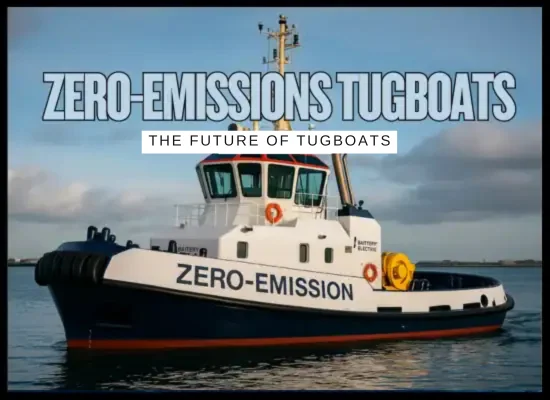
Zero emission tugboats have moved from concept to real workhorses in a few key ports. Fully electric tug fleets are already operating in Vancouver and on Canada’s west coast, powered by hydro grids and cutting both greenhouse gases and underwater noise, while Crowley’s eWolf and similar projects in the U.S. show that battery tugs can match or exceed the bollard pull of conventional designs. Hydrogen dual fuel tugs like Hydrotug 1 in Antwerp are adding a second zero emission pathway, although fuel and infrastructure remain limited going into 2026.
🚢
What is it and Keep it Simple...
Zero emission tugboats are harbour and escort tugs that can do their work without burning
conventional marine fuel during normal operations in port. Today that mainly means battery electric
tugs charged from the grid, and a first wave of hydrogen dual fuel or fuel cell concepts
where the main engines run on a clean fuel instead of diesel.
In simple terms: a traditional tug pulls and pushes using diesel engines running all day at the quay. A zero
emission tug does the same work, but its propulsion is driven by large battery packs or hydrogen systems. It
recharges or refuels between jobs, so the port sees almost no exhaust, far less noise and a cleaner ESG story
for everyone using its towage services.
Main technical ideas
Large lithium ion battery packs drive electric motors for bollard pull and manoeuvring. Some designs add
small generator sets for backup or extended range. Hydrogen concepts use dual fuel engines or fuel cells
with compressed hydrogen storage on board.
Why ports care
Every tug job is close to shore and often near dense cities. Cutting tug emissions and vibration helps ports
hit local air quality targets, reduce carbon intensity scores for port calls and answer pressure from
regulators, communities and cargo owners.
Zero Emission Tugboats: Advantages and Disadvantages
Category
Advantages
Disadvantages
Notes / Considerations
Emissions and noise
✅ Near zero local exhaust emissions when powered by clean grid electricity or green hydrogen.
✅ Cuts CO₂, NOx, SOx and particulate emissions in port, where communities are most exposed.
✅ Much lower noise and vibration along the waterfront and for crews on board.
❌ Climate benefit depends on upstream power or fuel production; fossil based grids reduce the net gain.
❌ Battery manufacture and hydrogen production have their own footprint that stakeholders may question.
Use local grid or fuel emission factors when building ESG and carbon intensity cases.
Bollard pull and performance
✅ Electric drives can deliver full torque from zero speed, which suits harbour manoeuvring and escort work.
✅ Early projects show equal or higher bollard pull compared to similar diesel tugs in the same port class.
✅ Regenerative options in some designs during escort braking or manoeuvres.
❌ Battery capacity limits continuous high power use; tugs are sized for duty cycles in a specific port, not any job anywhere.
❌ Hydrogen storage volume and safety zones can constrain layout and working deck space.
Match tug design to realistic towage profiles and peak demand in each harbour.
Operations, range and charging
✅ Battery tugs can recharge between jobs and during crew changes, fitting common harbour duty patterns.
✅ Shore charging stations can double as microgrids and integrate with local renewables and storage.
✅ Fewer moving parts in the propulsion train can reduce some maintenance tasks.
❌ Range is limited by battery capacity; intense peaks in traffic may require careful scheduling or backup tugs.
❌ Fast charging requires significant grid capacity and robust power quality controls.
❌ Hydrogen bunkering infrastructure is still rare and highly regulated.
Build scenarios for peak days and weather delays to confirm that battery or hydrogen storage is sufficient.
Port infrastructure and grid
✅ Investment in tug charging or hydrogen can anchor wider green port infrastructure and branding.
✅ Smart charging can smooth port loads and support demand response or local renewable integration.
❌ Substations, chargers, cabling and safety systems add cost and require space in crowded port estates.
❌ Grid reinforcement may be needed if several tugs charge at once or if other OPS loads are present.
❌ Hydrogen storage, ventilation and safety zoning can be complex inside ports with mixed cargoes.
Coordinate tug projects with wider shore power, logistics and grid upgrade plans rather than treating them alone.
Capex, opex and lifecycle
✅ Higher upfront cost can be offset by lower fuel use, reduced engine hours and potential incentives or green finance.
✅ Predictable duty cycles make tugs well suited to battery sizing and lifecycle planning.
✅ Strong decarbonisation story can support long term towage contracts with ports and industrial clients.
❌ Battery packs and power electronics represent significant capital and replacement cost over the vessel life.
❌ Residual value is still uncertain for first generation zero emission tugs.
❌ Hydrogen fuel and green electricity can cost more per unit of energy than diesel in some markets.
Build vessel and infrastructure business cases together, including grants, carbon pricing and client contract terms.
Regulation and reputation
✅ Helps ports and operators meet tightening local emission limits and future greenhouse gas targets.
✅ Strong signalling value for cities and cargo owners that want visible green assets in their supply chains.
✅ Can support favourable treatment in port tenders and customer scoring systems.
❌ Regulations and incentives differ by region, which makes global fleets harder to standardise.
❌ If local policies change, the expected premium for green towage services may not fully materialise.
Link tug investments to long term port or industrial contracts wherever possible to stabilise revenue.
Technology maturity and risk
✅ Battery electric tug designs have multiple references in service since 2023 and 2024 in several regions.
✅ Class rules and safety guidelines for batteries and hydrogen on small vessels are now well defined.
✅ Early projects are generating real operational data for next generation designs.
❌ Technology is evolving quickly; early adopters risk buying designs that look sub optimal in a few years.
❌ Supply chains for key components and fuels can be fragile and region specific.
❌ Crews, pilots and port staff need training and drills for battery and hydrogen incidents.
Use staged fleets: start with one or two pilot tugs, then roll out a standardised design when lessons are clear.
Summary: Zero emission tugboats are among the first workboats where full electric and hydrogen concepts are
already in real harbour service. The upside is cleaner, quieter towage with a strong decarbonisation signal. The
downside is concentrated in capex, grid and fuel infrastructure, duty cycle limits and uncertainty around long term
pricing and regulation. The strongest cases come where ports, utilities, industrial clients and tug operators plan
together instead of acting alone.
✅
2025–2026 Zero Emission Tugs: Is It Really Working?
Where battery and hydrogen tug projects stand once they leave the brochure and enter harbour duty.
1 · Battery tugs in daily service
Fully electric tugs are now in regular operation in a handful of ports, handling standard harbour jobs with
predictable duty cycles. Operators report normal bollard pull, quieter decks and enough endurance when charging
windows and job planning are tuned to the port pattern.
2 · Grid and charging: proven but local
High capacity quay chargers tied into robust city grids are working well where they exist. The tougher part is
scaling this model to ports with weaker grids, competing shore power loads or limited real estate for substations
and cabling.
3 · Hydrogen tugs: early but real
Hydrogen dual fuel and fuel cell tug projects have left the design stage and are starting real harbour work,
but are still tied to specific pilots where hydrogen supply, safety zoning and bunkering procedures are tightly
managed. Scaling beyond a few units per port remains a work in progress.
4 · Commercial signal is mixed
Some ports and industrial clients are willing to pay a premium or sign long contracts for zero emission towage.
Others still buy mainly on price per job. That means projects with strong anchor customers move ahead, while
speculative green tugs struggle to close the business case.
5 · Not a drop in replacement yet
A battery tug designed for one harbour may not fit another without redoing the energy model, charging concept
and crew routines. Hydrogen concepts are even more tied to local infrastructure and regulation. It works, but
only where the port, utility and operator plan together.
6 · Where it fits today
The strongest fit is in busy, compact ports with short transits, predictable job patterns, supportive utilities
and a few large customers who value visible decarbonisation. In those niches, zero emission tugs are already a
practical tool rather than a future concept.
Owner takeaway: the main question is not whether a zero emission tug can pull, but whether your
port, grid and customers line up well enough to keep it charged, utilised and paid for over the long term.
Zero Emission Tug — Fuel, CO₂ and Payback
Training values only — replace with your port and contract data
Baseline Diesel Tug (Per Vessel)
Zero Emission Operations and Costs
Annual job split and energy
—
Annual cost: all diesel vs diesel + zero emission
—
Annual CO₂ reduction from zero emission coverage
—
Net annual benefit after extra zero emission OPEX
—
Payback, NPV and IRR over analysis period
—
This calculator compares a purely diesel tug scenario with a mixed fleet where a share of jobs is handled by a
zero emission tug using shore power or equivalent clean energy. It uses simple averages for fuel, power, prices
and carbon cost and then applies a discounted cash flow model for the incremental capex. Replace all values with
your own harbour job statistics, fuel and power contracts, carbon exposure and vendor quotes before using it in
any real budget or investment decision.
Zero emission tugs sit right at the intersection of fuel, grid and contract structure. If you plug in your own harbour jobs, duty cycles, fuel and power prices, realistic zero emission coverage and the capex you are being quoted, the calculator gives you a first cut on whether the idea pays back on today’s conditions or needs stronger carbon prices, grants or long term towage contracts to make sense in your specific port.