Starlink for Ships: 2026 Guide
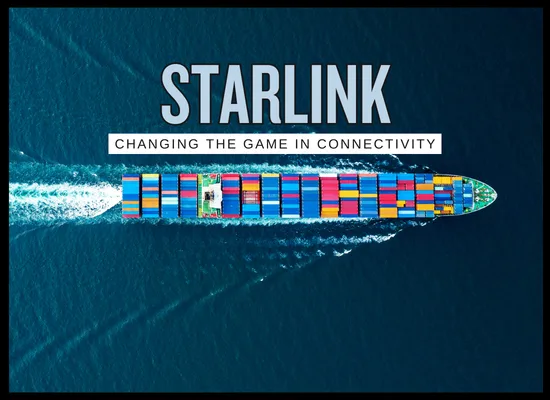
Starlink has changed expectations onboard fast: crews now assume video calls, cloud apps, and real-time support at sea, while operators care about one thing even more, whether connectivity stays usable when the ship is far offshore, in rough weather, or in high-demand regions. In 2026, the story is less “can we get internet?” and more “can we manage priority data, onboard behavior, and redundancy so the link stays operational when it matters?”
What is it and Keep it Simple...
Starlink for ships is a low-earth-orbit (LEO) satellite internet system that uses a flat antenna on the vessel to connect to a fast-moving satellite network overhead. Compared with older geostationary systems, LEO links are generally designed for lower latency and higher throughput, which makes normal “internet life” onboard feel closer to shore-based connectivity.
The operational detail that matters is how your plan handles “priority” data at sea. Many maritime configurations are sold as priority-data tiers (by GB or TB) and are meant to keep business traffic usable, even when the network is busy. When priority data is exhausted, performance and access rules can change based on plan type and location.
- A faster, lower-latency connection for crew + operations, with wide ocean coverage
- A priority-data model you can budget and manage (instead of “everyone stream everything”)
- A new onboard IT job: traffic shaping, device hygiene, and uptime monitoring
- A redundancy decision: single pipe, dual Starlink, or Starlink + alternate satcom for continuity
| Category | Advantages | Disadvantages | Notes / considerations |
|---|---|---|---|
| Crew welfare + retention | Better onboard experience (messaging/video/social) can reduce friction and improve morale. | Unmanaged personal use can consume priority data and degrade operational traffic. | Set policies: crew VLAN, caps, streaming limits, and scheduled “heavy use” windows. |
| Operations + remote support | Supports remote troubleshooting, cloud apps, and faster data exchange from sea. | More always-on connectivity can increase cyber exposure if endpoints and networks are weak. | Segment networks (OT vs IT), enforce MFA, patch discipline, and logging on the router side. |
| Latency-sensitive work | LEO links are designed for lower latency than GEO, improving interactive tools and calls. | Performance can vary by region, weather, congestion, and plan priority rules. | Measure real-world performance on your routes; do not buy on “peak Mbps” alone. |
| Cost structure | Maritime tiers can be simpler to budget than per-MB legacy billing, depending on usage profile. | Priority data can still be expensive if usage is not controlled. | Budget with a “priority allowance” and treat it like bunker: monitored daily, not monthly. |
| Hardware + install | Flat-panel kits are built for mobile use and can be easier to deploy than large stabilized domes. | Placement still matters (obstructions, vibration, spray, cable runs, EMC considerations). | Do a real antenna siting review: mast shading, crane arcs, exhaust heat, and safe service access. |
| Resilience | Strong primary link for many trades; can be paired with a second path for redundancy. | Single-provider dependency is a business risk if the vessel has zero backup path. | Decide your continuity standard: single link, dual Starlink, or Starlink + alternate satcom. |
| Data governance | Clear priority tiers make it easier to define “business traffic first.” | Without QoS rules, a few devices can dominate bandwidth and distort outcomes. | Implement QoS: prioritize ops apps, throttle updates/streams, and block unknown devices. |
| Regulatory + safety comms | Can complement traditional safety communications as an operational data channel. | It is not a substitute for required GMDSS equipment and procedures. | Keep compliance lines clear: operational internet is separate from mandated safety systems. |
2026 Starlink onboard: what’s really working
Custom tier (only if selected)
Estimated monthly usage (GB)
0
Daily burn (GB/day)
0
Buffer-included target (GB)
0
Cap headroom (GB)
0
Days until cap (est.)
n/a
Implied cost per GB (cap-based)
$0
Recommended tier
—
If over cap: suggested top-ups
—
Starlink is usually a win onboard when you treat it like an operational utility, not a consumer internet perk. The practical model is simple: estimate your monthly burn rate, add a buffer, choose a tier that avoids mid-month surprises, and enforce traffic policies so operations stays clean during crew peak hours. If you want a conservative setup, start with lower crew GB/day assumptions, then adjust after 30 days of actual usage logs.
We welcome your feedback, suggestions, corrections, and ideas for enhancements. Please click here to get in touch.