Practical Uses of Maritime AI That Go Beyond Buzzwords
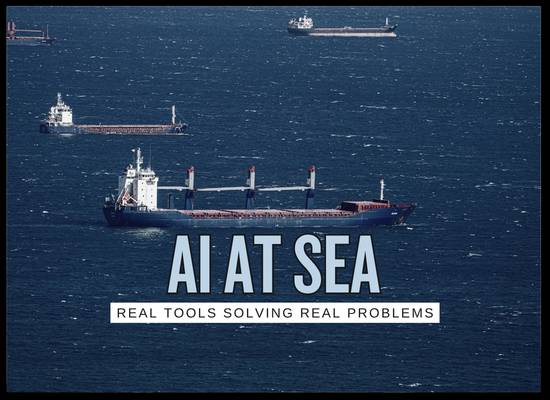
Maritime AI becomes commercially interesting when it helps a ship burn less fuel, keeps machinery online longer, reduces survey friction, improves port timing, lowers paperwork drag, or gives operators earlier warning of trouble. The real story is not futuristic autonomy. It is narrower and more useful: applying data models to expensive decisions that crews, technical managers, ports, and commercial teams already make every day.
The practical lanes where maritime AI is already useful
The point is not to pretend every fleet is becoming autonomous tomorrow. The point is to show where AI is already becoming commercially relevant in operations that owners, managers, ports, and technical teams can recognize today.
① Voyage optimization that actually changes fuel burn
One of the clearest practical uses is route and speed guidance tied to weather, vessel performance, congestion, and voyage constraints. This works because ships already make repeated trade-offs between speed, ETA reliability, bunker consumption, and emissions exposure. AI helps narrow those choices faster and more consistently, especially when integrated with live operational data instead of static planning assumptions.
Importance commercially: fuel remains one of the biggest voyage-cost levers, and even modest improvement becomes meaningful across a fleet over time. The commercial value is stronger when the system is tied to voyage execution and not just used as a planning screen no one follows.
② Predictive maintenance that cuts expensive downtime
AI has a strong fit in machinery health because marine assets generate recurring signals that can be trended, compared, and flagged before failure becomes visible in a traditional way. The goal is not to replace engineers. It is to move from reactive maintenance and broad calendar-based intervals toward earlier intervention on the systems most likely to create costly disruption.
Importance commercially: the hidden savings are often larger than the obvious ones. Better failure prediction can reduce off-hire risk, avoid travel rushes for parts and technicians, and improve drydock and superintendent planning.
③ Port call timing and berth coordination
Ports and port communities are increasingly using digital tools, data-sharing layers, and optimization models to improve timing across arrivals, berths, resources, and hinterland flow. AI becomes practical here because wasted waiting time is expensive and because better coordination can lower congestion, emissions, idle time, and avoidable schedule friction.
Importance commercially: poor port timing spills outward into bunker burn, crew workload, customer service, yard pressure, and inland coordination. AI is most useful when it helps a port community act earlier rather than simply report what already happened.
④ Remote inspection and defect detection
Classification and inspection workflows are becoming more digital through remote techniques, digital twins, image capture, and AI-assisted anomaly detection. In practice, that means helping surveyors and asset teams identify corrosion, structural hotspots, and areas worth closer review without relying on the same amount of manual inspection effort every time.
Importance commercially: scaffolding, access arrangements, waiting time, repeat inspection effort, and unplanned findings all cost money. AI-supported inspection becomes attractive when it shortens the path from visual data to maintenance action.
⑤ Emissions and compliance decision support
Regulation is turning operational data into a financial question. AI becomes useful when it helps operators compare route choices, speed profiles, fuel decisions, and asset condition in ways that support emissions management, reporting readiness, and margin protection. This is not glamorous, but it is one of the most commercially credible uses because the reporting burden and operating consequences are real.
Importance commercially: once emissions management affects voyage economics, chartering choices, and performance discussions, the value of cleaner operational insight rises fast. Fleets that treat data as a strategic asset can move sooner than fleets treating it as a paperwork burden.
⑥ Paperwork and document flow that reduces port friction
Not all maritime AI value lives onboard. Administrative friction remains expensive across declarations, document checks, regulatory submissions, cargo instructions, and arrival workflows. As maritime single windows expand and digital exchange becomes more structured, AI can help validate data, catch inconsistencies, pre-check submissions, and reduce avoidable back-and-forth that delays movement.
Importance commercially: the cost of paperwork mistakes is often hidden inside delay, exception handling, and manual labor. This is not the most exciting AI use, but it can be one of the easiest to justify financially.
⑦ Shore-side exception management
Many maritime businesses still manage disruption through inboxes, phone calls, and fragmented spreadsheets. AI can help rank alerts, surface the most important exceptions, and point superintendents, operators, or logistics teams toward the few issues most likely to become expensive if ignored. In other words, it helps shore teams spend attention better.
Importance commercially: the cost here is not only direct failure. It is also the opportunity cost of expensive shore-side labor being spent on noise rather than on the handful of events that genuinely need intervention.
⑧ Digital twin use that supports real operating choices
Digital twins are often overmarketed, but they become practical when they provide a reliable digital model that helps teams monitor condition, compare scenarios, plan inspections, or understand operational performance over time. AI adds value when it turns that model into an active decision layer rather than a static visual asset.
Importance commercially: digital twins start to matter when they reduce uncertainty around maintenance timing, performance drift, or coordination across technical and operational teams. Without that, they risk becoming expensive presentation tools.
Where the strongest maritime AI value is showing up
The practical pattern is simple. AI delivers best when it sits inside a costly decision loop that already exists, where better timing, prediction, or screening can directly change money, time, or risk.
| Use lane | What the model is really helping with | Commercial payoff | Main adoption risk | Best early metric |
|---|---|---|---|---|
| Voyage optimization | Speed, route, weather, and performance trade-offs | Fuel savings, tighter ETA control, lower emissions drag | Crew and ops teams ignore recommendations | Fuel per voyage and arrival variance |
| Predictive maintenance | Earlier warning on machinery or performance degradation | More uptime, fewer emergency jobs, better planning | Poor sensor quality or weak maintenance workflow | Unplanned downtime and urgent callouts |
| Port call optimization | Arrival, berth, yard, and network coordination | Less waiting, less idle burn, smoother throughput | Weak data-sharing across stakeholders | Waiting hours per call |
| Remote inspection | Faster defect screening and integrity review | Lower access cost, safer surveys, better defect visibility | Image quality and workflow trust | Inspection cycle time and defect capture rate |
| Compliance support | Operational choices tied to reporting and efficiency pressure | Better margin control under regulatory pressure | Data scattered across systems | Time to produce and validate reporting outputs |
| Document and submission flow | Error checking, validation, and faster preparation | Less admin burden and fewer costly corrections | Bad source data and inconsistent templates | Correction rate and turnaround time |
| Exception management | Prioritizing the few alerts that matter most | Faster intervention and better shore-side focus | Too many false positives | Time to action on high-priority events |
| Digital twin applications | Turning a model into an operating decision tool | Better planning and lower uncertainty | Too little usable data to keep the model alive | Maintenance planning accuracy |
The value is usually operational first
Most maritime AI returns do not begin as a marketing story. They begin by reducing waste inside a repeated decision such as route choice, maintenance timing, or inspection focus.
Good data still decides the ceiling
Even strong models struggle if vessel, port, maintenance, or documentation data is fragmented, stale, or poorly structured.
Workflow adoption matters more than demo quality
The systems that stick are the ones crews, operators, technical managers, and shore teams can actually use inside existing routines.
Maritime AI readiness score
This is a practical screening tool, not a tech maturity trophy. It is meant to show whether a fleet, operator, terminal, or maritime service business has the conditions needed to get value from AI without falling into buzzword spending.
A cleaner rollout path for maritime teams
The most reliable way to use AI in maritime settings is to start with one workflow that already hurts, already repeats, and already has measurable cost.
| Stage | Main focus | Best candidate use cases | Visible proof of value |
|---|---|---|---|
| First move | Fix one expensive repeated decision | Voyage optimization, maintenance alerts, document validation | Fewer exceptions and easier ROI tracking |
| Next layer | Embed outputs in real workflows | Shore-side exception handling, inspection planning, port coordination | Teams actually act on recommendations |
| Scale phase | Connect more systems and improve trust | Cross-fleet analytics, digital twin support, wider compliance decisions | Better consistency across vessels or sites |
| Mature use | Treat data as operating infrastructure | Portfolio-level performance management and broader optimization | Faster decisions with less friction and fewer surprises |
Maritime AI becomes useful when it helps operators spend less fuel, lose fewer hours, catch problems earlier, and reduce paperwork or inspection friction. The strongest projects are usually not the flashiest ones. They are the ones tied to a repeated cost problem that the organization is actually ready to solve.
We welcome your feedback, suggestions, corrections, and ideas for enhancements. Please click here to get in touch.