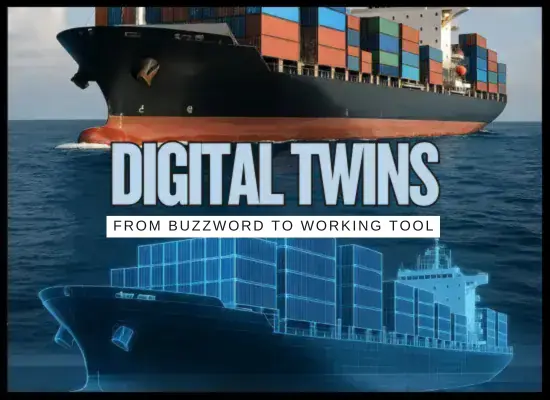
Digital twins have moved from buzzword to working tool on real ships and in real ports. Into 2026, owners are using “performance twins” of hull and machinery to trim fuel use and monitor fouling, ports like Singapore and Rotterdam are standing up full port digital twins to test traffic and berth plans, and class/engine makers have published formal guidelines on how to build and assure trustworthy twins for safety-critical uses.
🛰️
What is it and Keep it Simple...
A digital twin is a live, data-fed model of a ship, system or port that behaves like the real thing.
Sensors, logs and manual inputs update the twin so it can replay voyages, test “what if” scenarios and show how the
asset would respond before you change anything on the water.
For a vessel, that might be a twin of the hull, engine and propeller that uses speed, draft, weather and fuel data to
estimate resistance, fouling and fuel burn. For a port, it might be a 3D layout with real-time ship movements, tugs and
yard operations. The crew sees dashboards and timelines; shore teams see simulations: “If we slow steam here, clean the
hull then, or move this arrival window, what happens to fuel, CO₂ and schedule risk?”
On board it feels like…
An upgraded performance and situational awareness screen: live KPIs, replay of past legs, alerts when the ship
starts drifting from “healthy” behaviour, and recommended trims or speeds based on predicted outcomes.
For owners it means…
A shared reference model for design, operations and maintenance that can support fuel savings, safer operations,
better drydock planning and more transparent performance discussions with charterers, yards and class.
Maritime Digital Twins: Advantages and Disadvantages
Category
Advantages
Disadvantages
Notes / Considerations
Vessel performance & fuel
✅ Uses real voyage and weather data to estimate true hull and propeller condition, not just noon reports.
✅ Supports trim, speed and route optimisation to cut fuel and CO₂ across the life of the ship.
✅ Makes it easier to compare sister vessels and spot outliers that need attention.
❌ Needs trustworthy input data (speed, power, draft, weather); poor sensors produce misleading “insights”.
❌ Models must be re-calibrated after modifications, fouling or major repairs or they drift from reality.
❌ If the twin is a black box from a vendor, owners may struggle to challenge or validate results.
Ask vendors to explain model assumptions and show how they validate the twin against real performance after each drydock.
Maintenance, reliability & safety
✅ Enables condition-based maintenance by monitoring vibration, temperatures and loads on critical equipment.
✅ Can simulate “what if” failures and emergency scenarios for training and risk assessment.
✅ Structural twins can track fatigue and loads on hulls, offshore units and key components.
❌ Over-reliance on a twin without conservative margins can create a false sense of security.
❌ Building high-fidelity structural or machinery twins requires detailed design data that may be hard to access from yards.
❌ Advanced models and dashboards can overwhelm crews if not simplified for day-to-day use.
Start with a small number of high-value assets (main engine, propulsion, critical auxiliaries) and simple KPIs before going fleet-wide.
Design, newbuilds & retrofits
✅ Links design-stage simulations to real operating data, improving future hull forms and machinery selection.
✅ Helps evaluate retrofit options (new propeller, air lubrication, scrubbers, OCCS) virtually before committing to yard work.
✅ Supports “lifecycle” thinking: design, build, operate and recycle around a shared data model.
❌ Requires cooperation and data sharing between shipyards, designers, owners and class that may not exist today.
❌ Intellectual property concerns can block sharing of detailed 3D models or engine maps.
❌ If each project builds its own twin from scratch, costs and complexity escalate quickly.
Look for frameworks and guidelines (e.g. class and industry digital twin guidance) that promote standardised data formats and interfaces.
Ports, terminals & traffic
✅ Port digital twins can simulate traffic, berth plans and yard operations to reduce congestion and waiting time.
✅ Supports just-in-time arrivals, shore power planning and tug allocation.
✅ Helps stress-test future layouts, channel deepening and terminal expansions before construction.
❌ Bringing together AIS, terminal systems, customs and pilotage data often means integrating many legacy IT systems.
❌ Governance questions arise: who owns the data, and who can see which part of the twin?
❌ Smaller ports may find it hard to justify cost and complexity compared to simpler tools.
Corridor and hub projects (e.g. between major ports) often move first; smaller ports can plug into common standards later.
Data, integration & cyber
✅ Forces owners to map sensors, networks and data flows, which also benefits general digitalisation and reporting.
✅ Once data pipelines are in place, the same feeds can support multiple tools (twinning, routing, emissions reporting).
✅ Clear assurance practices for twins make it easier to trust automated insights.
❌ Poor-quality or intermittent data is the main reason early digital twin projects disappoint.
❌ More connectivity and cloud integration increase cyber risk if not managed carefully.
❌ Multiple vendors may create overlapping dashboards and models that do not agree.
Treat the digital twin as part of OT/IT cybersecurity and data governance, not a separate “app” living on its own.
Commercial & adoption
✅ Can support transparent performance-based contracts with charterers, yards and engine makers using agreed KPIs.
✅ Helps quantify savings from energy efficiency and maintenance, strengthening the case for green loans or subsidies.
✅ Fleet-level twins enable benchmarking across ships and trades, revealing best practices and weak performers.
❌ Benefits are often spread across departments (operations, technical, chartering), while costs show up in one budget line.
❌ Culture and change management can be harder than the technology; some crews and managers remain sceptical.
❌ Vendor lock-in risk if data formats and APIs are closed or highly proprietary.
Start with a clear business case: which decisions will the twin improve, who will use it, and how will savings or risk reductions be measured?
Summary: Maritime digital twins are shifting from slides to everyday tools for performance, safety and port planning.
The upside is better decisions backed by live data and simulations; the downside is the effort needed to build reliable twins,
secure data sharing and embed them in real-world workflows instead of treating them as one-off dashboards.
📊
2025–2026 Maritime Digital Twins: Are They Really Working?
Quick status check from real fleet and port projects, not just slide decks.
1 · Live on ships
Performance twins are running on real fleets: Owners are using hull and engine twins to track fuel, fouling and speed loss across sister ships, with results feeding into trim guidance, cleaning windows and chartering discussions rather than sitting in a lab.
2 · Port and corridor pilots
Port and fairway twins are in daily use in a few hubs: Selected major ports now run digital twins to test berth plans, traffic flows and just-in-time arrivals, with real vessel tracks and terminal data feeding the model each day.
3 · Class and assurance
Guidelines for trustworthy twins are emerging: Class societies and engine makers have published guidance on how to validate and maintain digital twins that influence safety or compliance, so models are less of a black box and more of an assured tool.
4 · Data reality check
Data quality is still the main headache: Owners report that missing sensors, bad calibrations and inconsistent noon reporting limit early gains. The most successful projects paired the twin rollout with basic sensor and data housekeeping.
5 · People and workflow
Value appears when the twin is in the workflow: Crews and superintendents who get clear, simple KPIs and alerts use them. Projects that only add another complex dashboard without changing meetings, reports or incentives see little benefit.
6 · Where it fits today
Best fit is targeted, not universal: Twins are working best on high-consumption ships and busy ports where small percentage gains matter. Many owners start with a handful of vessels or one corridor, prove savings, then scale with a clearer playbook.
Owner takeaway: digital twins are already delivering value where data is solid and responsibilities are clear, but they are a focused tool for specific decisions, not a magic overlay for every screen on board.
Digital Twin Project - Cost, Savings and Payback
Training values, replace with your own numbers
Baseline Vessel Cost and Savings Potential
Twin Cost and Sharing of Benefits
Baseline annual cost exposure (fuel + delay)
—
Gross savings potential (fuel, delay, other)
—
Owner share of savings (before twin OPEX)
—
Net annual benefit after twin OPEX
—
Payback (discounted), NPV and IRR
—
This calculator is a simple training tool. It assumes that digital twin savings show up mainly as lower fuel use, fewer
off-hire days and some maintenance or commercial gains. Replace all numbers with your own fuel spend, delay history,
proven savings from pilots, actual license and integration quotes, and any sharing terms with charterers before using it
in real investment decisions or external communication.
Digital twins are now moving from trials into day-to-day tools on selected ships and corridors, but they still live or die on data quality and how well they are woven into real decisions. For an owner, the practical next step is to treat a twin project like any other technical investment: run the numbers with realistic savings, include change management and license costs, agree who shares in the benefit, and start with a small set of vessels where you can prove value and refine the playbook before scaling.