Autonomy at Sea Made Simple: 2025 Update
October 3, 2025
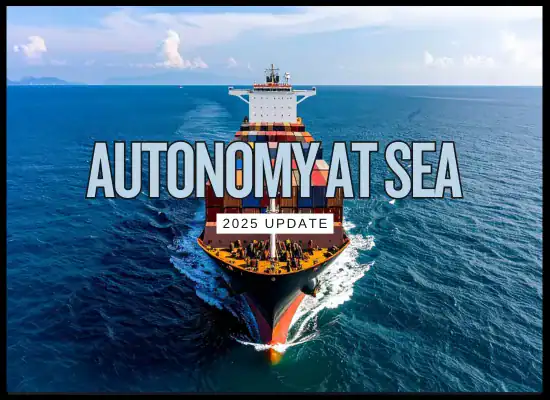
Autonomy at sea is moving from trials to practical tools that help crews sail safer and run tighter schedules. The big shift is not “crewless ships” overnight, but smarter assistance, remote support from shore, and supervised autonomy on routine legs. Owners care because it tackles safety, crewing pressure, and fuel-burn mistakes in one package.
What is it and Keep it Simple...
Autonomy at Sea uses sensors, AI, and reliable links to assist or automate parts of navigation, watchkeeping, and maneuvering. Think of it as a ladder: decision aids on the bridge, remote help from a shore center, supervised autonomy on predictable routes, and in some cases fully remote operations in restricted waters.
2025 Autonomy at Sea: What’s Really Working
- Assisted navigation in service: Track-keeping aids, collision-avoidance advice, and computer-vision lookout are operating on crewed bridges; humans remain in the loop.
- Auto-docking and remote support: Ferries and workboats are using automated berthing; shore control centers provide monitored assistance on defined routes.
- Supervised autonomy on predictable legs: Commercial trials run on repeated coastal passages and sheltered waters with clear handover to manual control when needed.
- Reliable sensor fusion: Radar, EO/IR cameras, AIS, and inertial data are fused for target detection and tracking; performance holds in night and moderate weather with proper maintenance.
- Resilient positioning and communications: Multi-GNSS with inertial backup and radar fixes, combined with dual-path satcom, sustain guidance and shore visibility during dropouts.
- Operational wins owners report: Fewer human-factor incidents, tighter ETA windows, smoother speed control, and better use of scarce crew via shore-side specialists.
- What still constrains scale: Mixed acceptance by ports and pilots, cyber hardening requirements, GNSS spoofing risk, sensor fouling in heavy spray, and unclear accountability without strong procedures.
- Regulatory pathway today: Projects proceed under flag/class approvals on a case-by-case basis while a unified code is finalized; success comes from phased pilots on specific corridors.
- Buyer checklist: Modern sensors (including thermal), clear HMI with Manual/Assist/Auto states, resilient PNT and comms, OT-cyber segmentation, simulator training, and a pilot/VTS engagement plan.
- How to prove it works: Track before/after incident and near-miss rates, ETA variance, fuel variance, and clean handover logs; document pilot/VTS acceptance during port calls.
Autonomy at Sea — ROI, Payback & NPV
Edit inputs to match your quotes and routes
Baseline & Economics
Global Effect Caps
Measures & Costs
Annual fuel savings
—
Annual time-value savings
—
Annual incident-cost reduction
—
Net annual benefit (after OPEX)
—
Payback (discounted)
—
NPV / IRR
—
Replace defaults with your quotes and routes. Annual benefits here come from three buckets: (1) fuel reduction from steadier tracking/routing and better handling, (2) time saved in port/close-quarters with auto-docking and support, (3) fewer incidents due to assisted lookout and remote supervision. These are indicative only; validate with trials and simulator sessions.
We welcome your feedback, suggestions, corrections, and ideas for enhancements. Please click here to get in touch.