15 Pieces of Navigation Redundancy That Suddenly Matter More in the Gulf
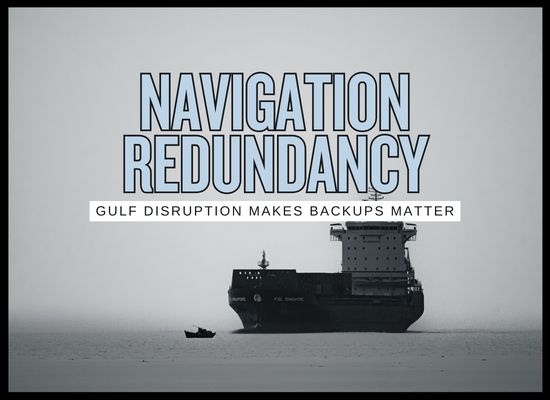
Navigation redundancy has moved from a best-practice conversation to a live operating issue in the Gulf. Current JMIC advisories say significant GNSS interference, spoofing, and jamming continue across the Strait of Hormuz approaches, Gulf of Oman, and Arabian Gulf, with more than 600 disruption events reported in 24 hours in recent updates and documented effects including positional offsets, AIS anomalies, false tracks, and intermittent signal degradation. UKMTO-linked guidance is also telling mariners to cross-check GPS with radar ranges and visual bearings, validate ECDIS with secondary systems, and increase bridge manning in constrained waters, while the Royal Institute of Navigation’s 2026 work says a modern vessel can have more than 20 systems across seven categories processing GNSS data or time, with less than half directly tied to vessel navigation. In other words, redundancy is no longer just about carrying backup gear. It is about preserving trustworthy navigation, timing, and bridge judgment when the primary digital picture is under stress.
| # | Redundancy layer | Backs up | Importance in the Gulf now | What failure looks like without it | Best practical use | Buyer lens | Impact tags |
|---|---|---|---|---|---|---|---|
| ① |
Independent radar ranges and radar parallel indexing discipline
This is not just “having radar.” It is maintaining a genuine non-GNSS position cross-check.
|
It backs up position confidence when the electronic chart picture may still be visible but no longer fully trustworthy. | In a spoofing or jamming environment, the vessel can retain a neat-looking display while underlying positional integrity degrades. Radar ranges and parallel indexing restore an independent navigation logic that does not depend on the same vulnerable truth source. | The bridge team may keep steering by a persuasive but inaccurate digital position, especially in traffic, approaches, or constrained waters where timing and alignment matter. | Strongest when used proactively in chokepoints, port approaches, near offshore structures, and during any period of suspected positional offset or unstable signal behavior. | Redundancy only counts if officers are practiced enough to use it at speed under workload. | Position check Radar discipline Constrained waters |
| ② |
Visual bearings and bearings book routine
Old-school bearing work becomes strategic when the digital picture is suspect.
|
It backs up situational truth by giving the bridge a human-verified relationship to land, lights, marks, platforms, and other fixed references. | Gulf operations can combine congestion, security stress, restricted maneuvering space, and electronic interference. A bearings routine gives crews a navigation method that is independent from GNSS distortion and useful for catching false confidence early. | The bridge may realize too late that the displayed position and the outside world have diverged, which is especially dangerous when traffic density or infrastructure proximity is high. | Best used as an active cross-check cadence during suspicion periods rather than a last resort after the team is already confused. | The real asset is not the compass alone. It is the bridge culture of regularly proving the picture against the real world. | Visual proof Bridge culture False confidence |
| ③ |
A second independent position source rather than one integrated answer
The point is to avoid a single corrupted truth chain masquerading as redundancy.
|
It backs up navigation integrity when the primary system, receiver, or integrated display chain is affected by interference or deceptive input. | Many ships appear redundant on paper because they have multiple displays, but if those displays are still fed by the same GNSS-dependent chain, the redundancy can collapse together. In the Gulf, that distinction matters much more. | The crew may believe they are cross-checking two systems when both are echoing the same compromised input. | Strongest when the secondary source has different failure behavior or different dependency logic, not merely another screen showing the same feed. | Buyers should ask whether the backup really diversifies failure modes or just duplicates user interface. | Single-point risk True independence System architecture |
| ④ |
Paper charts or genuinely ready non-primary chart procedures
The value is continuity of safe navigation logic, not nostalgia.
|
It backs up route awareness, hazard relationship, and bridge confidence if the main electronic picture becomes unreliable or disputed. | In a corridor where GNSS interference and AIS anomalies are being reported as live conditions, the ability to continue navigation with a less automation-dependent reference becomes more than a compliance memory. It becomes a resilience tool. | The bridge can become overly dependent on a digital picture that it no longer fully trusts, which increases hesitation and confusion during already stressful conditions. | Best when the ship has not only the charts or fallback material, but also a clear practiced method for switching mental mode quickly. | Backup materials are weak if watchkeepers have not rehearsed how to use them under live pressure. | Fallback charting Continuity Mode switch |
| ⑤ |
Gyro, magnetic, and heading cross-check discipline
Heading confidence becomes more valuable when position confidence drops.
|
It backs up the vessel’s movement truth, especially when track, course over ground, and displayed orientation start to look inconsistent. | When GNSS-derived information is unstable, crews need stronger confidence in what the ship is actually doing through the water and relative to hazards. Heading cross-checks can expose inconsistencies before they cascade into bad interpretation. | The bridge may misread whether strange track behavior reflects real vessel motion, current, traffic interaction, or corrupted positioning. | Best as part of a disciplined anomaly response, not just a periodic instrument check. | Redundancy is strongest when it helps answer “What is the ship truly doing right now?” with independent evidence. | Heading truth Anomaly response Motion awareness |
| ⑥ |
Bridge team manning depth and role clarity
Human redundancy matters as much as hardware redundancy when the picture gets messy.
|
It backs up detection speed, cross-check quality, and workload absorption when the navigation environment becomes more ambiguous. | Current advisories explicitly point toward increased bridge manning in constrained waters during interference conditions. That reflects a simple truth: degraded electronic confidence increases task load and weakens single-operator resilience. | One officer can become overloaded trying to verify position, monitor traffic, manage communications, and interpret anomalies all at once. | Best when redundancy roles are pre-decided, such as who verifies radar, who checks bearings, who logs anomalies, and who owns immediate navigation control. | A bigger bridge team only helps if tasks are allocated cleanly and early. | Human redundancy Workload control Role clarity |
| ⑦ |
Independent timing awareness and time-sensitive system checks
The hidden issue is that GNSS is often backing up timing as well as position.
|
It backs up the integrity of systems and records that quietly depend on trusted time, not only the visible navigation display. | The RIN analysis makes clear that modern vessels have many more GNSS-linked dependencies than most bridge discussions acknowledge. In the Gulf, a timing integrity problem can therefore ripple beyond route display into wider operational confidence. | Operators may focus on visible navigation symptoms while missing quieter downstream effects in monitoring, records, alarms, or system coordination. | Best when crews and shore teams know which functions depend on GNSS time and which warning signs suggest the problem is broader than position alone. | Buyers and operators should map timing dependency, not just location dependency. | Timing risk Hidden dependency System awareness |
| ⑧ |
Speed log, echo sounder, and dead reckoning discipline
When GNSS confidence weakens, classic movement logic becomes more valuable again.
|
It backs up the vessel’s estimated position, water-depth relationship, and movement trend when satellite-derived position can no longer be accepted cleanly. | In Gulf conditions where positional offsets and false tracks are being reported, dead reckoning supported by speed, heading, and depth awareness gives the bridge a continuity method that does not collapse the moment the primary digital fix becomes suspect. | Without this layer, teams can become trapped between an untrusted electronic fix and no practiced alternative method for estimating where the ship should now be relative to hazards, depth contours, and track history. | Strongest when dead reckoning is updated actively and compared against radar, visual, and depth cues rather than treated as a theoretical classroom backup. | Redundancy is stronger when it keeps the ship mentally navigated, not just electronically displayed. | Dead reckoning Depth check Movement trend |
| ⑨ |
Secondary communications path for bridge-to-shore and bridge-to-bridge coordination
Redundancy is not only about fixing position. It is also about sustaining coordination when the picture degrades.
|
It backs up operational continuity when primary comms channels, standard reporting flows, or confidence in shared digital awareness becomes weaker. | Current Gulf advisories have linked electronic disruption with degraded communications and navigational reliability. That makes backup communications more valuable because ambiguity spreads faster when ships, operators, and supporting parties cannot exchange a stable picture quickly. | A bridge may know the digital picture is unreliable but still struggle to coordinate effectively with traffic services, company operations, escort assets, or nearby ships when normal channels are overloaded or degraded. | Best when the backup path is pre-briefed, tested, and tied to a clear escalation routine rather than left as a theoretical emergency option. | Communication redundancy helps contain confusion before confusion turns into navigation risk. | Comms resilience Coordination Escalation |
| ⑩ |
AIS skepticism and traffic-picture cross-checking
The backup is not another AIS display. It is the discipline of not treating AIS as self-proving truth.
|
It backs up collision avoidance and situational awareness when transmitted tracks, identities, or movement patterns may be misleading. | AIS anomalies are part of the current Gulf risk picture, so crews need a stronger habit of comparing AIS behavior against radar, visual observation, and local logic instead of assuming a clean AIS trail is reliable by default. | Without this layer, bridge teams can lose time interpreting false or distorted traffic behavior and may give too much weight to a contaminated digital traffic picture. | Strongest when AIS is used as one information source among several, especially in dense traffic, chokepoints, and security-sensitive waters. | Redundancy sometimes means distrusting a tool intelligently rather than adding another tool beside it. | AIS anomalies Traffic trust Collision avoidance |
| ⑪ |
Bridge notebook, anomaly log, and immediate evidence capture
A written record becomes part of the redundancy stack when the electronic story is contested.
|
It backs up later reconstruction, command decisions, internal reporting, and proof of what the team observed when systems behaved oddly. | In a disruption environment, the bridge may need to explain not only what the ship did but why the displayed picture was distrusted. A timely anomaly log helps preserve chronology, observations, and actions before memory compresses them. | Without it, later review can become dependent on incomplete system traces, disputed AIS history, or inconsistent recollection of when signal behavior changed and what the team did next. | Best when entries capture time, symptoms, systems affected, cross-check results, and actions taken while the event is still unfolding. | Redundancy includes preserving evidence of degraded trust, not just surviving degraded trust. | Evidence Chronology Incident review |
| ⑫ |
Printed contingency procedures and quick-reference response cards
When bridge workload spikes, the backup is clarity.
|
It backs up decision speed by turning a vague disruption scenario into a known sequence of checks, callouts, and fallback actions. | Gulf interference conditions can blur whether the issue is signal loss, spoofing, traffic distortion, or broader electronic degradation. A concise procedure card helps the team move faster from suspicion to structured response. | Without it, crews may improvise inconsistently, lose time debating next steps, or perform cross-checks in the wrong order while workload is rising. | Best when the card is short, bridge-usable, and tied to the ship’s actual equipment and reporting chain rather than copied from generic guidance. | Procedural redundancy matters most when it reduces hesitation under pressure. | Procedures Fast response Workload control |
| ⑬ |
Power resilience for critical bridge equipment
A backup method is weaker if the equipment chain supporting it cannot stay alive cleanly.
|
It backs up continuity of essential radar, communications, navigation displays, and core instruments during stress or degraded operating conditions. | In a region where electronic reliability is already under pressure, the ability to preserve stable operation of critical bridge equipment becomes more valuable because crews may need to lean harder on the remaining trusted systems. | Without dependable power continuity, the bridge may lose not only the primary truth source but also the very backups needed to re-establish confidence. | Strongest when emergency-power assumptions are tested against real bridge-use priorities rather than only against broad statutory expectations. | Redundancy on paper fails quickly if power sequencing and equipment priority are not aligned. | Power continuity Critical systems Backup integrity |
| ⑭ |
Shore-side monitoring support with independent review logic
The ship should not be the only place where the navigation picture is challenged.
|
It backs up situational assessment by giving operators ashore a second layer of anomaly detection, route logic review, and escalation support. | In Gulf conditions, the vessel may be dealing with dense traffic, security pressure, and bridge workload at the same time that signal integrity is unstable. A shore team that knows what to look for can help validate whether the vessel’s picture appears plausible or suspicious. | Without this layer, the ship can become isolated in the exact moment when independent support, documentation, and wider-context review would be most useful. | Best when shore monitoring is tied to defined triggers, clear communication rules, and an understanding that shore data can also be contaminated if not critically reviewed. | Good shore redundancy supports judgment. Bad shore redundancy just repeats the same compromised picture from another screen. | Ship-shore support Anomaly review Isolation risk |
| ⑮ |
Rehearsed degraded-navigation mindset
The final redundancy layer is mental, procedural, and cultural.
|
It backs up the crew’s ability to recognize early warning signs, distrust polished but doubtful outputs, and shift quickly into a more skeptical navigation mode. | The Gulf issue is not simply that systems may fail. It is that they may fail in persuasive ways while traffic, security concerns, and time pressure continue. A rehearsed mindset helps the bridge respond before confusion hardens. | Without it, even well-equipped ships may respond too slowly because the team hesitates to abandon familiar digital trust habits or does not recognize that multiple anomalies are part of one bigger picture. | Strongest when practiced through drills, briefings, and real watchkeeping habits that normalize cross-checking rather than reserving it for theory. | The most valuable redundancy on the ship may be a crew that knows how to think clearly when technology becomes less trustworthy. | Mindset Drill value Bridge resilience |
Which redundancy layers should you trust first in the Gulf right now
This tool helps readers translate a confusing bridge situation into a more practical redundancy response. Instead of treating every backup equally, it prioritizes the layers that matter most based on traffic pressure, signal confidence, crew readiness, and how strong your independent cross-checks really are.
Move the sliders based on actual conditions. The output is designed to answer two useful questions fast: how much degraded-navigation pressure are you under, and which redundancy layers deserve immediate attention before the bridge starts trusting the wrong picture.
Estimated degraded-navigation pressure
Simple read on how much immediate navigation-redundancy discipline the situation may now demand
This profile suggests the ship may be operating in a meaningful degraded-confidence environment. The main priority is to move away from passive trust in the electronic picture and toward faster independent proof through radar, bearings, heading checks, clearer bridge roles, and tighter escalation.
Redundancy layers to verify first
These priorities change automatically as the risk profile changes
Useful bridge prompts in a suspected interference window
- Which cross-check right now is truly independent of the suspect signal path?
- Are both displays really independent, or are they echoing the same compromised source?
- Has the team shifted from normal navigation mode into degraded-navigation mode explicitly?
- Is anyone logging anomalies and actions while the event is unfolding?
We welcome your feedback, suggestions, corrections, and ideas for enhancements. Please click here to get in touch.