Submarine Push Meets Industrial Reality
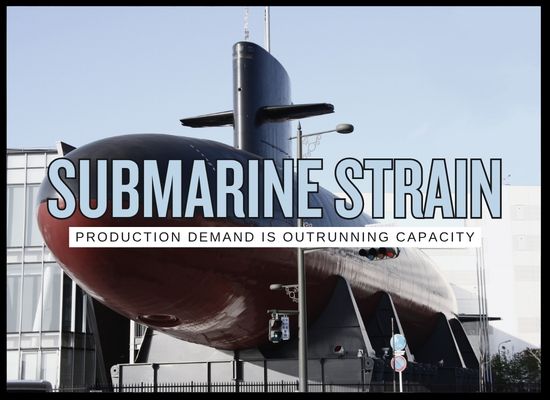
The submarine production push looks straightforward from a distance: build faster, restore numbers, strengthen deterrence. But the deeper 2026 picture is much tougher. U.S. Navy leadership is openly saying current submarine delivery is running at about 1.2 boats per year when at least 2.3 is needed, while the same industrial base is trying to support Columbia, Virginia, and AUKUS-linked demands at once. GAO and CBO material also point to persistent shipyard, workforce, supplier, and maintenance constraints, which means the real story is not just ambition. It is whether the system can absorb that ambition without breaking pace, schedule, or readiness.
The bottleneck story is bigger than one yard
Submarine production pressure is building across shipyards, suppliers, workforce pipelines, maintenance capacity, and allied commitments. The production push is real, but the hard truth is that every gain now depends on whether the whole undersea ecosystem can scale together rather than whether one program wins more rhetoric or funding.
The undersea buildup is being driven by several pressures at once. Columbia is non-negotiable because it underpins strategic deterrence. Virginia remains essential because it carries near-term attack-submarine demand and future strike capacity. AUKUS adds allied industrial and sustainment pressure rather than waiting politely off to the side. That combination means the submarine push is no longer just a procurement story. It is an industrial stress test running across production, maintenance, workforce, forward sustainment, and supplier resilience all at the same time.
Strategic urgency does not cancel production physics
Leadership can make clear that undersea force levels are critical, but urgency does not instantly create skilled labor, clean supplier flow, or schedule recovery. This is the core tension behind the production push. Strategic demand is rising faster than industrial healing.
Columbia crowds the system because it has to
Columbia is not just another major program. It is the sea-based nuclear deterrent replacement. That gives it protected priority, but that same priority also means labor, management focus, infrastructure, and supplier attention are not infinitely available for everything else at the same time.
Supplier weakness remains one of the most stubborn chokepoints
Even when prime yards improve, submarine delivery still depends on lower-tier suppliers, specialized components, and a healthier industrial web than the U.S. has had for years. Supplier fragility is a hidden limiter because it can delay progress without producing one dramatic headline moment.
Workforce is not only a hiring issue
The industrial base needs welders, pipefitters, electricians, planners, engineers, supervisors, inspectors, and maintenance talent, but it also needs experience density. Hiring helps. Retention, qualification, and learning curves matter just as much when programs are this complex.
AUKUS is not waiting at the end of the line
AUKUS adds real operational and sustainment work now, not only future submarine sales later. That matters because allied forward-maintenance capability, workforce preparation, and sustainment infrastructure are already becoming part of the undersea production and support picture.
Production gains alone do not solve readiness
Submarine power depends on maintenance availability, modernization, forward support, trained crews, and usable time on station. Even if production improves, the broader undersea enterprise still has to sustain, repair, and deploy the force effectively. Output and readiness are connected, but they are not identical.
| # | Pressure lane | How the strain shows up | Importance | What stronger performers do differently | Impact tags |
|---|---|---|---|---|---|
| 1 |
Prime yard throughput
The submarine story still runs through the ability of major builders to move work cleanly and predictably.
|
Schedule pressure, concurrency, and complex sequencing can keep work moving slower than strategy demands. | Prime yard drag affects delivery pace, program credibility, and the broader confidence needed for supplier investment. | Better performers reduce rework, stabilize planning, and make yard improvement measurable rather than rhetorical. | Throughput Schedule Yard pressure |
| 2 |
Supplier capacity
A delayed component deep in the chain can ripple upward through the whole production push.
|
Supplier shortfalls often emerge as uneven capacity, material lateness, or weak resilience at lower tiers rather than as one single visible failure. | This matters because submarine construction depends on a long, specialized, and unforgiving industrial chain. | Stronger systems invest in supplier development, earlier visibility, and healthier lower-tier confidence. | Supply chain Components Delay multiplier |
| 3 |
Workforce depth
The issue is not only headcount. It is experienced headcount.
|
Rapid workforce growth can still leave quality, qualification, and supervisory depth under strain. | A complex build program loses pace quickly when experience density thins too much. | Stronger programs push hiring, retention, qualification, and trade-school pipelines together instead of treating hiring alone as the answer. | Trades Retention Experience gap |
| 4 |
Columbia and Virginia concurrency
The industrial base is not working one clean submarine problem at a time.
|
Columbia’s priority status and Virginia’s operational importance pull on the same ecosystem. | This matters because the production push succeeds only if concurrency is handled as a system challenge rather than a slogan. | Better planning treats strategic priority, attack-submarine demand, and industrial sequencing as one integrated problem set. | Concurrency Resource competition Crowding |
| 5 |
Maintenance and sustainment capacity
The submarine push is not just about new construction. It is also about keeping the undersea force ready.
|
Yard capacity, forward support, and modernization work remain central to how much undersea power is actually usable. | Production gains matter less if sustainment remains too slow or too centralized. | Stronger operators build repair capacity, maintenance flexibility, and forward options alongside new construction. | Readiness Sustainment Availability |
| 6 |
Allied scaling through AUKUS
Undersea production and sustainment are becoming more multinational in practice.
|
Australia-related maintenance, training, and infrastructure are already part of the live undersea workload. | This matters because the future allied submarine model depends on real sustainment proof, not only strategic announcements. | Better programs use forward maintenance and workforce integration to create real operational elasticity instead of keeping all capacity at home. | AUKUS Forward support Allied integration |
Navy leadership is publicly admitting the production-rate gap
The Chief of Naval Operations said in March 2026 that the industrial base is delivering at about 1.2 submarines per year when the minimum should be at least 2.3.
The submarine industrial base is being treated as a national-capacity issue
NAVSEA’s Maritime Industrial Base program says by 2028 the Navy must deliver one Columbia and two Virginia-class submarines annually while also managing broad surface-ship demands.
GAO is still warning that shipbuilding and repair capacity problems remain structural
Its 2025 work says infrastructure and workforce challenges continue to undermine the Navy’s shipbuilding and repair goals and that the Navy still lacks a fully strategic approach to industrial-base investments.
AUKUS sustainment is already becoming real work
NAVSEA reported in February 2026 that USS Vermont completed a submarine maintenance period at HMAS Stirling, demonstrating forward sustainment in Australia and training Australian maintainers for future rotational submarine activity.
Budget pressure and production ambition still have to coexist
The FY2026 Navy budget keeps emphasizing readiness, shipbuilding, and industrial-base health at the same time, which reflects how tightly the submarine push is tied to broader maritime capacity recovery.
Track deliverable output, not only contracted ambition
The key question is not how many submarines are desired. It is how many complete, combat-credible boats the system is actually producing and supporting on time.
Push supplier development as hard as yard performance
The deepest bottlenecks often sit below the prime yards. The healthiest production pushes improve lower-tier resilience, not just final assembly narratives.
Treat workforce maturity as a production metric
Hiring is necessary, but experienced, retained, and qualified labor is what turns volume into reliable throughput.
Protect sustainment while chasing new construction
An undersea force that cannot be maintained, modernized, and repaired on useful timelines will still feel smaller than its inventory suggests.
Use allied forward sustainment to create real margin
AUKUS becomes more meaningful when it shortens maintenance distance, builds workforce depth, and expands usable operational flexibility instead of remaining mostly diplomatic messaging.
Raise the first slider when strategic and political pressure to grow undersea output is high. Raise the other sliders as yard throughput, suppliers, workforce, sustainment, and allied support improve. If demand rises faster than those support lanes, the push becomes more fragile rather than more credible.
Reader interpretation
- The clearest warning sign is strong strategic demand paired with weak throughput at yards and suppliers.
- A high-stress production push can still be rational, but it should not be mistaken for easy or cleanly executable.
- The strongest undersea strategies expand sustainment and industrial depth at the same time as they expand output ambition.
This report does not argue that the submarine push is misplaced. It argues that the push is harder than slogans imply. The challenge in 2026 is not proving the need. It is proving that the industrial, workforce, and sustainment system can rise enough to meet it.
We welcome your feedback, suggestions, corrections, and ideas for enhancements. Please click here to get in touch.