Naval Build Priorities That Could Reshape the Maritime Supply Chain
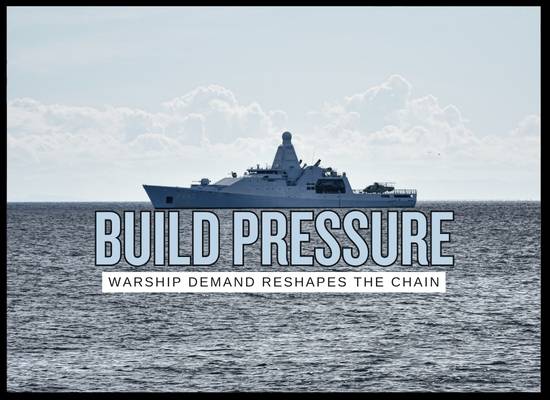
Naval build priorities in 2026 are starting to matter well beyond warship counts. The clearest shift is that submarine expansion, amphibious connector programs, missile-defense combatants, auxiliary ships, and unmanned systems are all pulling on the same deeper network of yards, repair capacity, electronics, castings, forgings, propulsion, software, and specialized labor. Official U.S. budget material explicitly frames FY2026 around strengthening shipbuilding and the maritime industrial base, while GAO says infrastructure and workforce challenges continue to make Navy shipbuilding and repair goals difficult to achieve.
Naval demand is moving past the shipyard gate
Warship construction priorities are increasingly shaping a wider maritime supply chain made up of steel, engines, combat systems, electronics, castings, forgings, repair slots, software, specialist labor, and sustainment capacity. The deeper story is not only which navies are buying. It is which industrial lanes start tightening first when several naval priorities pull on them at once.
The most important naval build priorities in 2026 are the ones that create second-order pressure across commercial and defense-adjacent suppliers. Submarines consume scarce industrial attention and highly specialized production capacity. Amphibious connectors and support vessels widen demand for steelwork, propulsion, and modular fabrication. Missile-defense combatants pull on radar, power, electronics, and systems integration. Unmanned vessels widen demand for autonomy software, mission systems, control links, and smaller specialized production runs. That mix can reshape supplier incentives even before the ships themselves are delivered.
Submarines pull hardest on specialized industrial depth
Submarine construction remains one of the clearest examples of how a naval priority can tighten an entire supply ecosystem. The pressure does not stop at final assembly. It reaches castings, forgings, propulsion components, electrical systems, skilled trades, engineering capacity, and lower-tier suppliers that often sit out of public view until they become the bottleneck.
Distributed amphibious and littoral fleets widen the vendor base
Programs built around smaller connectors, medium landing ships, and distributed littoral support can have a different supply-chain effect from top-end destroyers or submarines. They broaden demand into additional fabrication, modular construction, smaller yards, marine systems, and sustainment networks that might otherwise sit outside the highest-priority naval lanes.
Missile-defense combatants create dense systems demand
Large surface combatants matter to the supply chain not only because they are expensive ships, but because they concentrate high-end radar, combat-system, power, integration, and electronics demand. Those requirements can create pressure in advanced manufacturing and specialist supplier tiers that also matter to allied and civilian industrial planning.
Support ships and sustainment work can be more supply-chain relevant than they look
Auxiliaries, oilers, maintenance work, and fleet-sustainment contracts often draw less attention than submarines or destroyers, but they can move supplier confidence in a more immediate way. A support-focused build and sustainment strategy provides steadier demand, wider participation, and more practical industrial continuity than some flagship combatant programs alone.
Unmanned maritime systems shift demand toward software and control architecture
As naval autonomy grows, the supply chain effect becomes less about tonnage alone and more about software assurance, remote-control architecture, sensors, smaller production batches, and mission-system adaptation. That creates a different kind of maritime demand curve, one that blends shipbuilding with defense electronics and digital systems more tightly than before.
| # | Pressure lane | Naval demand hits it | Impact in the maritime chain | Alternatives | Impact tags |
|---|---|---|---|---|---|
| 1 |
Specialized castings and forgings
A classic choke point because demand can be strategic long before capacity expands.
|
Submarine and high-end combatant programs can tighten these lanes early because the component base is narrow and difficult to expand quickly. | Delays here ripple upward into schedules, costs, supplier confidence, and future program pacing. | Better planners treat lower-tier metalworking capacity as a strategic lever, not only a procurement detail. | Forgings Hidden chokepoint Schedule risk |
| 2 |
Marine propulsion and power systems
Demand widens quickly when several classes are being built or sustained at once.
|
New combatants, auxiliaries, connectors, and modernization work all compete for propulsion-related manufacturing and integration capacity. | This matters because propulsion delays can slow both naval construction and commercial maritime confidence in overlapping supplier bases. | Stronger industrial strategies widen supplier visibility and support more stable long-term planning rather than episodic demand spikes. | Propulsion Overlap demand Capacity strain |
| 3 |
Combat systems and advanced electronics
The densest surface-combatant programs often squeeze this lane first.
|
Aegis-type destroyers, ASEV, and other high-end surface builds increase demand for radars, power management, integration work, and specialist electronics. | That can influence lead times, export pathways, and supplier priorities across a wider defense-maritime ecosystem. | Better planners recognize that combat-system availability can shape fleet timing as much as hull construction itself. | Electronics Radar Integration strain |
| 4 |
Repair slots and sustainment labor
The build story and the maintenance story increasingly compete for the same industrial attention.
|
As navies expand or modernize, sustainment demand rises alongside new-build demand, especially where fleets need life extension and transition support. | This matters because a maritime supply chain under naval pressure is shaped by repair and support work as much as by keel-laying headlines. | Better planners fund sustainment continuity and repair elasticity instead of assuming construction and support can be separated cleanly. | Repair Sustainment Workforce pull |
| 5 |
Small and mid-tier yards
Distributed naval construction can move opportunity beyond the biggest names.
|
Littoral, support, and connector programs can route more work into a wider yard ecosystem than the top-end combatant pipeline alone. | That can diversify participation and regional industrial depth, but only if contract structure and workload continuity are credible. | Better approaches use smaller-yard work to widen resilience rather than merely offload overflow. | Regional yards Distributed build Industrial spread |
| 6 |
Software and autonomy support
Naval demand is moving the maritime chain toward more code, control, and systems assurance.
|
Unmanned programs and hybrid fleets increase dependence on secure software, mission logic, sensors, and control-pathway support. | This matters because future maritime supply-chain pressure is no longer only about steel and engines. It is also about software talent and system assurance. | Better planners treat software sustainment and digital integration as core supply-chain lanes rather than secondary add-ons. | Autonomy Software Digital dependency |
U.S. budget priorities are explicitly industrial as well as naval
FY2026 Department of the Navy material centers shipbuilding and the maritime industrial base, while GAO says industrial constraints still complicate fleet-growth and readiness goals.
Submarine demand is already pulling on broader capacity
Current Navy leadership says submarine output is still below what strategy requires, which reinforces pressure on the industrial base and lower-tier suppliers at the same time.
Distributed amphibious build plans are widening demand
The FY2026 U.S. request for nine Medium Landing Ships is a clear sign that naval demand is not centered only on the largest and most complex hulls.
Allied plans are linking shipbuilding with sustainment more directly
Australia is treating shipbuilding and sustainment as a long-duration national industrial plan, not only a procurement sequence, while the UK is pushing a cheaper and simpler hybrid fleet logic.
Unmanned maritime demand is widening the definition of supply chain
Japan’s FY2026 material keeps pushing ASEV, maritime autonomous systems, and a combat-supporting multipurpose USV, underscoring how naval priorities now mix hardware demand with software and control-system demand.
Track lower-tier chokepoints early
The most important supply-chain pressure often begins below the prime yard, especially in forgings, castings, electronics, and specialist components.
Separate headline programs from real industrial spread
A flagship combatant may dominate attention, but a steadier support-ship or sustainment flow can be more important to supplier confidence and regional capability growth.
Watch support work as closely as new construction
Sustainment contracts, repair windows, modernization work, and training pipelines can shape the maritime industrial base just as much as new keels.
Expect software to matter more inside maritime supply chains
Unmanned systems and digital ship architectures mean future maritime demand will increasingly pull on code, control logic, secure integration, and systems assurance.
Prefer continuity over spikes
Industrial resilience grows fastest when workload is predictable enough for suppliers to invest confidently in people, tooling, and capacity.
Raise the sliders where submarine pressure, surface-combatant demand, distributed littoral building, unmanned expansion, and sustainment demand are strongest. The score rises when naval demand is likely to create broader maritime supply-chain tightening rather than stay contained inside one program lane.
Which lanes are taking the most pressure
Reader interpretation
- The clearest signal is that submarines and high-end combatants can tighten lower-tier industrial lanes before public debate notices them.
- Support and sustainment work can be more supply-chain relevant than a headline combatant program if it provides steadier and broader demand.
- As naval autonomy grows, maritime supply chains will increasingly be shaped by software and systems assurance as well as steel and machinery.
This report does not suggest naval demand is replacing commercial maritime demand. It suggests that in 2026 the naval side is becoming a stronger force in how some industrial lanes price risk, attract labor, allocate capacity, and decide where future investment looks safest and most durable.
We welcome your feedback, suggestions, corrections, and ideas for enhancements. Please click here to get in touch.