Distributed Shipbuilding Could Redraw the Naval Supply Chain
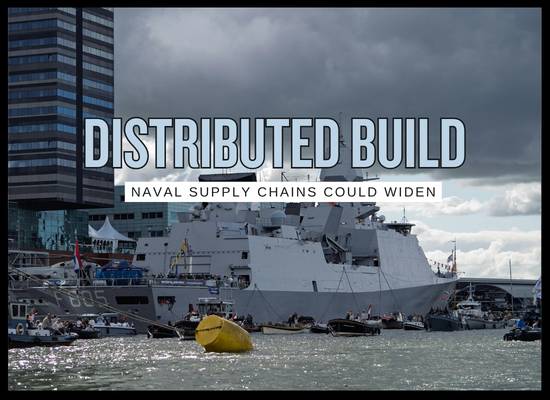
Distributed manufacturing is moving from an interesting industrial theory to a more practical naval supply-chain concept. The shift is being driven by the same pressures that keep showing up across 2025 and 2026 official material: bottlenecks in shipbuilding and repair, the need for more supplier resilience, the push for faster additive manufacturing adoption, and the growing value of a wider industrial network that can absorb work outside a handful of overloaded nodes. The U.S. Navy’s Maritime Industrial Base program says its 2025 progress came from aligning supply chain, advanced manufacturing, and workforce efforts, while NAVSEA says the Navy’s frontline 3D-printing expansion cut some lead times by 70 percent and helped establish a distributed manufacturing network with AUKUS allies.
The next supply-chain edge may come from more nodes, not just bigger nodes
Distributed manufacturing could change the naval supply chain by widening where parts are made, how quickly repairs happen, which suppliers gain relevance, how additive manufacturing is used near the fleet, and how allied and regional industrial capacity fits into naval readiness. The point is not to replace major yards. It is to reduce dependence on too few choke points.
Naval supply chains are most vulnerable when too much critical work sits in too few places, with too few qualified suppliers, too little surge elasticity, and too much dependence on long lead times for difficult parts. Distributed manufacturing does not solve every shipbuilding problem, and it does not replace prime yards or heavy industrial infrastructure. But it can reduce waiting time, create alternative sourcing pathways, bring repair capability closer to the fleet, widen supplier participation, and make the industrial system less fragile when one site or one class of supplier falls behind.
1️⃣ It could reduce dependence on a few overloaded supplier nodes
One of the strongest arguments for distributed manufacturing is basic resilience. If more work can be sourced across more qualified sites, the supply chain becomes less exposed to failure or delay at one bottlenecked supplier, yard, or region.
2️⃣ It could shorten lead times for critical parts
If distributed additive manufacturing and qualified regional production can handle more parts, some repair and sustainment timelines can shrink materially. The biggest value is not novelty. It is time saved where waiting is currently expensive.
3️⃣ It could make frontline repair more practical
When additive manufacturing moves closer to ships and operational units, the supply chain becomes less centralized and more responsive. That matters most in repair environments where waiting for one part can delay a larger maintenance sequence.
4️⃣ It could widen participation beyond the traditional supplier core
A more distributed production model can create room for smaller manufacturers, regional fabricators, and nontraditional firms that would not otherwise compete inside a tightly concentrated naval supply chain.
5️⃣ It could make alternate sourcing more realistic
When a naval program needs a backup path for castings, forgings, electronics, or legacy parts, distributed manufacturing can help create multiple ways to keep work moving instead of waiting on one fragile lane.
6️⃣ It could strengthen allied industrial interoperability
Once a distributed manufacturing network spans trusted allied partners, the naval supply chain gains more than capacity. It also gains geographic spread, faster support options, and a stronger basis for shared sustainment during operations.
7️⃣ It could shift more value toward digital qualification and data trust
Distributed production only works at naval standards if part files, certification paths, material assurance, and inspection methods are trusted. That means digital threads, metrology, and qualification discipline become more economically important.
8️⃣ It could make the repair side of naval logistics less brittle
Repair systems break down when one missing part or one overloaded facility holds up an entire job. More distributed production options can improve repair elasticity by giving maintainers additional paths to source and restore what they need.
9️⃣ It could create a better match between regional workforce programs and real naval demand
When more work is spread across more nodes, workforce growth can happen across more places too. That can help training programs tie directly into actual production and sustainment lanes instead of only into a handful of large sites.
🔟 It could support a more modular fleet model
Distributed manufacturing aligns naturally with a fleet architecture that uses modular payloads, open systems, and faster upgrades. The same industrial logic that helps print or fabricate parts regionally can also support quicker payload refresh and subsystem replacement.
1️⃣1️⃣ It could improve surge resilience in a stressed environment
If crisis conditions disrupt a major node, the existence of multiple validated production sites matters more than peak efficiency under peacetime assumptions. Distributed manufacturing creates more options when the standard route fails.
1️⃣2️⃣ It could force naval buyers to think differently about what counts as industrial strength
In a more distributed model, industrial strength is not only the size of the biggest yard. It is also the number of qualified nodes, the speed of certification, the quality of digital manufacturing pathways, and the ability to move work without rebuilding the whole chain each time.
| # | Pressure lane | How distributed manufacturing affects it | What could improve | Main condition for success | Impact tags |
|---|---|---|---|---|---|
| 1 |
Spare parts and repair items
Often the fastest and most visible gain area.
|
More local or fleet-adjacent production can reduce waiting time for specific low-volume parts. | Repair speed, maintenance sequencing, and ship availability. | Qualified digital files, inspection trust, and approved materials. | Repair Lead-time cut Availability |
| 2 |
Lower-tier supplier fragility
Alternate sourcing becomes more practical when more nodes are qualified.
|
A broader production network can reduce dependence on one stressed vendor lane. | Resilience, continuity, and sourcing flexibility. | Enough qualified regional or allied nodes to matter in practice. | Bottlenecks Alternate source Resilience |
| 3 |
Allied sustainment
Distributed manufacturing gains strategic value when trusted partners are part of the network.
|
Allied nodes can support logistics and maintenance closer to where fleets operate. | Geographic flexibility and support depth. | Trusted standards, trade permissions, and shared qualification systems. | AUKUS Trusted network Sustainment |
| 4 |
Regional labor and supplier development
A distributed model can widen who gains from naval industrial growth.
|
Work and training can be spread across a broader industrial geography. | Workforce growth and supplier participation. | Stable demand, clear qualification rules, and real workload continuity. | Jobs Regional growth Supplier breadth |
| 5 |
Digital manufacturing trust
The more distributed the model becomes, the more quality assurance matters.
|
The chain depends more heavily on secure data, certification discipline, and inspection fidelity. | Speed with confidence rather than speed with uncertainty. | Strong metrology, digital-thread governance, and repeatable qualification. | Digital thread Quality risk Certification |
| 6 |
Surge and crisis response
Distributed manufacturing matters most when the main route is disrupted.
|
More nodes give the naval supply chain fallback options in stressed conditions. | Redundancy and responsiveness. | Pre-qualified capacity that already exists before the disruption begins. | Surge Fallback capacity Crisis utility |
The Maritime Industrial Base program is explicitly built around supply chain, advanced manufacturing, and workforce development
That matters because distributed manufacturing sits exactly at the intersection of those three lines of effort.
The Navy says frontline additive manufacturing cut some lead times by 70 percent in 2025
That is one of the clearest current signs that distributed production can deliver practical operational value rather than remaining a laboratory promise.
The same NAVSEA reporting links additive growth to a distributed manufacturing network with AUKUS allies
That broadens the story from local production to trusted allied support pathways.
GAO still sees dry docks, infrastructure, and workforce as hard constraints in shipbuilding and repair
That strengthens the argument for any model that can reduce concentration and add alternative capacity around stressed lanes.
Australia’s continuous naval shipbuilding plan is explicitly anchored by sovereign supply chains and a wider long-run workforce
That is another sign that allied distributed capacity is becoming a strategic, not merely local, industrial concept.
Start where delay hurts readiness the most
Repair parts, sustainment items, and lower-volume critical components are often the best first use cases.
Treat data quality as industrial capacity
A distributed model only works if digital files, certification, and inspection systems are trusted enough to support repeatable output.
Use distributed manufacturing to widen the supplier base, not only to accelerate one part
The larger payoff comes when more nodes are qualified and more firms can participate credibly.
Link regional workforce programs to actual distributed production nodes
That is how distributed manufacturing becomes a durable industrial model instead of a string of one-off pilot successes.
Build allied trust pathways early
Distributed production across trusted partners is much more powerful when trade rules, standards, and support models are ready before crisis conditions arrive.
Raise the sliders where bottleneck concentration, repair urgency, additive-manufacturing maturity, allied support depth, and qualification confidence are strongest. Higher scores suggest distributed manufacturing could have a bigger practical effect on the naval supply chain.
Which lanes gain the most
Reader interpretation
- The strongest early use cases are usually parts and repair items where delay hurts readiness directly.
- Distributed manufacturing becomes more valuable when the existing chain is concentrated, slow, or dependent on too few suppliers.
- The system works best when qualification trust, digital files, and inspection standards are strong enough to support broader production nodes.
Distributed manufacturing is not a cure-all for naval industrial strain. Large yards, heavy fabrication, and prime-system integration will still matter enormously. But in 2026, the evidence increasingly suggests that a wider production network can improve resilience, repair responsiveness, and supply-chain flexibility in ways that traditional concentration alone has struggled to deliver.
We welcome your feedback, suggestions, corrections, and ideas for enhancements. Please click here to get in touch.