HomeFire SafetyFire at Sea: Causes, Risks, and Top Solutions
Fire at Sea: Causes, Risks, and Top Solutions
June 9, 2025
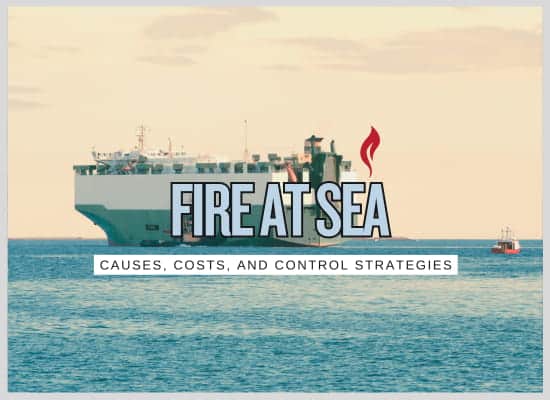
In just the first week of June, two major fires broke out aboard commercial vessels, reigniting industry-wide concerns over cargo safety, crew preparedness, and the adequacy of current fire suppression systems. These high-profile incidents serve as a stark reminder that the risks are real, rising, and costly.
From lithium-ion battery shipments to engine room malfunctions, fire hazards today are more complex than ever. Shipowners, operators, and insurers are being forced to rethink traditional protocols and adopt smarter, faster, and more proactive strategies. In this report, we break down the main causes, evaluate the most pressing risks, and explore practical, forward-thinking solutions. We also highlight digital tools that can help fleets stay one step ahead of disaster.
Recent fires on large car carriers, container ships, and tankers have highlighted vulnerabilities in both cargo handling and onboard systems. Many of these fires originate from a small number of repeatable failure points. These include misdeclared or improperly stowed hazardous goods, electrical malfunctions, fuel system leaks, and human error during maintenance or welding. The rise of electric vehicles and lithium-ion battery cargoes has added a new layer of complexity, presenting challenges that standard fire suppression systems are often unable to manage.
Understanding the most common causes is critical for fleet operators, insurers, and port authorities. The table below outlines the leading categories of shipboard fire risk based on recent maritime data and investigative reports.
Leading Causes of Fires on Ships
Cause Category
Underlying Issue
Real-World Examples
Implications
Cargo Misdeclaration
Hazardous materials not properly declared, especially lithium batteries, flammable liquids, or oxidizers
Multiple container ship fires including the MSC Flaminia and Maersk Honam were linked to misdeclared cargo
Undermines stowage planning and fire response; exposes shipowners to liability and insurance disputes
Lithium-Ion Battery Fires
Thermal runaway triggered by damage, poor packaging, or manufacturing defects
Fires aboard vessels like Felicity Ace and Fremantle Highway intensified due to burning EV batteries
Difficult to extinguish; often require flooding or controlled burn-out; can reignite days later
Engine Room Fires
Leaking fuel, lube oil, or hydraulic fluid contacting hot surfaces; lack of insulation or maintenance
Still one of the top causes of total loss; older ships especially vulnerable
High risk of total propulsion failure; risk of explosions; focus of port state inspections
Electrical Failures
Overloaded circuits, short circuits, corroded wires, or unsealed connections in humid environments
Frequent cause of accommodation fires and hidden smoldering events in reefer areas or control rooms
Hard to detect before ignition; inspection cycles often overlook deteriorating wire conditions
Hot Work Accidents
Welding, grinding, or cutting without fire watch, permits, or isolation of flammable materials
Routine cause of engine room and deck fires; some fires blamed on repairs during port calls
Human error leads to costly claims and delays; training and permit-to-work enforcement are key
Poor Cargo Segregation
Incompatible dangerous goods stowed too closely (e.g., oxidizers near combustibles)
Improper stowage contributed to rapid spread of fires aboard container ships and RoRos
Violates IMDG code; increases the chance of a small ignition turning into a large-scale fire
Galley and Accommodation Fires
Unattended cooking, grease build-up, or malfunctioning galley appliances
Especially common on cruise ships and mixed-use vessels with crew living spaces
Typically localized but still dangerous; may disable ventilation or spread via ductwork
Data sourced from maritime incident reports, IMO circulars, classification society publications, and loss prevention bulletins.
⚠️ Risk Minimization Strategies
While no vessel can eliminate risk entirely, the most effective fleets apply layered prevention strategies that start at the cargo booking stage and extend through onboard operations. From better cargo screening to smarter stowage decisions and real-time monitoring, modern tools and practices are giving shipowners more control than ever before. The strategies below reflect proven methods drawn from incident reports, safety audits, and regulatory best practices.
Risk Minimization Strategies for Maritime Fire Safety
Strategy
Description & IMO Reference
Effectiveness
Implementation Level
Verified Gross Mass & CTU Packing
SOLAS Chapter VI requires accurate container weights and CTU packing per IMO/ILO/UNECE standards, ensuring safe stowage and stability.
High – prevents misload scenarios, supports safe stacking and weight distribution.
Regular crew training on IMDG Code, risk-based DG stowage plans (e.g., Maersk updates post-Honam).
High – ensures correct declaration and segregation; reduces human error.
Required during loading; annual refresher; verified during PSCO inspections.
Fixed Detection & Suppression Systems
Per SOLAS II-2 and FSS Code: CO₂, water mist, foam, and sprinkler systems for enclosed spaces.
Medium–High – rapid containment; may struggle with EV/battery fires.
Mandatory for engine rooms, cargo spaces; must be tested and maintained.
Routine Maintenance & Electrical Surveys
Routine checks of wiring, insulation, machinery—part of ISM Safety Management System.
High – addresses early-stage wear and prevents short-circuits.
Shipowner responsibility; audit trail via ISM internal and external audits.
Hot‑Work Permit Systems
Controlled welding/cutting only approved after fire watches, permits, area preparation.
High – elimination of a leading human-error category.
Implemented via SMS and ISM procedures; verified during PSC and SIRE inspections.
Cargo Hold Ventilation & Heat Monitoring
Enhanced ventilation plans and temperature/GPS monitoring of holds to detect anomalies early.
Medium – alerts crews to unusual heat accumulation in deep holds.
Requires installation of sensors and training to interpret data onboard.
Fire‑Response Drills & Familiarization
Regular drills covering cargo, engine room, accommodation—plus fire safety plan reviews.
High – reduces response delays; empowers crew for diverse fire scenarios.
Monthly onboard drills; documented logs in SMS. PSC verification.
Note: Based on IMO‑mandated regulations, classification society guidance (ABS, DNV)..
⚙️ Recommended Equipment and Systems
From early detection to active suppression, the right combination of onboard equipment can make the difference between a contained incident and a full-blown disaster. This section highlights the essential fire safety equipment used across modern cargo vessels, tankers, and RoRo ships, with an emphasis on systems proven to be effective under real-world maritime conditions. Each item is selected based on regulatory standards, industry usage trends, and feedback from fleet safety reports.
Recommended Equipment and Systems for Maritime Fire Protection
Equipment / Function
Advantages
Limitations
Applicable Areas
Fixed CO₂ Suppression
Displaces oxygen in compartments to extinguish fire
Effective for enclosed spaces; required by SOLAS for engine and cargo areas
Not suitable for lithium battery fires; requires evacuation before use
Engine rooms, cargo holds, machinery spaces
Water Mist Systems
Uses fine water droplets to cool and suppress fires
Minimal water damage; effective for electrical and Class A/B fires
Not ideal for large open spaces; requires regular nozzle maintenance
Engine rooms, pump rooms, generator spaces
Foam / Water-Spray Systems
Applies foam or water mist over flammable liquids
Standard for hydrocarbon fires; rapid coverage of oil-spill zones
Limited use against electrical or smoldering fires
Pump rooms, tank decks, machinery areas
Thermal & Smoke Detectors
Detect heat spikes or smoke and trigger early alarms
Provides early warning; scalable to multiple compartments
False alarms possible; dependent on regular testing
Cargo holds, EV decks, engine rooms, accommodation
Portable Extinguishers & Fire Hoses
Manual firefighting tools for first response
Versatile and accessible; mandatory for all crew areas
Limited range; less effective against large or spreading fires
All compartments, galleys, bridge wings, machinery spaces
Rate-of-Rise Heat Sensors
Detect rapid temperature increases to trigger alarms
Simple, cost-effective sensor for hidden fires
May not detect slow-smoldering fires or vapor ignition
Cargo holds, machinery, reefer compartments
Emergency Power & Alarm Systems
Provides backup power to fire control and alarm circuits
Keeps alarms and pumps running during power failure
Requires battery testing; may be overlooked during drills
Bridge, control rooms, engine room panels
Note: Based on SOLAS regulations, classification society standards, and manufacturer specifications.
🛡️ Insurance and Regulatory Impact
Major underwriters and P&I clubs are reevaluating coverage structures in response to cargo fires, especially those involving electric vehicles, lithium batteries, and misdeclared dangerous goods. At the same time, international maritime bodies such as the IMO and IACS are introducing tighter regulations aimed at prevention, reporting, and crew preparedness. For shipowners and operators, this dual pressure from insurers and regulators means greater scrutiny, stricter documentation standards, and higher costs for vessels that fail to meet evolving expectations.
🔍 How Recent Fires Are Affecting Insurance Premiums
Major insurers and reinsurance markets (e.g. Lloyd’s, Swiss Re) have flagged fire risk as a top-tier underwriting concern for container ships and RoRo vessels.
Premiums have increased 15–30% for vessels carrying battery-intensive cargoes like EVs or hybrid vehicles.
P&I clubs are adding new exclusions or requiring addendums for misdeclared dangerous goods.
Underwriters are now demanding evidence of fire suppression capabilities suited to lithium-ion cargo before issuing full cargo coverage.
Substandard fire response logs or outdated training have led to claim disputes in recent high-profile cases.
⚖️ IMO, SOLAS, and Flag State Regulatory Changes
The IMO has issued new guidelines for safe transport of EVs and lithium-ion batteries, including recommendations for ventilation, detection, and fire containment.
SOLAS Chapter II-2 continues to evolve with updates to fixed firefighting systems, escape route lighting, and onboard drills.
Flag states are requiring stricter documentation of hot work permits, DG declarations, and CTU inspections.
Some flag administrations are conducting randomized ISM audits focusing specifically on fire safety equipment, documentation, and crew readiness.
Port State Control regimes (e.g. Paris MoU, Tokyo MoU) have flagged fire safety and DG stowage as top inspection items for 2025–2026.
⚠️ The Role of Documentation and Inspection in Coverage Validity
In recent incidents, insurance claims were reduced or denied due to:
Misdeclared cargo (e.g. lithium batteries labeled as general goods)
Absence of up-to-date fire drill logs
Incomplete hot work permit records
Lack of photographic or signed verification of CTU inspections
Failure to segregate incompatible cargo types, despite being caught on manifest, has triggered fines and partial claim rejections.
P&I clubs have reinforced the need for real-time cargo condition tracking logs, particularly for temperature-sensitive or flammable goods.
Chain of custody for dangerous goods documentation is now a critical audit item in post-incident reviews.
Shipboard fires pose one of the most complex and costly risks in modern maritime operations. As incidents continue to rise, shipowners, operators, and insurers are under increasing pressure to adapt. From cargo screening to onboard suppression and documentation, every layer of protection matters. By combining proven equipment, well-trained crews, smart digital tools, and strict compliance with evolving regulations, the industry can move toward safer, more resilient fleets.