13 Shipowner Side Hustles That Scale in 2026
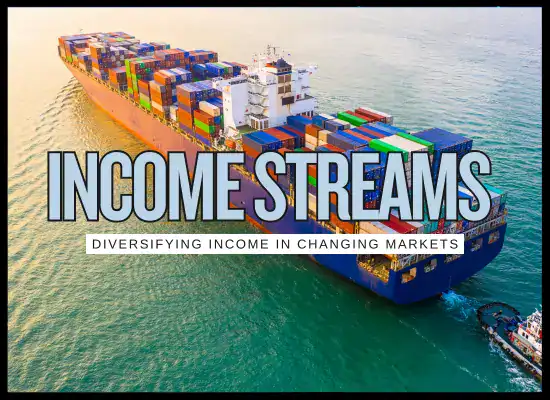
Cash flow is getting lumpier at the exact time capital and compliance costs are sticking. To stay in control, we can treat the vessel as a platform, not just a ship. The goal is simple: stack contractual side hustles that smooth earnings, widen our customer base, and keep crews and assets working when core trades soften.
- Offset Rate Volatility: Spot markets remain unpredictable across bulk, tanker, and container sectors.
- Unlock Idle Potential: Older tonnage and underutilized crews can generate new earnings with small tweaks.
- Diversify Clients: Governments, NGOs, wind developers, and survey firms are offering long-term work.
- Leverage Existing Equipment: DP, ROV decks, accommodation capacity, and lifting gear have secondary value.
- Improve Cash Flow Smoothing: Multiple income streams reduce downtime risk and smooth inflows.
| Signal | What It Means |
|---|---|
| ⚓ Freight Rate Swings | Side contracts reduce reliance on spot highs. |
| 🛢️ Energy Transition Spending | Wind, CCS, and cables need marine assets now. |
| 📉 Aging Vessel Pressure | Repurposing beats premature scrapping in many cases. |
| 💼 Public Procurement Growth | Long-term charters and tenders are expanding fast. |
| 📊 Compliance Costs | Supplementing revenue helps offset new regulatory drag. |
- Global offshore wind capacity is set to double by 2030, with major construction years peaking around 2026–2028.
- Wind developers often sign 3–10 year charter agreements with optional extensions, creating stable income streams.
- Conversions of OSVs and PSV hulls into walk-to-work or light accommodation units are becoming increasingly common.
- Platform Supply Vessels (PSVs) with DP2 capability
- Small-medium crew boats and fast support vessels
- Construction support units with open deck space or moonpool capacity
- Day rates for SOVs: $35,000–$65,000+ depending on region, spec, and market tightness
- CTVs in the U.S. can command $6,000–$10,000 per day
- Multi-year commitments (3–10 years), often with escalation clauses tied to CPI or fuel cost
- Must meet flag state and offshore safety compliance (e.g. IMCA, ISO standards, GWO certification for personnel)
- Vessels may need minor upgrades: DP tuning, crew quarters, gangway mounting points, or tech integration
- Relationship-driven industry — must approach developers or brokers early in the project planning cycle
- UK, Germany, and Denmark continue to lead in Europe
- U.S. East Coast ramping up (New York Bight, Vineyard Wind, Empire Wind)
- Taiwan, South Korea, and Japan emerging in Asia-Pacific
- Developer delays or permitting issues can stall or shorten charter periods
- Heavy upfront compliance and retrofit costs may deter casual entrants
- Market saturation risk if too many players convert similar tonnage without contracts secured
- Offshore wind is one of the most proven marine side hustles heading into 2026. For owners with DP-capable vessels, it represents a contract-rich, globally expanding opportunity with real staying power.
- Over $30B in new subsea cables are expected by 2030, including renewable grid exports and private data lines.
- Europe’s Green Deal, U.S. grid modernization, and Asia’s wind expansion all depend on reliable cable logistics.
- Repair capacity is under stress, many contracts are now bundled as installation + 10-year repair standby.
- Cable Layer Vessels (CLVs) and older telecom cable ships
- Multipurpose vessels with large deck space and good station-keeping (DP2 preferred)
- Heavy-lift ships, barges, and OSVs with cable tanks and tensioners retrofitted
- Installation contracts range from $30,000–$90,000+ per day depending on location and capability
- Standby cable repair retainers can generate $1M+ annually per vessel for immediate response
- Contracts often span 2–5 years, sometimes bundled with exclusivity or service-area zones
- Requires tensioners, plows, ROVs, cable tanks, or ability to partner with those who have them
- Navigation, bathymetric, and engineering precision critical, requires trained crews
- Certification through IMCA, ABS, or equivalent often needed
- North Sea, Baltic, and Mediterranean (interconnectors and wind export lines)
- US East Coast (offshore wind grid cables)
- Global data cables: trans-Atlantic, Pacific, and new Africa–Asia corridors
- Upfront investment for retrofit or partnership with tech firms can be high
- Technical failure or poor precision can lead to costly delays or rework
- Exclusive long-term contracts can restrict flexibility if demand shifts
- Subsea cable demand is one of the clearest long-term growth areas in marine contracting. Owners with technical precision and patience can build steady, long-term revenue backed by essential infrastructure budgets.
- The MSP has been extended through 2035, paying up to $5.3M annually per vessel for fleet availability.
- Global tensions and supply chain security priorities mean sustained demand for commercial sealift support.
- MSC regularly charters tankers, RO/ROs, breakbulk, and container vessels for U.S. military logistics.
- U.S.-flagged product tankers, RO/ROs, and multi-use cargo ships
- Containerships eligible for rapid mobilization or prepositioning
- Vessels with U.S. crews, U.S. documentation, and security compliance
- MSP: $5.3M/year subsidy per vessel for maintaining readiness and U.S.-flag status
- VISA: No direct subsidy, but priority access to DoD contracts and sealift needs
- MSC Charters: Short- or long-term; day rates vary ($15,000–$45,000/day+ depending on vessel class)
- Must be a U.S.-flagged vessel with U.S. mariners and owned/controlled by U.S. citizens (per Jones Act and DoD guidelines)
- Registration with MARAD, compliance with U.S. Coast Guard and Defense Department standards
- Vessels must be militarily useful (often pre-screened for compatibility)
- Atlantic and Pacific sealift routes
- Prepositioning near Guam, Diego Garcia, and Middle East
- Global tanker routes and DoD project cargo lifts
- Strict eligibility criteria, difficult for non-U.S. owners or foreign-built vessels
- Subject to Congressional reauthorization and budget cycles, though historically well-supported
- MSP slots are limited (60 total) and already allocated, requiring secondary market access
- For U.S. owners with the right vessel class and documentation, government programs provide unmatched stability, long-term income, and access to high-paying charter opportunities that rarely go public.
- Climate-driven disasters and geopolitical conflicts are increasing the need for emergency maritime logistics worldwide.
- Global food aid programs rely on vessel charters for last-mile delivery to Africa, Southeast Asia, the Middle East, and island nations.
- Funding for UN and development missions remains high, with many contracts awarded to private shipping firms through vetted supplier lists.
- Small to midsize bulkers and breakbulk vessels
- Landing crafts and shallow-draft ships for beach landings or remote ports
- Refrigerated cargo vessels (reefers) for cold-chain supply delivery
- Voyage or time charters, typically 15 to 90 days
- Rates vary: $7,000–$20,000+/day depending on vessel class and region
- Emergency deployments may command premium due to time sensitivity or routing complexity
- Registration with UNGM (United Nations Global Marketplace) and/or WFP logistics vendor list
- Proven track record, vetted safety record, and flexible routing
- Ability to respond quickly with documented compliance and insurance
- East and West Africa (e.g. Djibouti to Somalia, Ghana to inland West Africa)
- Pacific island chains and Southeast Asia
- Post-disaster and emergency recovery zones globally
- Short-notice requests may require rapid mobilization and flexible port access
- Geopolitical or weather risks may affect safe transit or cargo discharge
- Payment cycles through UN systems can be slower than commercial averages
- Humanitarian charters offer a mission-driven side hustle with real returns. For shipowners with nimble assets and experience in challenging regions, this niche delivers steady work while contributing to global response efforts.
- NOAA, UKHO, and EU agencies have committed hundreds of millions to mapping EEZs and updating nautical charts.
- Offshore wind developers must complete geophysical and geotechnical surveys before construction or grid cable installation.
- Private ocean data firms and subsea service contractors often sub-charter smaller vessels for seasonal campaigns.
- Small DP1/DP2 support vessels (25–60 meters)
- Multipurpose vessels with moonpools, A-frames, or crane lifts
- Nearshore survey vessels with acoustic dampening and shallow draft
- Day rates range from $6,000–$20,000/day depending on equipment and region
- Seasonal contracts lasting 30–180 days are common during peak survey months
- Some public contracts (e.g., NOAA IDIQ) span multiple years with multiple awards
- Must accommodate survey gear: multibeam sonar, side-scan, winches, cable drums, etc.
- Compliance with IMO and coastal authority standards for survey operations
- Qualified survey crew or subcontractor partnership required
- U.S. Gulf Coast and East Coast (NOAA, BOEM, offshore wind)
- North Sea, Baltic, and Mediterranean (wind and cable prep)
- Australia and Southeast Asia (coastal mapping and new port development)
- Contracts are highly technical errors in data collection can lead to penalties or contract loss
- Survey seasons are concentrated vessels may be idle off-season unless diversified
- Significant planning and coordination required with geophysical partners
- Survey support work is a precision-driven side hustle with a growing market. For vessel owners willing to partner or outfit their ships for sensor work, it offers steady seasonal income tied to infrastructure buildouts and government programs.
- As vessel traffic increases and ship sizes grow, many coastal states are expanding Emergency Towage Vessel (ETV) programs.
- Notable contracts (e.g., UK Maritime & Coastguard Agency, Norway’s Kystverket) show a model other countries are adopting.
- Some ports are now requiring designated emergency tugs as part of new maritime safety plans.
- Anchor handling tugs (AHT/AHTS)
- Multipurpose standby vessels with bollard pull >50 tons
- Harbor tugs with firefighting and towing gear
- Standby rates: $3,000–$10,000/day depending on vessel and location
- Activation bonuses for actual towage or recovery may exceed $20,000 per incident
- Multi-year contracts (1–5 years), typically government-funded and tendered publicly
- Compliance with SOLAS, IMO firefighting (FiFi) requirements, and regional towage standards
- Vessel must be available on rapid notice (usually 1–2 hours) and within set patrol zones
- Prequalification via public safety or procurement portals required
- English Channel, North Sea, and Norwegian coast (active ETV programs)
- Straits of Gibraltar, Singapore Strait, and U.S. Alaska and Pacific Northwest coasts
- New interest emerging in West Africa and Southeast Asia due to increasing marine traffic
- Idle time between activations may challenge owners without standby subsidies
- Requires 24/7 crew readiness and equipment maintenance at a high standard
- Contractual penalties can apply if vessel is unavailable when called upon
- Emergency towage is a high-preparedness, low-activity hustle with reliable income for the right ship and location. Governments are increasingly outsourcing these roles, creating recurring revenue for well-positioned owners.
- Every new offshore wind lease now requires pre-construction wind, wave, and current data — often collected via LiDAR buoys.
- Global climate monitoring programs (NOAA, EU Copernicus, private weather firms) continue to expand ocean-based sensor networks.
- Port authorities and oil & gas operators also use metocean buoys for safe routing, dredging, and planning.
- Small to mid-size DP1 or DP2 offshore vessels (20–65m)
- Survey or research vessels with winches, cranes, or A-frames
- Light-lift workboats with deck handling crew
- Day rates: $6,000–$18,000/day depending on gear and region
- Missions typically last 2–10 days per deployment or recovery
- Buoy maintenance contracts may include multiple call-outs per year
- Vessels must have lifting capacity to deploy buoys (1–3 tons typical)
- Crews need to be trained in mooring line handling, anchor placement, and precise station-keeping
- Buoy tech partners (e.g., EOLOS, Fugro, AXYS) often subcontract vessels based on responsiveness and reliability
- U.S. East Coast and Gulf of Mexico (offshore wind site surveys)
- North Sea and Baltic (multiple wind farms under early-stage development)
- Australia, South Korea, and Taiwan (emerging offshore wind and science deployments)
- Seasonal weather windows may limit scheduling
- Requires careful gear handling — buoy damage during deployment can void contracts
- Charter durations are short, so building long-term client relationships is key
- Metocean deployments are a precision-driven niche that fits smaller offshore vessels. It’s a high-trust hustle: once an owner proves reliability, they’re often called back for recurring work in the same survey zones.
- IMO and regional mandates (e.g., California CARB, EU Fit for 55) are pressuring ports to offer shore power by 2030.
- Many smaller or developing ports lack the infrastructure budget, creating demand for mobile, rented alternatives.
- Shipowners with access to retired hulls or small barges can retrofit generators or battery systems for new revenue streams.
- Deck barges or pontoons fitted with power generation or storage systems
- Retired workboats or service vessels reconfigured for static power supply
- New-build low-emission barges designed for hybrid grid/diesel or battery output
- Day rates range from $8,000–$25,000/day depending on capacity (1–5 MW typical)
- Charter terms often span weeks to months for large infrastructure projects
- Some government subsidies or green-transition grants may apply to retrofits
- Requires shore connection compliance (e.g., ISO/IEC/IEE 80005 standard)
- Must integrate with port safety and grid compatibility protocols
- High initial investment for electrical gear and power management systems
- California ports (LA, Long Beach, Oakland) under CARB regulations
- European ports with Fit for 55 mandates (Rotterdam, Hamburg, Marseille)
- Temporary use in construction ports, cruise terminals, or energy hubs
- Requires electrical engineering expertise and certification
- Insurance and safety risks tied to live power operations on water
- Niche market — future competition may rise as fixed shore power expands
- Mobile shore power barges offer a forward-looking side hustle tied to decarbonization trends. With ports under regulatory pressure, nimble owners who build early capacity may lock in recurring port contracts before permanent systems arrive.
- Volatility in energy markets and global disruptions continue to trigger storage trades across crude, diesel, and LNG.
- IMO 2030 compliance is expected to increase demand for low-sulfur storage capacity as fleets manage blended fuels and scrubber availability.
- Bulk grain and fertilizer trades also see floating storage needs during congestion or sanctions shifts.
- Crude oil tankers (VLCC, Suezmax, Aframax)
- Product tankers (MR, LR1, LR2)
- Dry bulk carriers with covered hatches or weather-tight storage
- Storage charters range from 30–180 days, sometimes longer
- Rates can spike to $50,000–$200,000+/day during strong contango events (e.g. COVID-2020, Ukraine-2022)
- Charters may be structured as time charters with storage clauses or spot + demurrage multipliers
- Tankers must pass vetting by major oil companies and charterers (OCIMF SIRE, RightShip, etc.)
- Safe anchorage or permission from port/state authorities is required in many cases
- Vessel condition and crew standards must support idle operation and cargo preservation
- Singapore Strait, Fujairah, West Africa, U.S. Gulf Coast, key hubs during storage surges
- Straits of Hormuz and Malacca in times of geopolitical disruption
- Brazil, Argentina, and West African coasts for grain, ore, or fertilizer holds
- Timing is everything, revenue only spikes when pricing structures support storage
- Idle vessels must be properly maintained and crewed, mechanical failures while anchored can void insurance
- Regulatory issues may arise when anchoring long-term near sensitive regions
- Floating storage is a classic high-reward hustle, not constant, but when the market flips, prepared owners can book windfall profits. It’s about timing, vetting, and having idle capacity ready to deploy fast.
- More than 500 GW of new wind and solar capacity is being built worldwide, much of it requiring oversized transport.
- Countries are upgrading ports, substations, and heavy industrial zones, requiring turbines, transformers, reactors, and more.
- Heavy-lift charter rates are strong due to limited specialized fleet availability and tight dock schedules.
- Multipurpose vessels with cranes and reinforced decks
- Deck barges or semi-submersibles for modular or rolling cargo
- Geared bulkers or converted general cargo ships
- Voyage and time charters based on cargo type, lift needs, and delivery windows
- Day rates range from $15,000–$50,000+ depending on vessel spec and lift complexity
- Breakbulk projects can span 10–60 days, often linked to port logistics timelines
- Crane capability (100–500+ tons) is often essential; tandem lifting knowledge required
- Crew must be trained in heavy cargo stowage, lashing, and port coordination
- Close ties with EPCs, logistics integrators, and freight forwarders increase success
- Middle East and North Africa (oil & gas modules, desalination, solar)
- U.S. Gulf and East Coast (wind components, electrical grid equipment)
- India, Vietnam, and Indonesia (industrial zones and port upgrades)
- Port congestion and customs delays can impact project timelines
- Cargo damage claims can be high if improperly handled or stowed
- Fuel price spikes and waiting time can erode margins without strong contracts
- Project cargo is a lucrative hustle for well-equipped vessels. With the energy transition in full swing, owners who can lift big, plan tight, and partner early are landing profitable, non-cyclical work across global infrastructure corridors.
- Offshore wind and brownfield O&G redevelopment both require extended on-site workforce housing.
- Global accommodation vessel availability is tight due to retirements and redeployments.
- Some governments are contracting floatels for remote civil construction or emergency housing scenarios.
- Semi-submersibles or jack-ups converted for accommodation
- DP2 or DP3 offshore support vessels with hotel modules
- Barges fitted with housing blocks, helidecks, galleys, and gyms
- Day rates range from $25,000–$75,000/day+ depending on capacity and spec
- Charters usually last 30–180 days, with possible extensions
- Contracts often include catering, laundry, medical support, and crew logistics
- Strict safety and comfort standards (SOLAS, HSE, IMCA, MLC 2006)
- Onboard sewage, water-making, HVAC, and waste handling systems must be capable and compliant
- Requires certified hotel and catering crew or partnership with service providers
- North Sea and Baltic (wind construction staging and platform upgrades)
- U.S. Gulf of Mexico and Brazil (O&G field modernization)
- West Africa, Southeast Asia, and Middle East (modular port and energy construction)
- Conversion costs and furnishings can be high if not already installed
- Downtime between contracts can erode earnings requires skilled marketing or agency ties
- Requires strict attention to crew welfare standards and health regulations
- Flotel charters are a specialized but growing hustle. Owners with vessels offering safe, self-contained living spaces can earn excellent rates, especially during wind construction surges and offshore infrastructure campaigns.
- Global aquaculture output is projected to exceed 100 million tons by 2026, outpacing wild-caught fisheries.
- Norway, Chile, Canada, and parts of Asia are rapidly expanding offshore fish farming to reduce coastal impact.
- Operators require daily or weekly logistics support and long-term partnerships with vessel providers.
- Small DP1/DP2 OSVs or PSV conversions
- Barges or workboats with deck cranes and tank capacity
- Wellboats or fish transport vessels with circulation systems
- Day rates range from $5,000–$18,000 depending on services provided
- Contracts can be recurring (6–24 months) aligned with harvest or feeding cycles
- Some operators provide retrofit grants or co-financing for local fleet partnerships
- Vessel hygiene and biosecurity protocols are strictly enforced
- Local licensing or aquaculture compliance may be required depending on jurisdiction
- Operators often prefer local or regionally flagged vessels for long-term cooperation
- Norwegian fjords and North Atlantic coastlines (salmon farming)
- Chile, Canada, and Scotland (open ocean cage systems)
- Australia, Southeast Asia, and Mediterranean (cobia, barramundi, bream farming)
- Fish health or contamination events can lead to rapid demand shifts
- Seasonal cycles may cause idle periods unless diversified
- Specialist crew or partnerships may be required for feeding, diving, or fish handling
- Offshore aquaculture is one of the fastest-growing blue economy sectors. Shipowners who adapt early can secure recurring, multi-year work in a field that rewards consistency, local trust, and light-duty versatility.
- Over 250 CCS projects are in development globally, with 80+ planned to use marine transport instead of pipelines.
- Norway’s Northern Lights and Denmark’s Greensand projects already involve CO₂ shipping contracts.
- The EU and U.S. Inflation Reduction Act are providing billions in incentives for CCS infrastructure.
- Small pressurized or insulated tankers (3,000–10,000 DWT)
- Gas carriers convertible for LCO₂ (similar to LPG/CO₂ spec)
- Newbuild LCO₂ carriers under 10,000 CBM with cryogenic systems
- Charter terms for pilot runs range from 6 to 24 months
- Day rates are not yet standardized, early contracts are negotiated case-by-case, often with tech partners
- Some public-private projects offer co-investment or partial funding for newbuilds or conversions
- Specialized tank systems required (low-pressure/low-temp; -50°C to -80°C)
- Crews must be trained in gas handling, leak detection, and CO₂-specific safety procedures
- Only a few terminals currently certified to handle marine CO₂ transfer routing is limited
- North Sea CCS corridor (Norway, UK, Denmark)
- Netherlands, Belgium, and Germany (industrial clusters with capture capability)
- Early interest emerging in Gulf Coast U.S. and Australia
- Still a frontier market — tech and regulatory standards are evolving
- Long investment cycles — early movers may see idle time before scale kicks in
- Retrofitting vessels for LCO₂ is capital intensive and requires class approval
- CO₂ transport is one of the most speculative but potentially long-term rewarding hustles. Owners who position themselves now, through small retrofits, partnerships, or newbuild slots, could become key players in the future carbon shipping ecosystem.
We’ve spent a lot of time researching and curating this list of 13 real-world side hustles because we know how critical it is for shipowners to stay ahead of market shifts, not just react to them. Whether you run a single offshore vessel or a global fleet, we believe the future belongs to those who treat their assets like platforms, not just ships.
We’re not suggesting every opportunity on this list will be a fit, some require retrofits, partnerships, or licenses, but we’ve seen firsthand that the owners who explore even one or two of these areas are creating more stable, diversified, and resilient revenue streams.
As 2026 approaches, the landscape is shifting fast. Compliance costs are rising. Charter rates are less predictable. But the flip side? New markets are opening in wind, survey, defense, humanitarian response, and beyond.
We hope this breakdown helps spark ideas, inform decisions, and maybe even unlock a new income stream or two. If you want help turning one of these ideas into action or need guidance on sourcing, compliance, or tech partnerships, reach out. We’re building this platform to help shipowners win.
Let’s keep the fleet working.
We welcome your feedback, suggestions, corrections, and ideas for enhancements. Please click here to get in touch.