Maritime Shipping Myths Costing Owners Millions
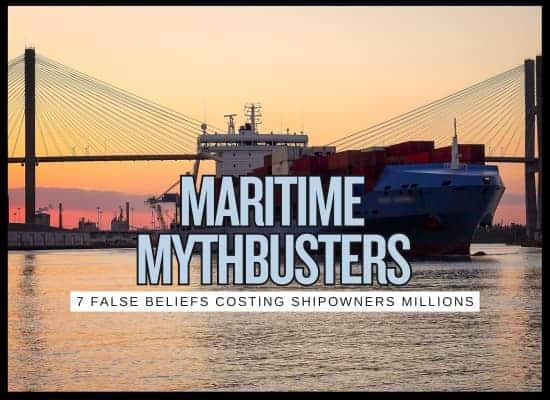
In an industry where margins are tight and risks are global, many shipowners still operate under assumptions that no longer hold water. Outdated beliefs about vessel performance, compliance, maintenance, and financing can quietly drain millions from a fleet’s bottom line each year.
This report breaks down the most persistent myths in maritime shipping, misconceptions that seem harmless on the surface but lead to real-world losses in fuel, revenue, charter value, and regulatory exposure. Whether you manage five ships or fifty, knowing what to unlearn might be just as important as knowing what to adopt.
We welcome your feedback, suggestions, corrections, and ideas for enhancements. Please click here to get in touch.
“Bigger Ships Means Better Profit Margins”
At first glance, scaling up with larger vessels seems like a direct route to better economies of scale. But in today’s shipping landscape, that logic can backfire. Ports, canal fees, cargo mismatches, and underutilization risks often turn these ‘bigger’ bets into costly burdens.
Key pitfalls include:
- Port bottlenecks where larger ships must wait for deeper berths or specialized cranes.
- Underutilized capacity, especially on trade routes without consistent demand.
- High canal fees and tug assist requirements, particularly through Suez and Panama.
- Reduced flexibility, making it harder to switch to high-frequency or diversified schedules.
“Fuel Prices are Dropping, Skip Hull Cleaning”
Delaying hull cleaning when fuel costs dip may seem smart, but biofouling doesn’t stop and drag penalties remain, regardless of fuel price. Here's why immediate cleaning is often the better bet:
- Fuel consumption rises sharply: Just a thin biofilm can boost fuel use by up to 80%, while macrofouling adds another 10–20% or more.
- Daily costs add up: Clean hulls can save operators tens of thousands in fuel every day—over $10k/day in some cases .
- Regulatory push: IMO and national regs now tie hull cleanliness to emissions compliance and invasive species control.
- Proactive tech trends: Autonomous robots and ultrasonic systems are becoming mainstream, maintaining efficiency without full dry-dock time
“AIS Off = Invisible”
Many ship operators, especially those in high-risk or restricted areas, still believe that turning off AIS makes a vessel disappear. But in today’s surveillance-heavy maritime world, that’s far from the truth. Modern satellite tech and port-state protocols make AIS silence more of a red flag than a shield.
Key misconceptions and realities:
- Turning off AIS triggers suspicion, not invisibility—especially in conflict zones, sanctions corridors, or piracy-prone waters.
- Satellite monitoring (SAR, EO, RF) still detects vessel presence and movement patterns, even with AIS disabled.
- Port authorities track AIS gaps, and unreported dark periods can result in fines, inspections, or denied entry.
- Repeat offenses damage commercial credibility, increasing insurance premiums or limiting charter opportunities.
“Carbon Regulations Are a Long-Term Concern”
Many shipowners treat carbon rules as a future burden, but 2025 is already a financial battleground. With mandatory EU emissions trading scaling up and global IMO pricing on the horizon, carbon costs are an immediate P&L issue, not a distant threat.
Key misconceptions and realities:
- EU ETS enforcement began in January 2024, covering vessels ≥5,000 GT entering EU ports.
- 2025 carbon compliance will cost more: shipowners must surrender allowances for 70% of 2024 emissions (up from 40% in 2024).
- Allowance prices rising: EU carbon permits are trading around €74/t in 2025, projecting significant costs per vessel.
- IMO global carbon pricing is coming: a levy of ~$100/t CO₂ is expected globally by 2028, following formal adoption in late 2025.
- Penalties for non-compliance: fines, banned access to EU ports, and blacklisting risks—carbon is no longer optional.
“Dry Dock Is Just a Cost Center”
Dry docking often gets dismissed as a one-and-done expense, but forward-thinking shipowners are transforming it into a strategic opportunity. With rising pressures on emissions, fuel economy, and reliability, the dock period has become a prime time for investments that pay back quickly.
- Propeller retrofits now deliver up to 10 % fuel savings, with demand for advanced designs surging by nearly four-fold since 2020.
- Hull & propulsion tech installed during dry dock can cut carbon intensity scores, support compliance, and avoid operational penalties.
- Modern dock upgrades reduce downtime and cost overruns, while worn-out infrastructure adds energy, emissions, and risk burdens.
- Capital efficiency gains: retrofit projects often yield ROI within 5–7 years—far quicker than commissioning newbuilds.
“Used Vessels Are Always Cheaper Than Newbuilds”
The upfront cost of a used vessel may be lower—but that doesn’t always mean better value. In today’s tightly priced second‑hand market, aging tonnage may carry hidden risks that wipe out initial savings.
- Second-hand prices are near record highs: Market-wide increases are pushing some used vessels close to new-build costs, tankers up ~98%, bulkers +85% since 2021.
- Rising maintenance & compliance costs: Older hulls and engines require more frequent repairs, retrofits, and may not meet emissions standards .
- Insurance and risk premiums escalate: A growing “shadow fleet” of aging vessels, now about 17 % of tankers is poorly insured and more accident-prone.
- Lifespan limitations: Many second-hand ships have limited remaining service life—often less than a decade compared to 20+ years for newbuilds.
- Market mismatch: Used vessels often lack modern fuel efficiency or CII-ready technology, forcing costly retrofits to stay competitive.
“Ship Finance Is Only for Newbuilds”
The longstanding belief that financial support is reserved for newbuilds ignores a dynamic shift in 2025. Today, a diverse toolkit of retrofit loans, green bonds, leasing structures, public grants, and even tokenized financing is empowering shipowners to fund upgrades, not just vessels fresh off the slipway.
Key developments to know:
- Retrofitting-first mindset: Financing for retrofit projects like hull coatings, propeller efficiency devices, and fuel-system upgrades is growing. Lenders now back compliance and carbon-saving investments.
- Green & transition loans: Banks are offering sustainability‑linked and transition financing tailored to retrofits and energy-saving tech.
- Public grants in play: Example: Estonia’s €25 M retrofit grant supports 15–30% of eligible green project costs.
- Alternative financing & leasing: Finance/operating leases now commonly cover retrofits and older vessels often with faster approvals and better tax efficiency.
- Innovative capital: Tokenization platforms and special-purpose retrofit funds are emerging to finance tech upgrades efficiently.
Each of these myths still circulates in boardrooms, maintenance plans, and budget reviews. But the reality in 2025 is clear: what used to work doesn’t always make sense anymore. Fuel savings are no longer optional. Carbon penalties are already on the books. And dry dock is no longer just downtime, it’s opportunity.
The most successful shipowners this year won’t be the ones chasing the biggest vessels or sticking to old habits. They’ll be the ones asking better questions, running leaner operations, and using every upgrade window to their advantage. If you're managing a fleet in today’s environment, it’s not just about staying afloat. It’s about staying ahead.