Top 10 Emerging Ports You Should Be Paying Attention To
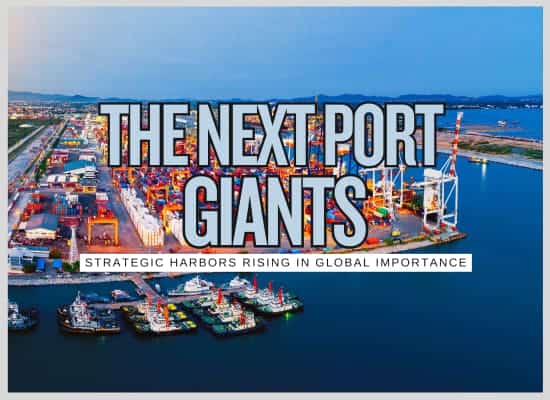
In a world where shipping lanes are shifting, supply chains are rebalancing, and strategic influence is measured in megatons and port access, a new generation of maritime ports is rising. These aren't just upgraded facilities, they’re geopolitical chess pieces, investment magnets, and efficiency game-changers.
From Africa’s Atlantic coast to the Indian Ocean’s edge, these ten emerging ports are setting new standards in throughput, technology, and regional dominance. Whether you’re a fleet operator scouting faster turnarounds, a charterer looking for reduced port fees, or an investor watching where infrastructure capital is flowing, these ports demand attention.

We welcome your feedback, suggestions, corrections, and ideas for enhancements. Please click here to get in touch.
This report unpacks what makes each one a standout, why they’re emerging, who’s backing them, how they compare to regional giants, and what risks to watch for. Welcome to the new map of maritime opportunity.
- Brand-new port built on a greenfield site with modern design, 17.5-meter draft, and capacity for Panamax and Post-Panamax vessels.
- First African port built explicitly as a transshipment and regional export-import hub from inception.
- Strategically located closer to Ethiopia and South Sudan than Mombasa, enabling access to new landlocked markets.
- Core anchor of the $24 billion LAPSSET Corridor (Lamu Port – South Sudan – Ethiopia Transport Corridor), designed to open up Northern Kenya and serve hinterland countries.
- Phase 1 completed with 3 berths (container, general cargo, and bulk); 29 more planned via PPPs.
- Constructed by China Communications Construction Company (CCCC) under Kenya Ports Authority leadership.
- Designed to serve Ethiopia’s rising economy, offering it an Indian Ocean outlet that reduces reliance on Djibouti.
- Provides direct ocean access to landlocked South Sudan and Ethiopia — two of the fastest-growing populations in East Africa.
- Part of a larger geopolitical chessboard involving China, Gulf investors, and Kenya’s regional leadership ambitions.
- Well-positioned to become a future Indian Ocean transshipment hub for East Africa, potentially reducing dependence on Durban, Djibouti, or Mombasa.
- Owner: Kenya Ports Authority (KPA).
- Phase 1 contractor: China Communications Construction Company (CCCC).
- Future plans: 29 additional berths funded via public-private partnerships with international port operators.
- Interest from Gulf state logistics firms for oil/LNG terminals and free trade zone participation.
- More modern and scalable than nearby ports, which suffer from congestion and older layout limitations.
- Better positioned to handle East Africa’s northern trade (South Sudan, Ethiopia, northern Kenya).
- Less congested maritime route with opportunities for new rail, road, and pipeline integration.
- Still underutilized — current volumes are minimal due to limited inland infrastructure and private operator delays.
- Security risks from militant groups (Al-Shabaab activity in Lamu County), although improving with increased patrol and investment.
- Environmental and community displacement concerns during early development stages caused friction with local communities.
- Lamu is a “long-play logistics gateway” — its real value emerges as Ethiopia industrializes and corridor infrastructure is completed.
- High potential to become East Africa’s leading transshipment port if Kenya successfully executes the LAPSSET buildout.
- Private operator interest will be key in transforming the first three berths into profit-generating assets.
Bottom line: Lamu is East Africa’s boldest bet on the future of trade. With deep water, strategic geography, and regional backing, it has all the ingredients to be a top-tier port — but only if infrastructure and political will align in time.
- Warm-water, deep-sea port located just 600 km from the Strait of Hormuz.
- Planned capacity to handle ultra-large container vessels and large crude carriers with future dredging.
- Designed as a multi-cargo port: containers, dry bulk, liquid bulk, LNG, and Ro-Ro.
- Centerpiece of the $62 billion China–Pakistan Economic Corridor (CPEC), providing China direct access to the Arabian Sea.
- Operated by China Overseas Port Holding Company (COPHC) under a 40-year agreement.
- Linked to ongoing development of Gwadar Free Zone, new international airport, oil pipeline corridor, and special economic zones.
- Seen as a logistics alternative to Dubai, Karachi, and Chabahar for future regional traffic.
- Offers China a land-sea trade corridor via Xinjiang, bypassing the vulnerable Malacca Strait.
- Provides Pakistan leverage in Gulf logistics, potentially shifting energy transit routes.
- Its location enhances China's access to West Asia, Central Asia, and Africa for both trade and influence.
- Operator: China Overseas Port Holding Company (COPHC).
- Funding: Chinese state-backed investment, including grants and loans through CPEC.
- Local partner: Gwadar Port Authority (Government of Pakistan).
- Additional interest from Saudi Arabia (refinery investment), UAE, and regional energy firms.
- Located outside Persian Gulf congestion and security risks.
- Faster and cheaper overland access to western China compared to ports in Southeast Asia.
- Planned integration with energy pipelines, railways, and bonded storage in a free zone model.
- Security threats in Balochistan, including attacks on port workers and Chinese nationals.
- Minimal container traffic today—bulk of promised infrastructure still incomplete or delayed.
- Geopolitical sensitivities with India and concerns about Chinese military access deter some Western investors.
- Gwadar is a long-game port—its real power lies in shaping trade flows over the next 10–20 years.
- Execution of CPEC infrastructure and regional security cooperation will determine viability.
- Success depends on Gwadar becoming more than a Chinese outpost—attracting multilateral shipping and industrial partners is key.
Bottom line: Gwadar is one of the world’s most strategically placed ports, but its commercial success is not guaranteed. Its future hinges on security, completion of inland trade corridors, and the ability to evolve from a political project into a functioning logistics powerhouse.
- Deep-water port with a basin depth of up to 18 meters, accommodating large vessels including VLCCs.
- Equipped with nine berths spanning 2.25 km, handling various cargo types: containers, dry bulk, liquid bulk, and Ro-Ro.
- Integrated with SEZAD, covering 2,000 km², the largest special economic zone in the Middle East and North Africa.
- Home to Asyad Drydock, one of the largest ship repair yards in the region.
- Central to Oman's Vision 2040, focusing on economic diversification and sustainable development.
- Recent $550 million expansion project includes dredging and construction of a new quay wall to support green steel production facilities.
- Significant Chinese investment through Oman Wanfang, committing up to $10.7 billion for industrial development within SEZAD.
- Collaborations with international partners like Port of Antwerp-Bruges and DEME Group enhance operational expertise.
- Located outside the Strait of Hormuz, providing a secure and stable alternative for maritime trade routes.
- Serves as a logistical hub connecting markets in Asia, Africa, and Europe.
- Hosts military logistics support facilities for the UK, US, and India, underscoring its geopolitical significance.
- Owner: Port of Duqm Company, a joint venture between the Government of Oman and Port of Antwerp-Bruges.
- Investors: Oman Wanfang (China), Investcorp (Bahrain), DEME Group (Belgium), and others.
- Recent Investments: Investcorp's $550 million commitment towards port expansion and green steel infrastructure.
- Strategic location with direct access to open sea routes, reducing dependency on the Strait of Hormuz.
- Comprehensive integration with industrial zones, logistics centers, and residential areas within SEZAD.
- Focus on sustainable and green energy initiatives, positioning it ahead in the transition to low-carbon economies.
- Current underutilization of port capacity, with container throughput below projected levels.
- Dependence on the timely completion of ongoing infrastructure projects within SEZAD.
- Need for enhanced connectivity with hinterland regions to fully realize its logistical potential.
- Duqm Port is set to become a pivotal maritime and industrial hub, leveraging its strategic location and integrated development model.
- Continued investment and international partnerships are crucial for accelerating its growth trajectory.
- Emphasis on sustainability and green energy aligns with global trends, enhancing its long-term viability.
Bottom line: Duqm Port embodies Oman's strategic vision for economic diversification and sustainable development. Its success hinges on continued investment, infrastructure development, and effective integration with global trade networks.
- Deep-water port with a draft of 16.5 meters, accommodating vessels up to 18,000 TEUs.
- Container terminal featuring a 1,200-meter quay and three berths, supporting an annual throughput capacity of 2.7 million TEUs.
- Integrated within the Lagos Free Trade Zone, offering streamlined customs processes and tax incentives.
- Addresses chronic congestion at Apapa and Tin Can Island ports, which handle over 80% of Nigeria's imports.
- Enhances Nigeria's export competitiveness, particularly for agro-allied products, under the African Continental Free Trade Area (AfCFTA).
- Fully automated operations with modern scanning and truck management systems, reducing cargo clearance times.
- Serves as a transshipment hub for West and Central Africa, facilitating trade with landlocked neighboring countries.
- Supports Nigeria's goal of becoming a regional maritime hub, boosting foreign exchange inflows and trade surplus.
- Proximity to the Dangote Refinery and other industrial projects enhances its role in energy exports and industrial supply chains.
- Developer: Lekki Port LFTZ Enterprise Limited (LPLEL), a joint venture comprising Lekki Port Investment Holdings Inc. (75%), Lagos State Government (20%), and Nigerian Ports Authority (5%).
- Major stakeholders: China Harbour Engineering Company and Tolaram Group.
- Project cost: Approximately $1.5 billion, making it one of the largest private infrastructure investments in Nigeria.
- Deeper draft and larger vessel accommodation compared to existing Nigerian ports.
- Advanced automation and integration with the Lagos Free Trade Zone streamline operations and reduce costs.
- Strategic location enhances connectivity to major shipping routes and regional markets.
- Dependence on the development of supporting infrastructure, such as road and rail connections, to fully realize its potential.
- Need for continuous dredging and maintenance to accommodate larger vessels and prevent siltation.
- Potential competition from other emerging ports in the region, necessitating continuous efficiency improvements.
- Expected to significantly boost Nigeria's GDP and create over 170,000 jobs.
- Projected to contribute approximately $361 billion in economic impact over 45 years.
- Poised to become a leading maritime hub in West Africa, enhancing Nigeria's position in global trade.
Bottom line: Lekki Port represents a monumental step in Nigeria's infrastructural development, offering advanced facilities and strategic advantages that position it as a key player in regional and global maritime trade.
- Located outside the volatile Strait of Hormuz, offering more stable Indian Ocean access.
- Two terminals: Shahid Beheshti (under Indian management) and Shahid Kalantari.
- Draft capacity of 16.5 meters and quay length of over 600 meters in the new phase.
- Can handle vessels up to 100,000 DWT and 2.5 million TEUs annually upon full buildout.
- Backed by India’s strategic investment of over $500 million in port and connecting infrastructure.
- Forms the southern leg of the International North-South Transport Corridor (INSTC), connecting India to Central Asia and Russia.
- Bypasses Pakistan-controlled trade routes, offering Afghanistan and Central Asia an alternative logistics corridor.
- Recent Indian-Iranian agreements to expand port operations and logistics zones to boost throughput.
- Serves as a counterweight to Gwadar Port (Pakistan), offering regional shipping diversification.
- Key for India’s regional influence and trade ambitions across Eurasia.
- Used for humanitarian shipments and aid delivery to Afghanistan during instability.
- Owner: Ports and Maritime Organization of Iran.
- Operator: India Ports Global Ltd (IPGL) operates part of Shahid Beheshti terminal.
- Investment: India committed $85 million for equipment and $150 million in line-of-credit for surrounding infrastructure.
- Additional funding from Iran’s government and support from Central Asian countries interested in port access.
- More politically neutral than Gwadar for Western and Indian logistics operators.
- Better access to western Afghanistan, especially for cargo heading to Herat or Kandahar.
- Can reduce shipping time and cost to Central Asia by over 30% compared to traditional northern land routes.
- U.S. sanctions on Iran complicate financing, insurance, and third-country participation.
- Port development and rail link construction face periodic delays due to geopolitical friction.
- Still far below capacity due to limited foreign liner participation and low cargo volumes.
- Chabahar’s future hinges on broader geopolitical cooperation — especially India-Iran stability and Western sanctions relief.
- Could emerge as a critical INSTC node if road and rail linkages to Central Asia are completed.
- Ideal for niche logistics and regional connectivity where bypassing Pakistan is a strategic advantage.
Bottom line: Chabahar Port is a geopolitically significant project with potential far beyond its current usage. While it faces real challenges, it remains a rare alignment of Indian investment, Central Asian demand, and strategic location — making it a port to watch closely as regional trade dynamics evolve.
- Comprises three container terminals with a combined capacity of approximately 7.2 million TEUs.
- Equipped to handle post-Panamax vessels, with berths up to 18 meters deep.
- Features advanced intermodal connections, including rail links facilitating cargo movement to Central and Eastern Europe.
- Strategic location connecting Asia, Europe, and Africa, making it a vital transshipment hub.
- Significant investments by COSCO have enhanced infrastructure and operational efficiency.
- Integration into China's Belt and Road Initiative has increased its global trade significance.
- Serves as a primary entry point for Asian goods into Europe, reducing transit times.
- Acts as a central hub in the China-Europe Land-Sea Express Route, facilitating trade between China and Central/Eastern Europe.
- Enhances Greece's role in global maritime logistics and trade.
- Operator: Piraeus Port Authority S.A. (PPA), majority-owned by COSCO Shipping Ports (67% stake as of 2021).
- Investments: COSCO has committed to substantial investments in port infrastructure, including terminal expansions and modernization projects.
- Financing: European Investment Bank and other institutions have provided funding support for various development initiatives.
- Offers faster transit times for goods from Asia to Europe compared to northern European ports.
- Advanced infrastructure and efficient operations attract major shipping lines.
- Strong intermodal connections enhance its appeal as a logistics hub.
- Geopolitical tensions and scrutiny over Chinese investments in European infrastructure.
- Labor disputes and concerns over working conditions have arisen under new management.
- Environmental and regulatory challenges related to port expansion projects.
- Poised to strengthen its position as a leading Mediterranean transshipment hub.
- Continued investments are expected to further enhance capacity and efficiency.
- Strategic importance likely to grow amid evolving global trade dynamics.
Bottom line: The Port of Piraeus stands as a testament to successful international collaboration, with strategic investments propelling it to the forefront of global maritime trade, while also navigating the complexities of geopolitical and regulatory landscapes.
- Comprises four container terminals with a combined handling capacity of 9 million TEUs annually.
- Features a 3,600-meter quay with a depth of 18 meters, accommodating ultra-large container vessels.
- Equipped with advanced automation technologies, including auto-mooring systems and digital berth planning.
- Integrated with industrial zones housing over 1,200 companies, contributing to $15 billion in exports in 2023.
- Surpassed its nominal container capacity in 2024, handling 8.61 million TEUs—a 13.4% increase from the previous year.
- Benefited from global shipping route reconfigurations, enhancing its role as a transshipment hub.
- Supports Morocco's export-oriented economy, particularly in automotive and aeronautics sectors.
- Recognized for operational efficiency, ranking 4th globally among container terminals in a 2024 analysis by the World Bank and S&P Global.
- Serves as a critical node linking Africa, Europe, and the Americas, enhancing global trade connectivity.
- Acts as a key transshipment point, reducing reliance on European ports like Algeciras and Valencia.
- Aligns with Morocco's vision to become a leading logistics and industrial hub in the Mediterranean.
- Operator: Tanger Med Port Authority (TMPA), under the supervision of the Moroccan government.
- Key partners: APM Terminals (a Maersk subsidiary), CMA CGM, and Hapag-Lloyd.
- Investments: Recent expansions include a €200 million loan from the European Investment Bank for infrastructure development.
- Financing: Supported by a combination of public funds and private investments to enhance capacity and technology.
- Outperforms regional competitors in capacity and efficiency, surpassing ports like Algeciras and Valencia.
- Offers cost-effective operations with a highly skilled workforce and advanced technological infrastructure.
- Integrated industrial zones provide seamless supply chain solutions, attracting global manufacturers.
- Approaching maximum capacity, necessitating further expansion to meet growing demand.
- Faces competition from emerging ports in the Mediterranean and West Africa.
- Requires continuous investment in infrastructure and technology to maintain its competitive edge.
- Poised to continue its trajectory as a leading global port, with plans to expand industrial zones and enhance capacity.
- Expected to play a pivotal role in global supply chains, particularly in automotive and manufacturing sectors.
- Strategically positioned to capitalize on shifting global trade patterns and nearshoring trends.
Bottom line: Tangier Med Port stands as a testament to Morocco's strategic investment in maritime infrastructure, solidifying its position as a premier transshipment hub and a catalyst for regional economic growth.
- Handled a record 7.78 million TEUs in 2024, with projections to surpass 9 million TEUs in 2025.
- Comprises multiple terminals: Colombo International Container Terminal (CICT), South Asia Gateway Terminals (SAGT), and Jaya Container Terminal (JCT).
- Accommodates ultra-large container vessels, including the 24,000 TEU Ever Arm.
- Strategic location on the East-West shipping route enhances its role as a transshipment hub.
- Infrastructure upgrades and efficiency improvements have boosted capacity and throughput.
- Development of the Colombo Port City Special Economic Zone aims to transform Colombo into a global financial and logistics hub.
- Serves as a key transshipment point for the Indian subcontinent, with over 75% of throughput attributed to transshipment cargo.
- Acts as a critical node in the Bay of Bengal region, facilitating trade connectivity between South Asia, Southeast Asia, and the Middle East.
- Enhances Sri Lanka's position in global maritime trade, contributing significantly to the national economy.
- Operators: Sri Lanka Ports Authority (SLPA), China Merchants Port Holdings (CICT), John Keells Holdings (SAGT), and APM Terminals.
- Investments: The U.S. International Development Finance Corporation (DFC) committed $553 million for the development of the West Container Terminal, in partnership with Adani Ports and John Keells Holdings.
- Financing: The West Container Terminal project is funded through a combination of private investments and international financing, aiming to expand capacity and enhance operational efficiency.
- Proximity to major shipping lanes offers reduced transit times compared to regional competitors.
- Advanced terminal facilities and deep-water berths accommodate the latest generation of mega vessels.
- Integration with the Colombo Port City SEZ provides additional incentives for global shipping and logistics companies.
- Geopolitical tensions and competition from emerging regional ports may impact transshipment volumes.
- Economic fluctuations and policy changes could affect investment flows and operational stability.
- Infrastructure development must keep pace with increasing demand to maintain competitiveness.
- With ongoing expansions and strategic investments, the Port of Colombo is poised to reinforce its status as South Asia's leading maritime hub.
- Projected to handle over 10 million TEUs annually by 2030, solidifying its role in global trade networks.
- The integration of port operations with the Colombo Port City SEZ is expected to attract further investments and enhance economic growth.
Bottom line: The Port of Colombo stands as a pivotal maritime gateway in South Asia, leveraging its strategic location, advanced infrastructure, and ongoing developments to serve as a central hub in global shipping and logistics.
- Comprises two main terminals: South Pier (operated by DP World) and North Pier (operated by APM Terminals).
- South Pier expansion increased berth length to 1,050 meters, accommodating three large vessels simultaneously.
- Equipped with advanced infrastructure, including new gantry cranes and all-electric yard cranes, enhancing operational efficiency.
- South Pier's capacity boosted by 80%, reaching 2.7 million TEUs annually.
- Completed a $400 million expansion project in 2024, significantly enhancing capacity and efficiency.
- Handled 1.96 million containers in 2024, marking a 19% increase over 2023.
- Arrival of mega-vessels, such as the 17,200 TEU APL Fullerton, underscores its capability to handle large-scale shipping operations.
- Ongoing investments, including a proposed $1 billion expansion by DP World, aim to further solidify its status as a regional logistics hub.
- Serves as a pivotal node in South America's Pacific trade, connecting Peru to Asia, North America, and Europe.
- Facilitates the export of key Peruvian commodities, including minerals, agricultural products, and fishmeal.
- Integration with inland transportation networks enhances connectivity to the country's interior regions.
- Operators: DP World (South Pier) and APM Terminals (North Pier).
- Investments: DP World's $400 million expansion completed in 2024; additional $1 billion investment announced for further development.
- Financing: Projects funded through a combination of private investments and international financing institutions.
- Advanced infrastructure and increased capacity position it ahead of regional competitors.
- Strategic location offers reduced transit times for trans-Pacific trade routes.
- Robust operational efficiency attracts major global shipping lines.
- Emerging competition from new ports, such as the Chinese-backed Port of Chancay, may impact market share.
- Urban congestion and infrastructure limitations in surrounding areas could affect logistics efficiency.
- Dependence on global trade dynamics makes it susceptible to economic fluctuations.
- Continued investments and expansions are expected to enhance its role as a key maritime hub in the region.
- Projected to handle over 3 million TEUs annually, reinforcing its position in global shipping networks.
- Strategic initiatives aim to integrate sustainable practices and technological advancements to maintain competitiveness.
Bottom line: The Port of Callao stands as a cornerstone of Peru's maritime infrastructure, with significant expansions and strategic investments propelling it to the forefront of South American trade, while navigating challenges posed by emerging regional competitors.
- Processed 1.6 million TEUs in 2024, nearly doubling the 840,926 TEUs handled in 2022.
- Features two main container terminals: Abidjan Terminal (operated by AGL) and Côte d’Ivoire Terminal (CIT), which commenced operations in November 2022 with a capacity of 1.5 million TEUs and a 16-meter draft.
- Accommodates large vessels, including the 14,300 TEU MSC ALIYA.
- Strategic investments, including a $400 million expansion project completed in 2024, have enhanced infrastructure and operational efficiency.
- Integration of advanced digital technologies, such as the Vessel Operation module (VSOPE WEB), has streamlined container handling operations.
- Plans to invest over €60 million in inland logistics infrastructure aim to strengthen connectivity with landlocked neighboring countries.
- Serves as a primary maritime gateway for West Africa, facilitating trade between Africa, Europe, and the Americas.
- Acts as a critical transshipment hub, enhancing trade connectivity for landlocked countries in the region.
- Contributes significantly to Côte d’Ivoire's economy, accounting for a substantial portion of customs revenues and GDP.
- Operators: Abidjan Terminal (managed by Africa Global Logistics, a subsidiary of MSC) and Côte d’Ivoire Terminal (a joint venture between APM Terminals and Bolloré Ports).
- Investments: Significant investments from international partners have funded terminal expansions and technological upgrades.
- Financing: Projects financed through a combination of private investments and international funding institutions.
- Advanced infrastructure and deep-water berths allow accommodation of larger vessels compared to some regional competitors.
- Strategic location along the Gulf of Guinea offers reduced transit times for major shipping routes.
- Robust intermodal connections enhance its appeal as a logistics hub for West Africa.
- Faces competition from emerging regional ports, such as the Port of Lomé and Port of Tema.
- Urban congestion and infrastructure limitations in surrounding areas could affect logistics efficiency.
- Dependence on global trade dynamics makes it susceptible to economic fluctuations.
- Continued investments and strategic initiatives are expected to enhance its role as a key maritime hub in West Africa.
- Projected to handle over 2 million TEUs annually by 2027, reinforcing its position in global shipping networks.
- Integration of sustainable practices and technological advancements aims to maintain competitiveness and environmental responsibility.
Bottom line: The Port of Abidjan stands as a cornerstone of West Africa's maritime infrastructure, with significant expansions and strategic investments propelling it to the forefront of regional trade, while navigating challenges posed by emerging competitors and infrastructural constraints.
The global maritime landscape is undergoing a quiet revolution. As trade routes adapt to new economic centers, geopolitical interests, and technological breakthroughs, the rise of these ten emerging ports signals more than just regional growth, it marks a shift in global influence.
For ship and fleet operators, these ports offer faster turnarounds, new chartering opportunities, and access to untapped markets. For investors and policymakers, they represent high-stakes plays in global logistics, energy flows, and diplomatic leverage. And for the maritime world at large, they point to where the future is being built, not where it’s already settled.
These aren’t just new dots on the map. They’re where the next decade of shipping will be won or lost. Keep watching.