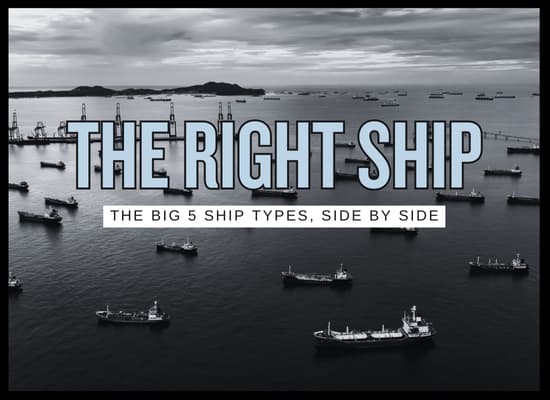
Big 5 Breakdown: Size, Fuel Burn, and Carrying Capacity
🔔 Subscribe to ShipUniverse Weekly →
Modern liner networks aren’t built around “a ship,” they’re built around five physical constraints that drive everything else: how big you can fit through canals and ports, how much you can carry in TEU and weight, how fast the schedule can realistically run, how much fuel that speed costs you, and how much cargo risk you concentrate in one call. This report ranks the core ship types that move most of the world’s seaborne trade and breaks each one down with current, real-world size bands, fuel-burn ranges, and carrying capacity so readers can sanity-check voyage plans, charter terms, and network assumptions fast.
📣 Make sure to check out The Ship Selector Tool at the end of this report.
1️⃣ Container ships
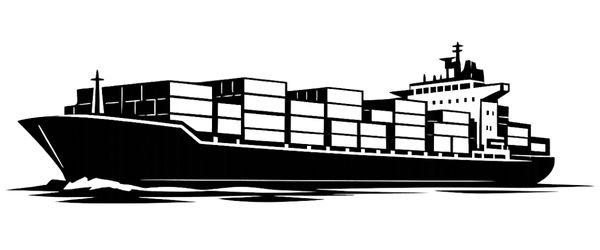
Container ships are the backbone of global “scheduled” trade because they move high-value, time-sensitive cargo in standardized boxes at scale. Their economics hinge on slot utilization (TEU filled and weight limits), speed vs burn (slow steaming vs recovery), and port/canal constraints that separate feeder networks from mainline routes. The result is a ship type where size classes matter a lot: the jump from Panamax to Neo-Panamax to ULCV changes which ports are viable, what schedules look like, and how exposed you are to disruptions at a single hub call.
| Class | Typical size band | Carrying capacity | Fuel burn (mt/day) | Primary uses | Benefits | Challenges |
|---|---|---|---|---|---|---|
| Feeder / Feedermax | ~120–220m LOA, ~20–32m beam, ~7–11m draft | ~300–3,000 TEU; ~5k–40k DWT (route-dependent) | At ~16–18 kn: ~8–25; Port/idle: ~2–6 | Regional “spokes,” short-sea, hub-to-small-port shuttles | Access to smaller ports; flexible rotations | Higher unit cost per TEU; more port calls amplify schedule risk |
| Panamax | ~270–295m LOA, ~32.2m beam, ~11–12m draft | ~3,000–5,100 TEU; ~40k–65k DWT | At ~18 kn: ~30–55; At ~22 kn: ~50–85 | Medium-haul mainline, secondary east–west strings | Broad port access; workable scale | Outgunned on cost/slot in top trades; speed recovery gets expensive |
| Post-Panamax | ~300–340m LOA, ~40–48m beam, ~12–14.5m draft | ~5,300–10,000 TEU; ~65k–120k DWT | At ~18 kn: ~45–85; At ~22 kn: ~90–150 | High-volume regional mainline, transpac legacy strings | Strong economics with fewer port limits than mega-ships | Port productivity becomes a major cost lever |
| Neo-Panamax | Max canal envelope ~366m LOA, ~51.25m beam, ~15.2m draft | ~8,600–15,000 TEU (design-dependent) | At ~18 kn: ~60–110; At ~21.5–23.5 kn: ~145–170 | Canal-enabled long-haul, big port pairs | Canal-enabled scale; strong TEU economics | Draft sensitivity; schedule recovery costs jump quickly |
| ULCV / Mega (18k–24k+) | ~390–400m LOA, ~58–61.5m beam, ~15.5–17m draft | ~18,000–24,346 TEU (current top end) | At ~16 kn: ~70–95; At ~18 kn: ~95–120; At ~22–24 kn: ~180–260+ | Hub-to-hub loops with deepwater terminals | Lowest cost per loaded TEU when full; efficient at slow steaming | Port shortlist; disruption costs amplified at a single missed call |
2️⃣ Dry Bulk Carriers
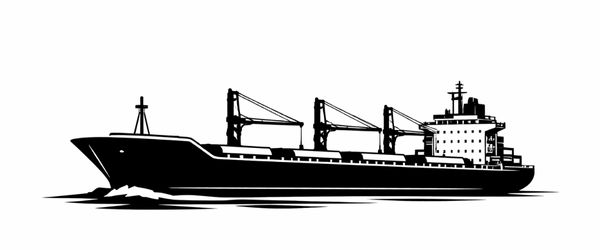
Dry bulk is the “workhorse” fleet for raw materials, and the big drivers are simple: how many tonnes you can lift (DWT), how fast you can cycle (speed and port time), and what your daily burn looks like at realistic service speeds. Unlike containers, bulk economics swing hard with draft limits, loading/discharge rates, and how often you can avoid waiting time at congested export terminals.
| Class | Typical size band | Carrying capacity | Fuel burn (mt/day) | Primary uses | Benefits | Challenges |
|---|---|---|---|---|---|---|
| Handysize (geared) | About 38k DWT benchmark; LOA ~180m; beam ~29.8m; draft ~10.5m | ~38,200 DWT; grain volume ~47,125 cbm | 14 kn: ~26 (laden) / ~24 (ballast) + small diesel at sea for auxiliaries | Minor bulks, grains, fertilizers, steels, short to medium-haul, smaller ports | Port access; onboard cranes reduce dependency on shore gear; flexible trades | Higher unit cost per tonne; more port calls; cargo fragmentation and wait time risk |
| Supramax / Ultramax (geared) | About 63.5k DWT benchmark; LOA ~200m; beam ~32.24m; draft ~13.4m | ~63,500 DWT; grain volume ~80,500 cbm; geared with grabs | 14 kn: ~29 (laden) / ~25 (ballast) on fuel oil (benchmark set) | Coal, grains, bauxite, petcoke, minor bulks; versatile “workhorse” size | Strong flexibility; geared capability; good balance between port access and scale | Draft excludes some small ports; cargo residue and holds cleanliness drive downtime |
| Panamax / Kamsarmax | About 82.5k DWT benchmark; LOA ~229m; beam ~32.25m; draft ~14.4m | ~82,500 DWT; grain volume ~97,000 cbm | 13.5 kn: ~33 (laden); 14 kn: ~31 (ballast) + small diesel at sea (benchmark set) | Grain, coal, bulks on long-haul routes where port drafts and canal limits matter | Strong tonne-mile economics; widely accepted parcel size; good liquidity in chartering | Queue risk at major export terminals; draft sensitivity; speed recovery increases burn fast |
| Capesize | About 182k DWT benchmark; LOA ~292m; beam ~45m; draft ~18.2m | ~182,000 DWT; grain volume ~199,500 cbm | 14 kn: ~52 (laden) / ~44 (ballast) on fuel oil (benchmark set) | Iron ore and coal on major export corridors; long-haul high-volume trades | Lowest cost per tonne on core routes when fully utilized; big parcel efficiency | Port shortlist; weather and congestion swings are expensive; limited redeployment flexibility |
| VLOC / Chinamax (Valemax-type) | Roughly 360–362m LOA; beam ~65m; very deep draft when loaded; limited port set | ~380,000–400,000 DWT iron ore parcels (specialized) | Service ~14 kn: ~90–100+ reported planning band for very large ore carriers | Dedicated iron ore shuttles between a small number of deepwater terminals | Maximum scale on a narrow route set; strong per-ton cost efficiency if cycle is stable | Extreme port constraint; diversion is expensive; scheduling is fragile to terminal disruption |
3️⃣ Crude Oil Tankers
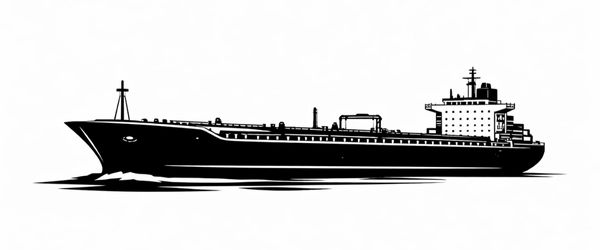
Crude tankers are built around one core job: move very large liquid parcels efficiently, safely, and predictably across long distances. The “big levers” are parcel size (DWT / barrels), draft and terminal access, and fuel burn at service speed. A one-step jump in size class (Aframax → Suezmax → VLCC) can change which ports you can load/discharge, how often you lighter, and how exposed you are to congestion and weather windows at a small set of crude hubs.
| Class | Typical size band | Carrying capacity | Fuel burn (mt/day) | Primary uses | Benefits | Challenges |
|---|---|---|---|---|---|---|
| Aframax | ~235–255m LOA, ~42–45m beam, ~12–15m draft (terminal-dependent) | ~80k–120k DWT; roughly ~0.5–0.8 million bbl crude (cargo/density dependent) | Eco ~12–13.5 kn: ~30–45; Service ~14–15 kn: ~40–60 | Regional crude moves and medium-haul trades; flexible routing into more ports than larger classes | Port access and redeployment flexibility; strong liquidity in many basins | Higher unit cost than larger classes on long haul; congestion and weather windows still bite |
| Suezmax | ~270–285m LOA, ~48–50m beam, ~15–17m draft (canal/port constraints) | ~120k–200k DWT; roughly ~0.8–1.2 million bbl (cargo/density dependent) | Eco ~12–13.5 kn: ~40–60; Service ~14–15 kn: ~55–80 | Longer-haul crude routes where parcel size matters but VLCC access is constrained | Good balance of scale and port access; strong tonne-mile economics on many lanes | Draft sensitivity at some terminals; schedule recovery quickly increases burn |
| VLCC | ~330–335m LOA, ~58–60m beam, ~20–22m draft (deepwater terminals) | ~200k–320k DWT; roughly ~1.7–2.2 million bbl (cargo/density dependent) | Eco ~12–13.5 kn: ~55–80; Service ~14–15 kn: ~75–110 | Core long-haul crude corridors (Middle East–Asia, Atlantic Basin long haul) and storage plays | Lowest cost per barrel on long haul when fully utilized; high transport efficiency | Port shortlist; berth windows and congestion are expensive; cargo concentration risk per voyage |
| ULCC (rare / route-specific) | ~400m LOA class; very deep draft; highly restricted terminal set | ~320k–550k DWT; roughly ~2.2–3.5+ million bbl (cargo/density dependent) | Eco ~12–13 kn: ~80–110; Service ~14 kn: ~110–150+ | Specialized shuttle-style crude moves where terminals and drafts can consistently handle it | Maximum scale where it fits; very strong per-barrel economics on a stable loop | Extreme port constraints; diversion/alternate discharge is painful; limited commercial flexibility |
| Shuttle tanker (offshore loading focus) | Varies widely; typically DP-capable with offshore loading gear; size often ~70k–150k DWT | DWT varies; capacity expressed in DWT and cargo volume rather than “route class” | Transit burn similar to size band; offshore ops add auxiliary load and standby time | Offshore field liftings to shore terminals or STS hubs; harsh-environment operations in some regions | Enables production lift where pipelines aren’t feasible; specialized capability is valuable | Weather downtime risk; higher complexity and operational constraints vs conventional trading |
4️⃣ Gas carriers
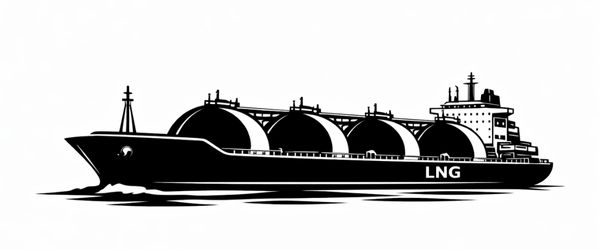
Gas carriers earn a “Big 5” slot because capacity is measured in cryogenic volume (m³), not TEU or simple DWT, and the fuel picture is tied to boil-off management and propulsion choice. Two ships with similar cargo volume can have very different daily energy use depending on whether they’re older steam LNGCs, DFDE/TFDE units, or modern two-stroke dual-fuel designs, and LPG carriers span everything from small pressurized coastal ships to VLGCs that behave like deep-sea workhorses.
| Segment / class | Typical size band | Carrying capacity | Fuel burn (planning) | Primary uses | Benefits | Challenges |
|---|---|---|---|---|---|---|
| Pressurized LPG (coastal) | Often ~90–120m LOA class; shallow draft designs for small terminals | ~1,000–5,000 m³ LPG | Example 5,000 m³ spec: ~12 t/day fuel oil at ~14.5 kn | Short-sea distribution, regional hub supply, smaller ports with limited refrigeration | Port access; flexible parcel sizes; simple terminal interface | Higher unit cost; weather and port congestion dominate cycle time |
| Semi-refrigerated LPG (handysize) | Wide design spread; optimized for regional petrochemical and LPG parceling | Commonly ~6,000–12,000 m³ LPG | Fuel varies heavily by plant and speed; use vessel noon data for budgeting | Regional LPG, petrochemical feedstocks, flexible parcel trading | Good operational flexibility; serves terminals that cannot take VLGC parcels | More equipment complexity; cargo conditioning time can consume schedule |
| VLGC / VLGP (fully refrigerated LPG) | Typical ~225–230m LOA, ~36–37m beam, draft ~11.5–12m | ~80,000–84,000 m³ LPG (very large parcels) | LPG dual-fuel example at ~16 kn: ~35.6 t/day LPG + ~1.8 t/day pilot; conventional FO examples can be ~52–56 t/day | Long-haul propane/butane exports, major arbitrage routes, high-volume term contracts | Scale efficiency; strong tonne-mile economics on stable loops | Terminal shortlist; cargo heating/conditioning and waiting time can drive effective cost |
| Standard LNG carrier (DFDE/TFDE era) | Commonly ~145k–160k m³; broad terminal compatibility | ~145,000–160,000 m³ LNG | Benchmark example at ~19 kn: ~72 t/day LNG-equivalent (varies by ship and BOG strategy) | Mainstream LNG trading, portfolio flex, wide terminal set | Good flexibility; well-understood operations and chartering | Less efficient than latest two-stroke dual-fuel; speed recovery raises burn quickly |
| Modern LNG carrier (two-stroke dual-fuel, ~174k) | Typical ~295–297m LOA, ~46.4m beam (common newbuild envelope) | ~170,000–174,000 m³ LNG | Example fuel benchmark at ~19.5 kn: ~106 t/day (gas + small liquid equivalent, vessel-type dependent) | Long-haul LNG, high-utilization portfolio routes | Stronger efficiency than older propulsion; good scale without mega-terminal limits | Terminal windows still tight; boil-off/reliquefaction decisions impact voyage economics |
| Mega LNG (Q-Flex / Q-Max type) | Q-Flex ~315m LOA, ~50m beam; Q-Max ~345m LOA, ~53.8m beam | Q-Flex up to ~216,000 m³; Q-Max ~266,000 m³ LNG | Fuel varies by reliquefaction and speed plan; treat as highly route- and ship-specific for budgeting | Dedicated mega-parcel corridors, fewer terminal pairs | Maximum parcel scale on stable loops | Very limited terminal access; diversion options are expensive; schedule fragility is higher |
| Very Large Ethane Carrier (VLEC) | Typical ~228–232m LOA, ~36.5–36.6m beam | ~85,000 m³ liquefied ethane (specialized) | Fuel varies by propulsion and cargo system; use vessel data for budgeting | Ethane export trades to petrochemical demand centers; long-haul specialized logistics | Enables large-parcel ethane economics vs smaller legacy parcels | Specialized trade dependency; terminal and contract rigidity; limited redeployment options |
5️⃣ Ro-Ro ships (vehicle carriers + roll-on/roll-off freight)
Ro-Ro is built around speed of loading/unloading and deck-area utilization, not containers or commodity parcels. Capacity is measured in lane meters (freight Ro-Ro) or CEU (car carriers/PCTC), and the “real constraint” is often height and deck strength as much as volume. The operational upside is fast port turns when terminals are set up, but the downside is sensitivity to terminal availability, ramp compatibility, weather alongside, and cargo mix that can quickly turn a schedule into a queue problem.
| Segment / class | Typical size band | Carrying capacity | Fuel burn (mt/day) | Primary uses | Benefits | Challenges |
|---|---|---|---|---|---|---|
| Freight Ro-Ro (short-sea) | Often ~150–200m LOA; draft ~6–8m; ramp/terminal dependent | ~1,500–3,000 lane meters; trailers and rolling freight | At ~17–19 kn: ~20–45 (route and design dependent) | Regional trailer lanes, ferry-style freight corridors, tight schedules | Fast turnaround; high frequency; flexible freight intake | Terminal slot sensitivity; weather alongside can disrupt ramp ops |
| ConRo (containers + Ro-Ro) | Often ~200–250m LOA; designed for mixed stowage | Lane meters plus containers (TEU varies by design) | At ~18–20 kn: ~35–70 (mixed-mode designs vary) | Routes needing both rolling cargo and containers, project cargo flexibility | Versatile stowage; can serve lanes with mixed demand | Operational complexity; balancing deck cargo vs boxes can reduce utilization |
| PCTC / Car carrier (7k–9k+ CEU) | New-gen units often ~200m LOA class; beam ~35–38m; high windage | ~7,000–9,200+ CEU; multiple liftable decks, height-sensitive | At ~18–19 kn: ~45–75 (design and speed dependent) | OEM vehicle exports, finished vehicles and high-and-heavy rolling units | High throughput when terminals are set; strong per-unit economics on stable loops | Windage and weather effects; terminal dependency; cargo concentration risk |
| High-and-Heavy Ro-Ro (project capable) | Often ~180–230m LOA with reinforced decks and high ramps | Lane meters with high deck strength; outsized rolling units | At ~16–18 kn: ~35–65 (cargo and speed dependent) | Construction equipment, trucks, rail cars, oversized rolling cargo | Handles difficult cargo without cranes; loading speed is an advantage | Utilization depends on cargo mix; port infrastructure and ramp geometry can be limiting |
| Ro-Ro “plus” (hybrid/eco newbuild trend) | Designs vary; more energy-focused propulsion and port interface features | Capacity varies; often optimized for a specific OEM or lane network | Highly variable; the key driver is speed plan and port time discipline | OEM-dedicated loops and high-frequency ro-ro networks | Better schedule reliability when paired with dedicated terminals and cargo streams | Network fragility when a terminal is congested; costly to reroute or substitute ships |
🚢 Ship Selector Tool
Tip: For the cleanest match, use the “native” unit: TEU for containers, tonnes for bulk, barrels/tonnes for tankers, m³ for gas, CEU or lane meters for Ro-Ro.
We strive for accuracy, but shipping markets, vessel classes, and operational constraints change over time and vary by port, draft, terminal gear, and contract terms. This tool provides a fast planning match, not a booking instruction. Confirm feasibility with your operator/charterer, port/terminal limits, and routing constraints.