
🔔 Subscribe to ShipUniverse Weekly →
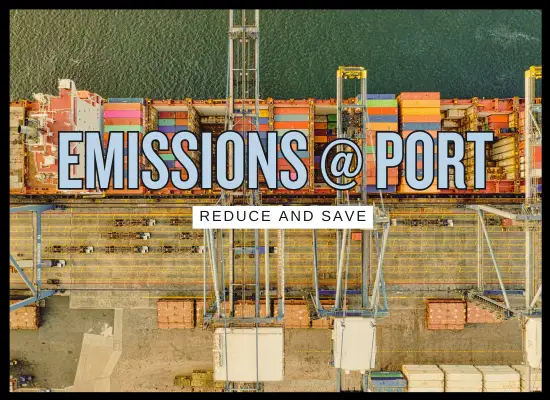
Reducing ship emissions at port in 2026 comes down to two levers: stop running auxiliary engines while alongside, and reduce time spent waiting at anchor. The biggest “hard tech” is still shore power (OPS / cold ironing), but a practical 2026 plan usually mixes shore power readiness with energy storage, cleaner auxiliary power options, and port call timing tools. Regulatory pressure is also trending toward more in-port controls, notably California’s at-berth rules phasing in by vessel type, and Europe’s push toward shore-side electricity in core ports later this decade.
| Tech or measure | What it reduces at port | Reduction level | Advantages | Disadvantages / watch-outs | Where it tends to fit best | What to measure or ask |
|---|---|---|---|---|---|---|
| Core Shore power (OPS / cold ironing / AMP) |
Most berth emissions from auxiliary engines (NOx, SOx, PM, CO2), depending on grid mix. | High | Directly turns off onboard generators at berth. Big local air-quality impact when used consistently. | Needs compatible shore connection, ship retrofit, port availability, and power quality. CO2 benefit depends on grid intensity. | Frequent callers with long berth stays and predictable terminals. | Ask: berth availability, connector standard, changeover time, power price, downtime policy. Measure: hotel load (kW) and typical hours plugged in. |
| Core Approved emission control strategies at berth (where allowed) |
Aux engine emissions while alongside using approved compliance pathways when OPS is limited. | High | Can achieve strong at-berth reductions if the strategy is accepted and executed correctly. | Approval and verification are jurisdiction-specific. Documentation and audits can be heavy. | Regulated ports where compliance is enforced and pathways are clearly defined. | Ask: what strategies are accepted for your vessel type and terminals, and how compliance is documented per call. |
| Power Battery energy storage for hotel load (hybrid retrofit) |
Aux engine runtime at berth and during maneuvering, plus peak shaving. | Medium | Reduces generator hours even when OPS is not available. Helps stabilize loads and can reduce noise. | Upfront cost, space, weight, safety engineering, class requirements, and lifecycle planning. | Ferries, short-sea, and repetitive port-call patterns with consistent hotel loads. | Measure: kWh needed for typical berth stay and peak loads. Ask: safety case, cooling, degradation assumptions, warranty terms. |
| Power Fuel cells for auxiliary power (pilot to early rollout) |
Local pollutants and CO2 at berth, depending on fuel and upstream supply. | High | Very low local emissions at point of use. Quiet operation. Pairs well with batteries for peaks. | Fuel logistics and certification are often the gating items. Early-stage economics for many ship types. | Early adopters and short-sea segments where fuel supply planning is realistic. | Ask: fuel supply chain, bunkering plan, maintenance model, stack life assumptions, class approvals. |
| Fuel Lower-carbon fuels for auxiliary engines (where available) |
CO2 profile and some pollutant outcomes, depending on fuel and engine setup. | Medium | Can be deployed quickly as a procurement lever with minimal hardware change in many cases. | Availability, price volatility, sustainability credentials, and quality consistency are the constraints. | Operators needing a near-term lever while waiting for OPS or major retrofits. | Ask: fuel spec, compatibility, storage stability, documentation for reporting and claims. |
| Aftertreatment SCR on auxiliary engines (NOx control) |
NOx at port and maneuvering. | Low | Strong NOx reductions when correctly operated with good urea management. | Not a CO2 solution. Requires urea logistics, maintenance, and performance management. Low-load behavior matters. | Vessels where NOx is a main driver and operations support correct operating windows. | Ask: NOx reduction at low load, urea consumption, maintenance intervals, monitoring approach. |
| Aftertreatment DPF or particulate control for auxiliary engines |
PM and black carbon at port. | Medium | Can materially improve local air quality impact near terminals and communities. | Backpressure, regeneration strategy, and maintenance are the main friction points. Not a CO2 solution. | Harbor areas with strong PM focus and compliance monitoring. | Ask: regeneration method, soot loading assumptions, maintenance burden, proof at similar duty cycles. |
| Tech or measure | What it reduces at port | Reduction level | Advantages | Disadvantages / watch-outs | Where it tends to fit best | What to measure or ask |
|---|---|---|---|---|---|---|
| Ops Port call optimization and just-in-time arrival |
Emissions while waiting at anchor or drifting near port approaches. | Medium | Often high ROI. Cuts wasted steaming and idle waiting when scheduling and berth planning align. | Needs coordination with terminal readiness and reliable port call data. Benefits drop if berth plans are unstable. | Congested ports and trades with frequent queueing near approaches. | Measure: anchor hours per call and speed profiles. Ask: data feeds, decision authority, and change communication ship to shore. |
| Ops Aux engine load management and hotel load reduction |
Fuel burn and emissions at berth by avoiding poor generator loading and unnecessary consumers. | Low | Lower cost than major retrofits. Captures steady savings through better generator dispatch and reduced demand. | Requires discipline and monitoring. Savings can be modest if loads are fixed by cargo needs. | Most ship types, especially when generators run lightly loaded for long periods. | Do: a berth load survey. Ask: generator loading targets, automation options, KPI reporting for berth fuel use. |
| Interfaces OPS readiness retrofit (cabling, switchboards, transformers) |
Enables OPS usage, which reduces auxiliary engine emissions when a berth has power. | High | Future-proofs vessels for ports expanding OPS. Reduces compliance risk in tightening ports. | Capex and shipyard time. Value depends on how often you actually berth at OPS-ready terminals. | Frequent callers on routes where OPS is expanding and vessels with long remaining life. | Ask: retrofit scope, downtime, compatibility standards, support for multiple voltage and frequency profiles. |
| Reality check What good looks like in 2026 |
Lower berth and port-stay emissions with proof, not assumptions. | Medium | Best results usually come from stacking: OPS where available, load control always, and port-call timing to cut waiting. | Without measurement, teams overestimate impact. Without coordination, ships still arrive early and idle. | Fleets that can standardize procedures across vessels and routes. | Track: berth hours on OPS, berth fuel use when not on OPS, anchor hours per call, aux engine run hours per port day. |
The biggest port-emissions win is simple: reduce auxiliary engine runtime while alongside. In 2026, the most reliable approach is a repeatable stack: use shore power where it exists, keep hotel loads under control everywhere, and reduce time spent waiting at anchor by tightening port-call timing and ETA discipline.
- Map your top 10 ports and note shore power availability by berth and schedule reliability.
- Measure hotel load at berth and average berth hours for each service loop or trade.
- Set a clear target: “OPS used when available” and a backup rule when it is not available.
- Decide whether you need a retrofit now or an OPS-ready design that avoids a second retrofit later.
- Cut anchor hours using port-call optimization plus stable ETA and terminal alignment.
Assumptions made simple
We welcome your feedback, suggestions, corrections, and ideas for enhancements. Please click here to get in touch.