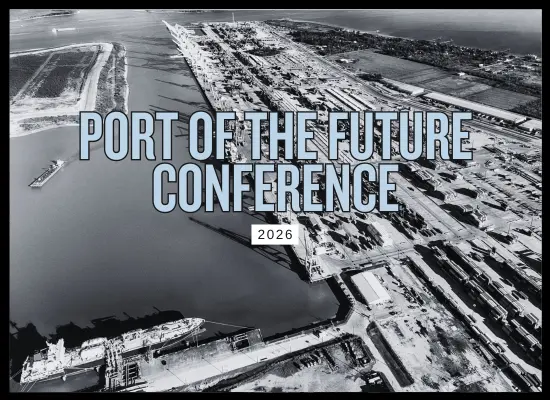
Port of the Future Conference is a focused, port-operator heavy forum built around real infrastructure decisions: modernization, security, resilience, and the digital layers that now sit on top of cargo flow. It is the kind of Houston week where port leaders, regulators, and solution teams compare what is actually deployable, what gets funded, and what breaks in execution.
🚢
Port of the Future Conference 2026 — Event Snapshot
Houston
Dates
March 24–25, 2026
City & Venue
Hilton University of Houston, 4450 University Dr, Houston, TX 77204
What it is
Port and border trade symposium covering infrastructure, operations, security, technology, and sustainability
Who shows up
Port executives and technical leaders, regulators and agencies, infrastructure and engineering teams, researchers, and solution providers
Core lanes
Port development and investment, intermodal connectivity, smart port systems and automation, operational efficiency, cybersecurity and emergency management, decarbonization and alternative fuels, port energy and sustainability
Pre-conference add-on
Port Grants Workshop (scheduled for Monday, March 23)
Staying near the University of Houston area keeps the morning simple and avoids cross-town timing risk for early sessions.
🧠
What makes this one stand out
Ports + policy + deployment
This event is hosted through the University of Houston ecosystem and is shaped around practical port realities: funding, regulations, security, and systems that must work in live cargo environments.
🏗️
Investment and execution first
The program is built around infrastructure and process change, not just product demos. Expect conversations that tie ideas to funding paths, timelines, and implementation constraints.
🛡️
Security and resilience are core lanes
Maritime security, cybersecurity, and emergency management are treated as operating requirements that sit alongside throughput and efficiency.
🔌
Energy and decarbonization in port terms
Alternative fuels and sustainability topics are framed around port energy needs, equipment transitions, compliance, and what can be scaled without disrupting cargo flow.
🎓
Academic host with a real-world mandate
Being hosted through the University of Houston College of Technology and BTI Institute pushes the agenda toward applied research, policy alignment, and repeatable best practices.
Quick ROI approach: arrive with one infrastructure priority, one security priority, and one data or automation priority. Use the first day to validate direction, then spend day two narrowing down partners and next steps.
🧭
Port of the Future 2026 week game plan
Mar 23–25, 2026 • Houston
You will get the most value by arriving with a short decision list and using the pre-conference workshop to map funding and agency alignment.
Then use the two conference days to pressure-test implementation details and lock next steps.
Suggested time split for a high-ROI week
Adjust if you are exhibitor or speaker
Plenaries and sessions
45%
1:1 meetings
30%
Workshop and floor time
25%
🧾
Monday, Mar 23
Port Grants Workshop is the leverage day. Go in with one project that needs funding clarity and one project that needs permitting or agency alignment.
Leave with a short list of programs, contacts, and next steps.
Bring a one-page project brief (scope, timeline, rough cost, risk)
Write your top 5 eligibility questions ahead of time
Ask what weak applications have in common
📅
Tuesday, Mar 24
Use day one to validate direction. Attend the sessions that map to your decision list, then spend midday in targeted conversations.
Save late afternoon and evening for networking and sponsorship touchpoints.
Book signing and reception are strong windows for compact introductions
Confirm what is realistic in 6 months vs 18 months
Ask vendors what fails first in real deployments
✅
Wednesday, Mar 25
Use day two to lock execution detail and follow-ups. Your goal is not more notes. Your goal is a shortlist and a timeline.
Aim to leave with three next meetings already scheduled.
Collect one reference contact per shortlisted solution
Confirm integration, training, and data ownership assumptions
Send same-day follow-ups while context is fresh
✉️
Two-message follow-up template
Same day
3 bullets: what you discussed, your constraint, and the one next step. Include a proposed date for a 20-minute call.
48 hours later
Confirm scope and decision path. Ask for a simple pilot outline and a reference operator that matches your profile.
🏙️
Practical notes for Houston and the venue
Hilton University of Houston
The hotel is on the University of Houston campus and sits a short ride from Downtown. Plan your week around simple morning arrivals and short evening transfers.
Venue map
Staying nearby reduces timing risk for early sessions and makes it easier to fit meetings into short gaps.
Airports and arrival plan
HOU is typically the fastest airport for a short transfer to campus.
IAH is a larger hub and can be a longer transfer, especially at peak traffic times.
For teams, set a fixed morning meetup time and one evening return window.
Getting around
Rideshare is the simplest for business schedules and multi-stop meeting days.
Houston METRORail includes service that reaches the University of Houston area, useful for Downtown corridor moves.
Build buffer time if you are moving between campus and Downtown during rush hours.
Hotel zones that tend to work well
On-campus or near campus for maximum schedule control.
Downtown for evening networking and quick access to large meeting venues.
Museum District or Texas Medical Center for a central base with good dining access.
Dinner and meeting flow
Keep client dinners in one district per night to avoid wasted transfers.
Downtown and EaDo are convenient if your group is doing receptions and sponsor events.
Pick one quick lunch plan near the venue so you do not burn meeting windows.
📌
One-page prep list to bring
Your top 3 priorities (infrastructure, security, digital)