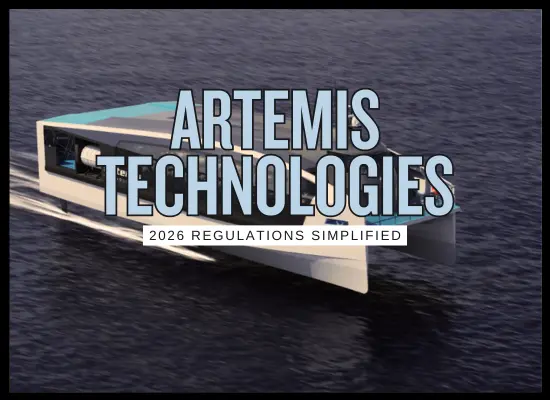
Artemis Technologies is trying to turn “fast ferry” into “clean, quiet and flying ferry,” using its eFoiler electric hydrofoil platform to lift vessels out of the water, cut drag, remove emissions in operation and trim operating costs for high speed routes and offshore work. From its Belfast base, the company is rolling out passenger ferries and workboats that can carry up to 150 people at 30 plus knots while targeting fuel cost reductions in the 80 to 90 percent range versus conventional diesel craft.
Queens Road, Belfast BT3 9DT, United Kingdom
- Removing emissions on high speed routes: Artemis positions its ferries and workboats as zero emissions in operation, aimed at decarbonising fast commuter and offshore segments that are usually hard to abate.
- Cutting fuel cost exposure: The combination of electric propulsion and hydrofoils delivers very high propulsive efficiency, with Artemis materials pointing to fuel cost reductions on the order of 80 to 90 percent compared with conventional fast ferries once capex is in the water.
- Improving passenger comfort and experience: Foiling above the waves removes much of the bumpy ride and slamming associated with displacement hulls, which can reduce seasickness and support higher average speeds without sacrificing comfort.
- Unlocking constrained waterways: Minimal wake from the foiling hull allows operations closer to shore and within sensitive waterways at speed, which can shorten journey times on urban routes where wake restrictions currently slow conventional craft.
- Lowering routine maintenance load: A fully electric drivetrain with fewer moving parts and no combustion machinery reduces scheduled maintenance compared with fast diesel ferries, and ultra fast charging concepts are designed so vessels can return to service quickly between rotations.
- Aligning with future regulation and funding: Artemis sits at the intersection of clean tech and public transport, benefiting from innovation grants and zero emission corridor initiatives, which can help operators frame projects for green finance and public tenders.
- Serving multiple mission profiles: The same eFoiler platform underpins passenger ferries, crew transfer vessels and workboats, so operators can look at a family of vessels that share technology rather than one off projects on each route.
- Anchoring projects in a proven ecosystem: Artemis leads the Belfast Maritime Consortium and has already moved EF 24 passenger builds and EF 12 workboats into sea trials and early orders, which gives buyers more confidence that this is not a paper concept.
- Getting closer to the source: Operators can explore technical details, vessel variants and deployment concepts directly with the Artemis team. Visit artemistechnologies.co.uk .
-
Belfast Maritime Consortium innovation grant Innovation City BelfastA Belfast Maritime Consortium led by Artemis wins a United Kingdom research and innovation grant in the tens of millions of pounds to develop zero emission high speed ferries in the city and create new maritime jobs. Open the consortium story .
-
Electric foiling ferries for Puget Sound WorkBoat / PlugboatsWorkBoat and Plugboats report on an agreement with Delta Marine in Seattle to manufacture Artemis eFoiler ferries for Washington State routes, framing it as a move to bring zero emission fast ferries to the Puget Sound region. Read the WorkBoat piece and the Plugboats coverage .
-
EF 24 passenger build and Belfast deliveries Maritime IndustriesMaritime Industries highlights a milestone where the first EF 24 Passenger ferries are delivered to Belfast, positioning the vessel as a flagship in the effort to decarbonise high speed coastal transport. Open the milestone update .
-
Zero emission hydrofoil trials in New York Harbor Riviera Maritime MediaRiviera reports on Artemis demonstrating its electric hydrofoil vessel in New York Harbor, with journalists and owners experiencing a quiet, fully foiling run as projects in Europe and the United States move toward launch. Read the Riviera article .
-
Electric foiling water taxi exposure in Seattle FOX 13 SeattleA local television segment in Seattle puts the EF 12 water taxi on camera and explains how an all electric hydrofoiling hull can move faster with less noise and energy compared with a conventional displacement craft. Watch the FOX 13 feature .
-
Feasibility study for Isles of Scilly route MarineLinkMarineLink covers a feasibility study led by Artemis on using a hydrofoiling electric ferry to reduce seasonal travel disruption between Cornwall and the Isles of Scilly, about thirty miles offshore. Open the MarineLink story .
| Category | Calculated value |
|---|---|
| Fuel use per day – conventional | 0 mt |
| Fuel use per year – conventional | 0 mt |
| Fuel cost per year – conventional | $0 |
| Approx energy cost per year – eFoiler | $0 |
| Cost saved per year | $0 |
| Cost saved per operating day | $0 |
| CO₂ emissions per year – conventional | 0 t |
| CO₂ avoided per year with eFoiler style switch | 0 t |
Artemis operates in a very specific corner of the market – fast routes where conventional diesel ferries burn hard to keep journey times down. The grid above gives operators a quick way to test whether those routes are big enough, busy enough and fuel hungry enough for an eFoiler style switch to matter, before they dig into the detailed engineering, port layout and funding work that a real project will demand.
We welcome your feedback, suggestions, corrections, and ideas for enhancements. Please click here to get in touch.