Smart Ports: 2026 Guide
🔔 Subscribe to ShipUniverse Weekly →
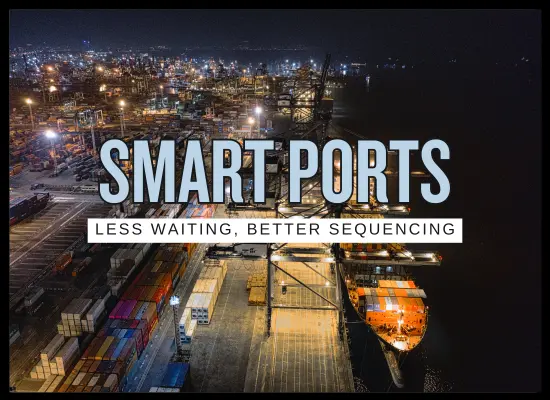
Smart ports are turning into live operating systems: terminals, vessel traffic, truck gates, and service providers share more real-time data so the port can predict congestion, sequence moves, and reduce avoidable waiting. The practical 2026 shift is that AI is being used less for “pretty dashboards” and more for specific decisions like berth and yard planning, gate appointments, equipment dispatch, and anomaly detection on port infrastructure.
What is it and Keep it Simple...
A smart port (powered by AI) is a port that uses sensors, shared operational data, and machine learning to plan and run daily operations with fewer surprises. Instead of each party guessing at ETAs and readiness, the port aims to maintain a single, continuously updated operational picture across berth, yard, gate, and marine services.
In practice, AI is used for narrow, high-value decisions: predicting berth availability, optimizing yard moves, scheduling cranes and equipment, smoothing truck flows, and spotting abnormal conditions in infrastructure or traffic. The win is not “more data.” The win is fewer plan resets, fewer idle hours, and more consistent turn times.
- Fewer hours lost to avoidable waiting and rework
- More predictable berth and yard execution
- Better truck turn times and gate flow planning
- KPIs that show improvement: fewer plan changes, faster turns, less idle equipment
| Category | Advantages | Disadvantages | Notes / considerations |
|---|---|---|---|
| Berth and marine planning | Better berth sequencing and readiness prediction reduces avoidable waiting and last-minute reshuffles. | If timestamps and roles are inconsistent, the AI just learns noisy data and confidence stays low. | Start by cleaning event definitions and ownership before expecting strong optimization outcomes. |
| Yard and equipment dispatch | Improved crane and yard move planning can reduce idle time and rehandles. | Automation and AI can create brittle workflows if exceptions are not handled cleanly. | Measure exception rate and recovery time, not only average productivity. |
| Truck and gate flow | Appointment and gate prediction reduces queues, improves turn time, and smooths peaks. | Benefits are limited if carriers, terminals, and truckers do not use the same process. | Incentives matter. Align rules so stakeholders have a reason to participate consistently. |
| Visibility and decision speed | Shared dashboards and alerts reduce manual chasing and accelerate decisions. | More screens can still mean slower decisions if governance is unclear. | Define who decides what, and what triggers a plan change. |
| Infrastructure monitoring | AI-assisted anomaly detection can improve inspection safety and maintenance timing. | False alarms can waste time and reduce trust if thresholds are not tuned. | Track false positives and tune per asset class. Treat it as an operational system. |
| Resilience to disruption | Earlier signals about congestion and bottlenecks help reduce cascading delays. | Model performance can degrade during rare events the system has not seen before. | Keep human override playbooks. Use AI to propose options, not to lock decisions. |
| Cyber and data risk | Centralized data sharing improves auditability when designed correctly. | More integrations expand attack surface and raise third-party risk. | Apply cyber resilience guidance for emerging port technologies and enforce access controls. |
| Cost and rollout effort | Layered deployments let ports start with high ROI use-cases before deeper automation. | Integration, training, and change management can be heavier than expected. | Run one lane and one terminal first. Expand after KPIs move for 60 to 90 days. |
2026 smart ports with AI: what’s really working
Hours avoided per year
0
Waiting value per year
$0
Standby value per year
$0
Net annual benefit
$0
Simple payback
n/a
Value per call
$0
Smart ports empowered by AI succeed when they reduce avoidable waiting and last-minute replanning by making berth, yard, and gate decisions earlier and more consistent. The quickest way to stay honest is to pilot on one terminal or trade lane, measure plan changes and hours saved, and scale only after 60 to 90 days of stable KPI improvement. Cyber resilience and access control should be treated as part of the core program because smart-port integrations expand the number of systems and data flows that must be protected.