8 Ports Racing to Shore Power in 2026 & Beyond
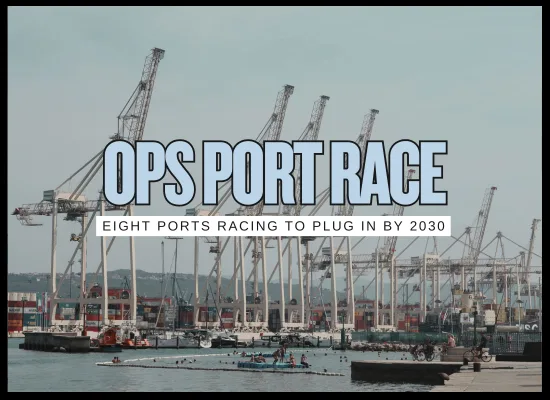
Shore power is moving from pilot to plan. By 2030, EU rules push container and passenger berths to provide plug-in power, and the ports that lock funding, grid capacity, and terminal buy-in now will capture the first wave of compliant calls. Here’s the first of eight leaders and what makes it real.
< Click Items to Expand >
1 Rotterdam (Netherlands) 🇳🇱 EU core port
Why it’s on the list
Rotterdam has a published shore power roadmap, live cruise OPS since March 2025, and funded studies with container and tank terminals. The port targets shore power at public berths by 2027 and backs the EU requirement for container and passenger terminals by 2030.
- EU policy (AFIR and FuelEU) sets 2030 for OPS provision at core container and passenger berths, with ship-connection obligations ramping accordingly.
- Grid constraints are acknowledged; phased connections prioritize urban-adjacent berths while terminal projects progress toward 2030.
OPS readiness meter
Quick sense-check based on your call type and year.
Heuristic: cruise = “high” from 2025; container ramps toward 2030 per AFIR/FuelEU; others depend on local projects and grid capacity.
Planner’s notes
- Cruise OPS is commissioned at Holland Amerikakade; container terminal deployments are moving through design, permitting, and grid connection phases.
- Expect staged connections and potential mobile/battery OPS trials at select berths during the ramp-up.
Notes reflect publicly available port plans and EU policy timelines.
2 Hamburg (Germany) 🇩🇪 EU core port
Why it’s on the list
Hamburg is committing cruise ships to plug in from 2027 with all cruise terminals fitted by 2026, while container terminals begin contracted OPS use and grid works ahead of EU obligations in 2030.
- Cruise OPS commissioned at Altona and Steinwerder; HafenCity completes in 2026, with a city mandate to plug in from 2027 (where capable).
- Container OPS roll-out includes early adopter agreements (e.g., CTA/CTB) and testing at large-ship terminals, moving toward broad readiness by 2030.
- AFIR and FuelEU Maritime set the 2030 OPS provision and ship-connection baseline for container and passenger calls at major EU ports.
OPS readiness meter
Estimate based on call type and year.
Heuristic: cruise = “high” from 2027; container ramps 2026→2030 as terminal plugs and grid capacity expand.
Planner’s notes
- Cruise: plan for mandatory plug-in (capable ships) from 2027; verify terminal allocation and cable management requirements.
- Container: early user agreements in place; confirm which berths (CTA/CTB, others) are live during your window and any booking lead times.
- Grid: staged connections; check peak-load constraints and potential queueing for power slots during summer cruise peaks.
Notes reflect public port statements, operator agreements, and EU policy timelines.
3 Gothenburg (Sweden) 🇸🇪 Nordic front-runner
Why it’s on the list
Gothenburg is building a high-capacity transformer station to power seven OPS berths (five at the container terminal and two at the car terminal) with completion scheduled for March 2027. The program dovetails with EU rules that require OPS at core ports by end-2029 and ship connection from 2030. Tanker OPS is being developed via the port’s “Green Cable” solution, and a recent hydrogen generator pilot supplied shore power to Stena Line ferries.
- CEF-backed investment and grid works anchor the container/Ro-Ro rollout; expect phased commissioning ahead of 2030.
- Tanker OPS uses a certified approach for hazardous areas; pilots with mobile/alternative power (e.g., hydrogen) increase resilience during grid ramp-up.
OPS readiness meter
Estimate based on call type and year.
Heuristic: container/ro-ro lift from 2027 as new station comes online; cruise limited today; tanker OPS possible where Green Cable is deployed.
Planner’s notes
- Target berths: five container, two car (vehicle) berths fed by the new transformer; confirm exact plugs and standards when booking.
- Hydrogen/mobile power pilots can bridge temporary grid limits during peak periods or outages.
- From 2030, OPS use at core berths becomes a compliance baseline for container/passenger ships; build this into scheduling and retrofit plans.
Notes reflect Port of Gothenburg releases, EU policy timelines, and recent pilot announcements.
4 Barcelona (Spain) 🇪🇸 Nexigen program
Why it’s on the list
Barcelona’s Nexigen electrification is already delivering: the first Mediterranean container-terminal OPS went live at Hutchison Ports BEST in 2024 and ferries began plugging in during 2025. A dedicated substation and private medium-voltage grid complete in 2026, with cruise terminal OPS scheduled to come on stream in 2027—positioning the port to meet EU OPS and ship-connection obligations by 2030.
- Container: BEST OPS can connect two ships and has handled ULCS calls; additional terminals follow as grid capacity ramps.
- Passenger: ferry OPS active; cruise terminal OPS planned from 2027 alongside full substation integration.
- Policy: AFIR requires provision by end-2029; FuelEU Maritime requires connection/use from 2030 for container and passenger ships.
OPS readiness meter
Estimate based on call type and year.
Heuristic: container=medium from 2024 at BEST, rising to high by 2030; ferries=high from 2025; cruise=medium in 2027, high by 2030; tanker=low (project-dependent).
Planner’s notes
- Confirm quay compatibility and cable positions at BEST; throughput includes first connections of ULCS-class vessels.
- Ferries: OPS active at Sant Bertran/Grimaldi; align call windows and booking rules.
- Cruise: plan for OPS availability from 2027; full network integration after substation completion.
Notes reflect publicly available port notices and EU policy milestones.
5 Valencia (Spain) 🇪🇸 CEF-funded OPS
Why it’s on the list
Valencia’s CEF-backed OPS program (2024–2028) is deploying shore power for ferries, cruise, and container ships at three terminals—APM Terminals Valencia, CSP Iberian Valencia, and Trasmed—supported by major grid upgrades. Two new 90 MVA substations are planned, with the first slated to be operational by the end of 2026, positioning the port to meet EU provision by end-2029 and ship-connection use from 2030.
- Scope covers ferries/cruise plus main container terminals, with reinforced private MV grid and renewable integration.
- EU framework: OPS provision at core ports by 31 Dec 2029 and mandatory connection/use for container and passenger ships from 1 Jan 2030.
OPS readiness meter
Estimate based on call type and year.
Heuristic: first substation online by end-2026 enables phased OPS; broad availability rises through 2028–2030.
Planner’s notes
- Terminals in scope: APMT Valencia, CSP Iberian Valencia, Trasmed (ferry). Confirm berth plugs, cable management, and reservation lead times.
- Grid works and substation commissioning are staged; expect progressive activation 2026→2028 with full EU compliance baseline by 2030.
- Align charterparty riders for OPS-ready calls (connection obligations, power pricing, failure-to-provide procedures).
Notes reflect Valenciaport OPS project releases and EU policy timelines.
6 Los Angeles / Long Beach (USA) 🇺🇸 Regulatory leader
Why it’s on the list
California’s At-Berth rule makes Los Angeles/Long Beach one of the strictest OPS markets: container, reefer and cruise ships already plug in, while Ro-Ro vessels statewide and tankers at LA/LB are under emissions-control requirements from 2025, with all California tanker terminals added in 2027. The San Pedro Bay ports also field the world’s most extensive infrastructure, including Los Angeles’s large AMP network and Long Beach facilities that include tanker shore power.
- Compliance starts: container/reefer/cruise (2023); Ro-Ro (2025); tankers at LA/LB (2025); all CA tankers (2027). Ships may connect to shore power or use an approved emissions-capture strategy, per CARB.
- Port capability: Los Angeles reports 80 AMP vaults (HVSC) as of 2024; Long Beach maintains a mature program with shore power available across major terminals and tanker capability.
- Enforcement: CARB reported 2024 statewide shore-power compliance above 95%, underscoring operational readiness and oversight.
OPS readiness meter
Estimate based on call type and year.
Heuristic reflects CARB timelines and current port capability; confirm terminal-specific plugs, voltages and booking rules.
Planner’s notes
- Versions of HVSC (IEC/ISO/IEEE 80005-1) are widely deployed at container/cruise berths; some calls may use CARB-approved emissions-capture instead of plugging.
- Power reliability is improving but remains a planning factor on the LA side during grid upgrades toward 2029; Long Beach operators report fewer issues. Coordinate with terminals for sensitive operations.
- Keep CARB reporting current for all vessel types (even when not required to control emissions) to avoid administrative findings.
*CARB compliance start dates for LA/LB: Ro-Ro (2025), tankers at LA/LB (2025), then all CA tanker terminals (2027). Container/reefer/cruise remain regulated. Verify terminal specifics before each call.
7 Seattle–Tacoma / NWSA (USA) 🇺🇸 2030 container goal
Why it’s on the list
The Northwest Seaport Alliance (NWSA) is executing a published plan to equip all major international container terminals with shore power by 2030. Terminal 5 in Seattle made the gateway’s first container plug-in in 2023, Husky Terminal in Tacoma completed its system in 2025, and Seattle’s cruise berths (Piers 66 and 91) are fully shore-power capable. Active grant programs at the state and federal levels are helping fund remaining container-terminal projects.
- NWSA goal and pipeline include T-18 (Seattle) and Washington United Terminal/Pierce County Terminal (Tacoma), targeting completion by 2030.
- Firsts and completions: Terminal 5 inaugural plug-in (2023) and Husky Terminal shore power completion (2025) mark gateway momentum.
- Cruise: all three Seattle cruise berths are shore-power enabled; the Port aims for 100% of home-port cruise ships to connect by 2030 or sooner.
- Funding: recent awards/applications include Washington State’s Port Electrification Grant and MARAD PIDP proposals supporting T-18 and Pierce County Terminal works.
OPS readiness meter
Estimate based on call type and year.
Heuristic reflects NWSA’s 2030 container goal and Seattle cruise infrastructure status; confirm terminal-specific plug standards and booking rules.
Planner’s notes
- Container: Terminal 5 live; Husky Terminal completed; next wave includes T-18 (Seattle) and WUT/PCT (Tacoma). Coordinate with utilities (Seattle City Light, Tacoma Power) on grid windows.
- Cruise: Piers 66 and 91 are shore-power ready; the Port targets 100% home-port connections by 2030 or sooner—verify berth assignment and cable management.
- Funding: track Washington’s Port Electrification grants and MARAD PIDP cycles for terminal match funds and schedule certainty.
Notes reflect NWSA/port releases and current state/federal funding programs.
8 Shanghai (China) 🇨🇳 Nationwide mandate
Why it’s on the list
Shanghai’s container terminals report full shore-power coverage with rapidly rising plug-in use, backed by national rules that require ships to connect when shore power is available and operationally feasible. The port is scaling OPS across Yangshan and Waigaoqiao while tightening green-port initiatives through Shanghai International Port Group.
- Container OPS coverage and usage growth reported for 2024–2025; SIPG highlights ongoing “green, smart, zero-carbon” port programs.
- National framework requires shore-power use while at berth “where conditions permit,” plus specific cruise and vessel-type provisions inside China’s ECAs.
OPS readiness meter
Estimate based on call type and year.
Heuristic reflects full container-terminal coverage and national OPS-use rules; confirm berth assignment, voltage and booking process with SIPG terminals.
Planner’s notes
- Container: Yangshan and Waigaoqiao offer OPS at main berths; usage is scaling—coordinate load, cable positions and connection windows.
- Cruise: shore-power provisions apply within ECAs and local rules; verify Wusongkou arrangements and connection standards before seasonal calls.
- Policy: national guidance requires OPS use where feasible; local enforcement can vary by berth and call type—keep documents ready for inspectors.
Notes reflect SIPG releases and national law/policy summaries on shore-power use.
Onshore power is converging from policy to practice. By 2030, the leaders above will pair real grid capacity with clear booking rules, while others sprint to catch up. Build berth-by-berth OPS plans into your 2026–2030 schedules now, validate plugs, power windows and local mandates on every call, and keep contingency options ready where projects are still ramping.
We welcome your feedback, suggestions, corrections, and ideas for enhancements. Please click here to get in touch.