7 Ports Leading the Way in Ammonia Bunkering
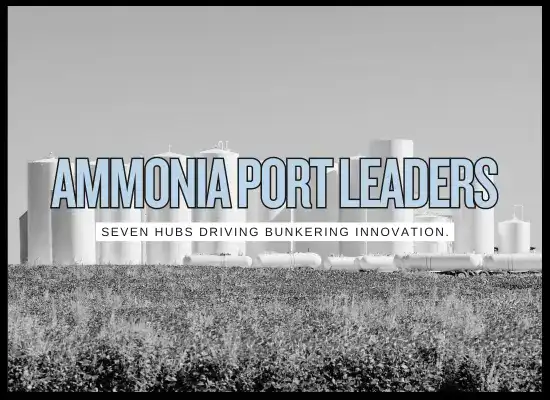
The race toward zero-carbon shipping is no longer a distant goal, it is unfolding right now at the world’s busiest maritime hubs. Ammonia is emerging as one of the most promising alternative fuels, capable of powering deep-sea vessels without direct CO₂ emissions. While the technology and regulations are still evolving, a select group of ports is moving ahead with real-world bunkering projects, pilot programs, and infrastructure buildouts. These early leaders are not just testing the waters, they are setting the pace for how ammonia could reshape global fuel supply chains in the decade ahead.
- Completed Pilots: Successful ship-to-ship or shore-to-ship ammonia transfers with verified procedures.
- Codified Safety: Approved risk assessments, emergency response plans, and crew training for NH₃.
- Fuel Pathway Ready: Contracts or MOUs for certified low-carbon ammonia supply and QA testing.
- Hardware in Place: Dedicated lines, breakaway couplings, detection and ventilation, and spill kits.
- Operational Playbook: Clear berth rules, meteorological limits, traffic zoning, and notification protocols.
| Signal | What It Tells You |
|---|---|
| ✅ Pilot transfer completed | Procedures tested with real cargo and crew. |
| 🧯 Emergency drills audited | Fire, medical, and evacuation plans are practiced. |
| 🧪 Fuel QA and certification | Quality specs and lifecycle data are verified. |
| 📏 HAZID/HAZOP and dispersion studies | Risk scenarios modeled and mitigations installed. |
| 🧭 Published bunkering code | Ports issue clear step-by-step rules for NH₃ calls. |
| 🔌 Interface compatibility list | Manifold, hose, and ESD systems match visiting ships. |
- Dedicated ammonia import terminal expansion with refrigerated storage tanks.
- Joint ventures with fuel producers like Yara and OCI Global to supply green ammonia.
- Ongoing safety trials for ship-to-ship and terminal-to-ship ammonia bunkering.
- Gateway for ammonia distribution to Northern Europe’s industrial and maritime sectors.
- Positioned on key deep-sea trade routes for container, tanker, and bulk carriers.
- Part of the EU’s TEN-T core network, ensuring priority in alternative fuel corridor development.
- First pilot bunkering operations expected before 2027.
- Full-scale commercial ammonia bunkering planned before 2030.
- Integration with hydrogen import projects for a diversified green fuels strategy.
- Complex safety regulations for toxic fuel handling.
- Need for coordinated training among port staff, ship crews, and emergency responders.
- Rotterdam’s scale, funding, and infrastructure make it a natural leader in ammonia bunkering, likely serving as a blueprint for other global ports.
- Successful completion of ship-to-ship ammonia bunkering trial with Fortescue, Vopak, and DNV.
- Development of dedicated ammonia handling facilities on Jurong Island.
- MPA-led working groups creating national ammonia bunkering safety standards.
- Maintains status as the top global bunkering location, enabling rapid scaling of ammonia adoption.
- Key refueling point for major East–West shipping lanes.
- Acts as a testbed for integrating ammonia alongside LNG and methanol in multi-fuel strategies.
- National bunkering standards expected to be finalized by 2025.
- Early commercial ammonia bunkering operations targeted before 2027.
- Planned expansion of storage and distribution networks to meet growing demand.
- Scaling ammonia supply chains to meet demand from oceangoing fleets.
- Managing toxicity and environmental risks during large-scale operations.
- Balancing infrastructure development for multiple alternative fuels.
- Singapore’s regulatory leadership, global connectivity, and proven trial success make it a likely pioneer in safe and large-scale ammonia bunkering.
- World’s first ship-to-ship ammonia transfer at anchorage, a landmark trial completed with stringent safety protocols.
- Partnerships with Yara Clean Ammonia and Pilbara Ports Authority to develop permanent bunkering infrastructure.
- Integration with major renewable hydrogen projects to supply green ammonia for export and local bunkering.
- Key export gateway for Australia’s clean energy transition, serving bulk carriers, LNG vessels, and future ammonia-fueled ships.
- Links directly to major Asian trade partners, especially Japan and South Korea, for green fuel supply.
- Part of Australia’s national plan to become a top-three global hydrogen and ammonia exporter by 2030.
- First pilot ammonia bunkering completed in 2023.
- Commercial-scale ammonia bunkering targeted before 2027.
- Long-term vision includes dual-fuel bunkering capability for ammonia and hydrogen.
- Remote location requires significant infrastructure investment for safe handling and storage.
- Need for harmonized international safety and fuel standards to enable deep-sea adoption.
- Port Dampier is leveraging its industrial base and export capacity to emerge as a flagship ammonia bunkering hub in the Southern Hemisphere.
- First bunkering of a 5,500 HP port tug entirely powered by green ammonia, conducted at COSCO’s terminal.
- Partnerships with state-owned enterprises and fuel producers to establish a reliable ammonia supply chain.
- Early development of port-wide ammonia handling guidelines and safety drills.
- Acts as a strategic link between Northeast Asia’s industrial hubs and deep-sea shipping routes.
- Supports China’s broader push to diversify away from oil-based fuels in domestic and international shipping.
- Potential hub for ammonia bunkering in the Bohai Sea region, serving both Chinese and foreign-flagged vessels.
- First green ammonia bunkering completed in early 2024.
- Pilot bunkering infrastructure expansion planned by 2026.
- Goal of establishing regular commercial ammonia bunkering by 2028.
- Need to align domestic safety standards with evolving IMO regulations.
- Balancing ammonia fuel adoption with existing LNG and low-sulfur fuel bunkering services.
- With strong state backing and early technical trials, Dalian is positioned to become one of North Asia’s leading ammonia bunkering ports by the end of the decade.
- Ship-to-ship transfer demonstration with NYK’s “Sakigake” tugboat, fueled with low-carbon ammonia.
- Collaboration between NYK Line, IHI Corporation, and Japan’s Ministry of Land, Infrastructure, Transport and Tourism (MLIT) to refine ammonia handling protocols.
- Integration of ammonia readiness into port infrastructure upgrades, including storage and transfer systems.
- Serves as a critical node in Japan’s national green shipping corridor plans.
- Gateway for future ammonia fuel imports from Australia and the Middle East.
- Model site for replicating ammonia bunkering protocols in other Japanese ports.
- Demonstration transfer completed in October 2023.
- Pilot-scale bunkering operations targeted by 2026.
- Commercial ammonia bunkering capabilities expected before 2030.
- Adapting port safety frameworks for toxic fuel hazards.
- Scaling from demonstration projects to regular, high-volume operations.
- Yokohama’s early demonstrations and strong industry-government collaboration put it on track to be a major ammonia fuel hub in East Asia.
- Feasibility studies underway for ammonia bunkering alongside LNG and methanol options.
- Collaborations between Spanish authorities, fuel suppliers, and maritime technology firms to develop safe handling and storage protocols.
- Exploring shared ammonia storage terminals to service multiple nearby ports.
- Critical refueling stop for vessels transiting between the Atlantic Ocean and Mediterranean Sea.
- Key location for servicing both long-haul container/tanker traffic and regional ferries.
- Potential gateway for ammonia fuel distribution into Southern Europe and North Africa.
- Initial safety assessments completed in 2024.
- Small-scale pilot bunkering trials targeted for 2026–2027.
- Full integration into existing multi-fuel bunkering services before 2030.
- Coordinating regulatory frameworks between Gibraltar (UK jurisdiction) and Spain.
- Ensuring competitive pricing versus established LNG bunkering services.
- The Straits’ unparalleled shipping volume and strategic location make it an attractive candidate for early ammonia bunkering deployment, with strong potential to scale rapidly once demand solidifies.
- Approval in Principle (AiP) secured for an ammonia bunkering tug-barge design led by a U.S. consortium including Maersk and the Georgia Ports Authority.
- Port feasibility studies underway for safe ammonia handling and storage systems.
- Integration with planned offshore wind and hydrogen projects to secure green ammonia supply chains.
- Serves East–West trade lanes and domestic coastal shipping routes.
- Acts as a green fuel gateway for U.S. cargo vessels, cruise lines, and international callers.
- Potential anchor for a trans-Atlantic green shipping corridor to Europe.
- 2025–2027: Safety framework development and infrastructure planning.
- 2028–2030: Pilot bunkering operations with initial vessels.
- 2030+: Full-scale commercial ammonia bunkering service.
- Lengthy regulatory approvals for toxic fuel operations in U.S. waters.
- Need for crew and port worker training on ammonia handling safety.
- With its consortium backing and integration with renewable energy supply chains, the U.S. East Coast is emerging as a credible contender in the global ammonia bunkering network.
We’ve covered seven ports that are shaping the future of ammonia bunkering, each moving the needle in its own way. From Rotterdam’s massive infrastructure push to Singapore’s early operational trials, and even emerging hubs like the U.S. East Coast, we’re seeing momentum build across the globe. As we track these developments, we’ll continue to dig deeper, share verified updates, and highlight where opportunities are opening up for shipowners, fuel suppliers, and port authorities alike.