12 Biofouling Innovations Saving Millions in Fuel
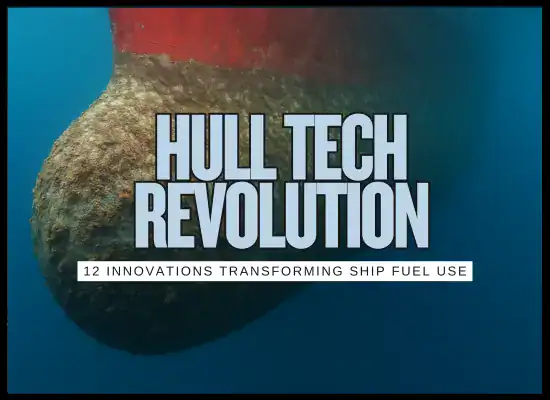
As global carbon regulations tighten and fuel prices remain volatile, shipowners are under pressure to reduce drag and boost efficiency. Fortunately, a wave of new innovations is changing how fleets manage hull performance. From advanced coatings and robotics to AI-powered maintenance tools, these technologies are delivering measurable savings in real-world conditions.
This report highlights 12 biofouling solutions that are helping operators stay ahead, cutting costs, complying with international standards, and extending dry-dock intervals.
🧭 Quick Navigation: 12 Fuel-Saving Biofouling Innovations
- 1️⃣ Silicone / Fluoropolymer Foul‑Release Coatings
- 2️⃣ Biocide-Free Hard Coatings
- 3️⃣ Copper-Free Self-Polishing Copolymer Paints
- 4️⃣ Hybrid Biocide + Foul-Release Systems
- 5️⃣ Jotun “Hull Skater” Robotic Grooming
- 6️⃣ Magnetically-Attached Cleaning ROVs
- 7️⃣ Ultrasonic Antifouling Transducers
- 8️⃣ UV-LED Spotlight Arrays
- 9️⃣ Electrolytic Marine Growth Prevention Systems (MGPS)
- 🔟 AI-Based Hull Performance Analytics
- 1️⃣1️⃣ Scheduled In-Water Grooming Programs
- 1️⃣2️⃣ Nano-Structured Graphene & SLIPS Coatings
1️⃣ Silicone / Fluoropolymer Foul-Release Coatings
Modern foul-release coatings have reshaped the biofouling game. Unlike traditional antifouling paints that kill marine growth with biocides, these ultra-slick coatings prevent organisms from attaching in the first place. Made from silicone or fluoropolymer blends, they reduce drag by shedding slime and barnacles through natural water flow or light cleaning.
Fuel savings of 5–9% are commonly reported across commercial fleets, with some long-haul vessels seeing even higher efficiency over multi-year coating cycles. These coatings are especially effective for vessels with higher activity rates, such as containerships and LNG carriers.
🔬 Coating Performance Snapshot
- ⚡ Up to 9% fuel savings reported by fleets using Intersleek 1100SR
- 📉 CO₂ emissions reduction of 500–1,500 tons per vessel per year
- 🧪 Biocide-free and IMO/USCG compliant under current antifouling regulations
- 🛠️ Requires clean hull prep and controlled application conditions
2️⃣ Sharkskin-Inspired Micro-Texture Films
Inspired by the denticle patterns found on shark skin, these micro-structured films are engineered to reduce turbulence and drag at the boundary layer between a ship’s hull and seawater. The design mimics how sharks glide efficiently through water by disrupting the formation of eddies.
These films are typically polymer-based and can be applied alone or layered over other antifouling coatings. While adoption is still limited, trials have shown drag reductions of up to 5 percent under controlled test conditions, with promising real-world applications on high-speed or specialized hull forms.
🔍 Bioinspired Efficiency Boost
- 🔬 Micro-textured surface mimics shark skin riblets
- 💧 Drag reduction of up to 5% in flow channel testing
- 🛳️ Best suited for fast ferries, military vessels, and high-speed hulls
- 🧪 Can be paired with foul-release coatings for combined effect
3️⃣ Copper‑Free Self‑Polishing Copolymer Paints
Copper‑free self‑polishing copolymer (SPC) coatings offer a biocide‑free alternative to traditional copper SPC. They maintain a fresh, low‑friction hull surface through controlled polymer hydrolysis. The result: reduced fouling and up to 10 percent fuel savings on active commercial vessels, without environmental toxins.
These coatings, such as AQUATERRAS by Nippon Paint Marine, leverage patented hydrolysis chemistry borrowed from medical polymers and are IMO‑compliant while avoiding harmful biocides.
💡 Fuel‑Saving & Green Performance
- ⚡ Up to 10% fuel savings verified in trials with AQUATERRAS
- 🌍 Biocide‑free SPC, fully compliant with IMO/USCG standards
- 🔄 Self‑polishing via polymer hydrolysis, not copper release
- ✨ Proven on container ships, tankers, bulk carriers
4️⃣ Hull Air Lubrication Systems
Air lubrication systems reduce hull friction by creating a layer of microbubbles between the ship and seawater. These systems work by forcing compressed air through specially designed outlets along the flat bottom of the hull. The resulting air film reduces resistance and improves fuel efficiency, especially for wide-beam vessels like LNG carriers, cruise ships, and bulkers.
Adoption has grown rapidly since 2023, with companies like Silverstream Technologies, Mitsubishi, and Hyundai reporting verified fuel savings of 5 to 12 percent, depending on hull shape, speed, and loading conditions.
🌊 Drag Reduction via Air Film
- ⚡ Fuel savings of 5 to 12 percent depending on vessel type
- 🛠️ Effective on large flat-bottom vessels like LNGCs and cruise ships
- 🌍 Verified carbon reductions of up to 1,500 tons CO₂ per year
- 📈 Silverstream reports 50+ installations with consistent results
5️⃣ Jotun “Hull Skater” Robotic Grooming
Jotun’s Hull Skater robot works in tandem with SeaQuantum Skate coating to deliver continuous in‑service cleaning. The robot, remotely operated by Kongsberg teams, removes early-stage biofouling whenever the vessel is idle or at anchor. This proactive approach keeps hulls clean throughout voyages, without dry‑docking for sustained fuel efficiency.
Based on trials and operator data up to mid‑2025, Hull Skating Solutions deliver fuel savings of around 12.5 percent on high‑activity vessels, with documented reductions of up to $4 million in fuel costs and 22,000 tons of CO₂ per ship over five years. Adoption is underway across global fleets such as Wallenius Wilhelmsen and Thoresen Shipping.
🧽 Always‑Clean Hull in Action
- ⚡ Consistent fuel savings of ~12.5 percent reported in trials
- 💰 Fuel cost reduction up to $4 million per ship over five years
- 🌱 CO₂ reduction around 22,000 tons per vessel over five years
- 🚢 Hull remains clean during port stays and anchor time
6️⃣ Magnetically-Attached Cleaning ROVs
Magnetically-attached remotely-operated vehicles (ROVs) clean vessel hulls by using magnets or magnetic crawlers to cling to the steel surface while scrubbing away biofouling. These robots can operate even during loading or bunkering, enabling proactive cleaning without delaying port operations.
Companies like CRABI Robotics and ECOsubsea have launched commercially viable magnetic-attachment ROVs. These systems run in currents exceeding two knots and perform in-transit cleaning or while docked, maintaining hull integrity with minimal disruption. Fuel savings range from 5–20 percent depending on service frequency and route fouling conditions.
🔧 Toward Always-Clean Hulls at Sea
- ⚡ Fuel savings of 5–20 percent depending on cleaning frequency
- 🚢 Can clean hull while bunkering or in transit at ~10 knots
- 🧼 Magnetic adhesion systems minimize thruster use and maximize stability
- 📊 CRABI partnered with CTM on commercial sea trials since early 2025
7️⃣ Ultrasonic Antifouling Transducers
Ultrasonic transducers mounted inside sea-chests or against hull plating emit high-frequency sound waves that disrupt biofilm and prevent marine organism attachment. This non-toxic technology works continuously, keeping surfaces cleaner with minimal maintenance. It works best on metal or composite hulls with good ultrasonic coupling.
Adoption is growing, market data shows the ultrasonic antifouling system sector was valued at approximately $10.7 billion in 2025 and is forecast to grow at 6.8% annually through 2029. Leading providers include Cathelco’s DragGone™, Alfa Laval (through acquisition of NRG Marine), Sonihull, Ultra‑SoniTec, and Hull Shield.
🔊 Continuous Antifouling, No Chemicals
- ⚡ Prevents slime and larvae settlement continuously
- 🛳️ Safe for metal and composite hulls but not wooden or foam cores
- 🌊 Market expected to reach $13.9 billion by 2029
- 📉 Early adopters report extended dry‑dock intervals and measurable fuel savings
8️⃣ UV‑LED Spotlight Arrays
Spotlight arrays using UV‑C light are mounted near sea intakes, niche areas, or ballast tank vents to inhibit algae, barnacle larvae, and other fouling organisms. These low-power systems offer a chemical‑free approach to delaying fouling buildup, especially in smaller enclosures where coatings or mechanical cleaning fall short. Trials indicate extended dry‑dock intervals and reduced local fouling in ports with high marine growth pressure.
💡 Targeted UV‑C Protection in Niche Areas
- ⚡ Suppresses algae and larvae adhesion at intakes or vents
- 🧼 Supports cleaner sea‑chests and niche areas
- 🔋 Low power consumption, safe for crew and equipment
- 📅 Seen to extend cleaning intervals by several weeks or months
9️⃣ Electrolytic Marine Growth Prevention Systems
Electrolytic MGPS systems use copper and aluminum electrodes installed in sea chests or pipework to release ions that deter barnacle, mussel, and algae colonization. The electrolytic process creates conditions that prevent marine organisms from settling, reducing drag and maintaining cooling efficiency without frequent hull cleaning.
These systems are widely used in seawater systems and hull protection zones aboard commercial vessels and offshore platforms. The global MGPS market was valued at roughly $1.2 billion in 2024 and is projected to grow at 5–6% annually through 2030.
⚡ Biofouling Prevention via Electrolysis
- 🚢 Reduces marine growth in sea-chest and cooling systems
- 💧 Prevents fouling without chemical dosing
- 📉 Helps maintain hull and pipework efficiency over long periods
- 📈 Growing market estimated at $1.2 b in 2024, rising to $1.8 b by 2033
1️⃣0️⃣ AI‑Based Hull Performance Analytics
AI monitoring platforms use onboard sensors and historical voyage data to estimate hull roughness, track performance degradation, and generate predictive maintenance alerts. These systems integrate fuel flow meters, speed sensors, weather, and AIS to model a digital twin of vessel performance, helping operators schedule cleaning, adjust sailing speeds, and optimize voyage planning.
Case studies such as Eastern Pacific Shipping using DeepSea AI have shown forecasting accuracy within 1% on fuel consumption across diverse vessel types. Tools like Nautilus Labs and Orca AI also provide route optimization and hull condition alerts, delivering measurable efficiency gains and ROI.
📊 Real-Time Hull Health Intelligence
- ⚡ Fuel use forecasting within 1% accuracy on multi-ship fleets
- 🧠 AI detects drag increase from roughness and fouling before manual checks
- 🛳️ Enables just‑in‑time cleaning, trim adjustment or speed change
- 📈 Industry AI fuel optimization market grew to ~$13.8 b in 2025
1️⃣1️⃣ Scheduled In‑Water Grooming Programs
Scheduled in‑water grooming refers to planned cleaning of hull and niche areas while the ship is still afloat, using divers or ROVs. The focus is on removing microfouling before it develops into more serious macrofouling. This proactive method preserves hull efficiency, reduces drag, and aligns with evolving regulatory standards.
In 2023, the IMO adopted updated biofouling guidelines (MEPC.378(80)) that emphasize proactive in‑water cleaning. By early 2025, supplementary guidance (MEPC.1/Circ.918) confirmed the environmental standards and capture requirements for both proactive and reactive cleaning.
✔️ Optimize Fuel & Follow IMO Rules
- ⚡ Removes slime before it becomes drag-intensive macrofouling
- 🌿 Compliant with IMO MEPC.378(80) and MEPC.1/Circ.918 for approved cleaning methods
- 📅 Recommended when fouling rating is less than 2 or areas use non-biocidal coatings
- 📉 Cuts fuel use and emissions by maintaining a lower roughness state
1️⃣2️⃣ Nano‑Structured Graphene & SLIPS Coatings
Nano‑structured graphene coatings and Slippery Liquid‑Infused Porous Surfaces (SLIPS) offer a cutting‑edge approach to antifouling that is both non‑toxic and highly effective. By combining nanostructured textures with lubricant‑infused layers, these coatings create ultra‑smooth, self‑healing surfaces that repel organisms and resist adhesion, reducing hull roughness and drag.
Real-world studies and lab trials show microbial growth reductions up to 90‑95% on graphene‑based surfaces and drag reductions in the range of 20‑40% under controlled conditions. While commercialization remains emerging, early deployments point to strong potential for future marine applications.
🧪 Nano‑Engineered Drag Reduction
- 🚫 Up to 95% bacterial adhesion reduction on graphene films
- 💧 SLIPS coatings show up to 40% drag reduction in lab models
- 🔄 Self‑healing surfaces resist buildup and abrasion
- 🌍 Emerging option for next‑gen low‑fouling hull protection
We welcome your feedback, suggestions, corrections, and ideas for enhancements. Please click here to get in touch.