10 Maritime Businesses Quietly Winning From the New Cape Route
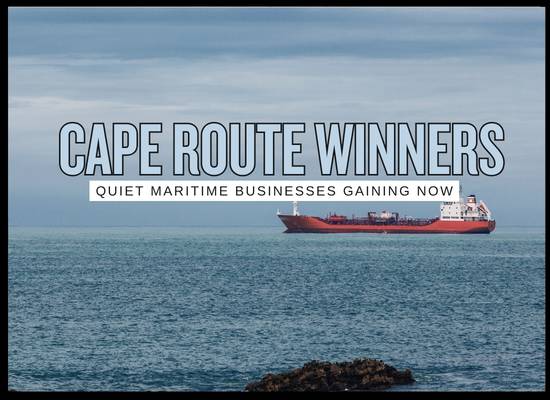
The new Cape route economy is not only about longer voyages and higher freight bills. It is also creating a second layer of winners among maritime businesses that benefit when ships stay off the Red Sea and spend more time, fuel, money, and operational attention around Southern Africa and the wider Indian Ocean. UNCTAD’s maritime reporting says rerouting around the Cape of Good Hope lengthened voyages, reduced effective capacity, and raised operating costs, while Namport has explicitly said cargo ships are bunkering at Walvis Bay as part of the preferred alternative route around the Cape. That means the real winners are not just shipowners with the right exposure. They also include the service businesses that help ships bunker, repair, provision, optimize, document, and execute those longer voyages more efficiently.
The pattern behind the quiet winners
When voyages move around the Cape instead of through the Red Sea, ships spend longer at sea, burn more fuel, need more route support, and lean harder on Southern African and Indian Ocean service points. That reshapes who earns not only from moving cargo, but from helping the voyage work.
The 10 quiet beneficiaries
These are the maritime businesses that genuinely look better positioned because the Cape route has become a bigger part of world shipping economics.
| # | Business | Benefiting | Model looks stronger now | Who gains most | Watch carefully |
|---|---|---|---|---|---|
| 1️⃣ |
Bunkering suppliers and traders around Southern Africa
One of the clearest true winners.
Bunkers
Walvis Bay
Cape route
|
Longer voyages around the Cape mean more fuel demand and stronger value in well-placed bunkering stops. Namport’s annual report explicitly said cargo ships are bunkering at Walvis Bay as part of the preferred alternative route around the Cape of Good Hope. | The route shift is not theoretical anymore. It has created a more durable case for bunkering businesses positioned around Southern African sailing patterns. | Fuel suppliers, bunker traders, and ports that can combine location with reliable service execution. | Service consistency, fuel availability, pricing competitiveness, and whether the Red Sea eventually normalizes enough to dilute demand. |
| 2️⃣ |
Port-call agency and husbandry providers in Cape-route service hubs
The route change creates more opportunities for support work around nontraditional call patterns.
Agency
Husbandry
Support services
|
More ships on longer routes create more need for launch services, crew support, local coordination, cash and stores handling, spares movement, and general husbandry. The winners are the firms positioned where extra calls or service interruptions are most likely to arise. | The Cape route economy has made routing less linear and more support-intensive, which favors local service providers who can handle unscheduled or non-core service demand well. | Agencies and marine-services companies in South Africa, Namibia, Mauritius, and related Indian Ocean service points. | Port efficiency, labor and berth reliability, and how much discretionary support demand remains if routing patterns ease. |
| 3️⃣ |
Ship repair, underwater service, and technical support businesses in the Cape arc
More voyage time often means more technical intervention opportunities.
Repairs
Cape Town
Technical support
|
Cape-route sailing adds distance and time, and that usually improves the case for en route repair, maintenance, cleaning, or technical support businesses positioned near those shipping patterns. The Port of Cape Town explicitly markets ship repair services in the Western Cape maritime region, and the Western Cape government is still trying to improve port performance and maritime fabrication and repairs in 2025. | The route change brings more ships physically closer to repair-capable hubs and makes downtime or performance degradation more expensive over longer voyages. | Dry docks, riding squads, underwater cleaning providers, fabrication shops, and specialist engineering support. | Port congestion, labor reliability, dry-dock access, and whether local infrastructure can match the opportunity. |
| 4️⃣ |
Marine stores, victualing, and spares logistics businesses
Longer voyages put more pressure on onboard logistics.
Chandlery
Victualing
Spares
|
Ships taking longer routes need better provisioning discipline, more reliable stores delivery, and stronger spares coordination, especially if schedules are less predictable and port calls become more strategically important. | These businesses look smarter now because route length and uncertainty both increase the value of reliable supply support close to the voyage. | Ship chandlers, bonded stores suppliers, cold-chain victualers, and marine logistics firms tied to service ports around Southern Africa. | Customs efficiency, airport and landside logistics performance, and how well suppliers can serve short-notice requests. |
| 5️⃣ |
Weather-routing and voyage-optimization providers
Longer voyages make better route decisions more valuable.
Weather routing
Voyage optimization
Fuel savings
|
When voyages lengthen, the value of better weather avoidance, speed planning, and route optimization rises. The extra days around the Cape give optimization firms more room to influence fuel burn and schedule outcome. | In a shorter Suez-based world, some of these services could feel incremental. In a longer Cape-route world, they look more like margin-protection tools. | Routing firms, voyage analytics platforms, and advisory services that can show measurable fuel and schedule benefits. | The strongest players will be the ones that can prove savings in real voyages rather than just sell software. |
| 6️⃣ |
Port-call optimization and timing-data platforms
The longer the route, the more expensive it becomes to arrive badly.
Port-call optimization
JIT arrivals
Timing data
|
The Global Maritime Forum’s 2025 work on port-call optimization underlines how much waste still comes from “sail fast, then wait.” That matters even more on Cape-route voyages, where extra distance already inflates cost before the ship reaches port. | This model looks stronger because longer voyages raise the value of better timing, stronger berth-readiness coordination, and reduced idle time outside port. | Data platforms, port-call optimization vendors, and service providers that reduce waiting time and improve arrival discipline. | Adoption still depends on ports, terminals, and charterparty logic being aligned enough to change behavior. |
| 7️⃣ |
Carbon and compliance analytics businesses
Longer voyages make compliance more operational, not less.
EU ETS
FuelEU
Analytics
|
EU ETS now covers 50% of emissions from voyages starting or ending outside the EU and 100% within EU ports and between EU ports. FuelEU Maritime is also in force. Longer Cape-route voyages on EU-linked business can therefore widen emissions exposure, which improves the case for businesses that help owners understand and manage those costs. | In 2023 this could still look like a future problem. In 2026 it is a live operating and commercial question. | MRV, ETS, and FuelEU specialists, software providers, and advisory firms that connect compliance to voyage economics. | Buyers want tools that help decisions, not just reporting. The model is strongest where analytics directly influence route, speed, and fuel choices. |
| 8️⃣ |
Crew logistics, welfare, and relief coordination providers
Longer and more uncertain routes raise the value of crew support execution.
Crew logistics
Relief
Welfare
|
The Cape route economy increases voyage duration and often changes call timing, which can make relief windows, travel plans, and family communication harder to manage. That helps businesses built around crew movement, husbandry, visas, and welfare support. | The commercial case is stronger when crew disruption becomes more frequent and more expensive to mishandle. | Crew-change specialists, welfare-linked service firms, and agencies with strong travel and local support capabilities. | Air connectivity, visa access, and the ability to move quickly when schedules change unexpectedly. |
| 9️⃣ |
Relay, feeder, and transshipment operators in Southern Africa and the Indian Ocean
A route reset usually creates secondary network winners too.
Feeder
Relay
Transshipment
|
When major shipping loops are redesigned, nearby relay and feeder businesses can gain because lines need more flexible ways to connect cargo, rebalance networks, and support changed mainline patterns. | Longer loop structures and different call sequences make network support services more strategically useful than they looked in the pre-diversion pattern. | Feeder services, regional relay operators, and ports capable of absorbing transshipment support roles. | The opportunity depends on actual network redesign and local port productivity. It is real, but uneven. |
| 🔟 |
Fuel-saving retrofit and wind-assisted propulsion businesses
Longer voyages improve the economics of saving fuel on every mile.
Wind assist
Retrofits
Efficiency
|
Wind-assisted propulsion and other retrofit efficiency businesses benefit because the Cape route increases voyage distance, which makes per-mile fuel savings more valuable. IMO and DNV both continue to frame energy-efficiency measures and wind-assisted propulsion as meaningful tools for reducing fuel use and emissions. | The payback case for fuel-saving technologies generally looks better when ships are sailing longer and fuel and emissions costs remain highly visible. | Wind-assist suppliers, retrofit firms, propulsion-efficiency vendors, and owners willing to improve existing tonnage rather than wait only for newbuild change. | Real benefits still depend on route profile, vessel type, wind conditions, installation cost, and operational discipline. |
Fuel sellers are not the only winners
The best-positioned beneficiaries are the businesses that earn because ships now need more certainty, support, and optimization on a longer route.
The route is creating a services economy
More bunkering, more husbandry, more optimization, and more support work means the Cape route has widened the business opportunity beyond freight alone.
Distance makes efficiency more valuable
When voyages stretch, the payback on timing, fuel savings, and better execution tends to improve, which strengthens several maritime service models at once.
Cape route opportunity screener
This tool helps estimate which service model looks most advantaged based on extra voyages, added fuel demand, service intensity, and how much the route pattern has really shifted.
What separates the real winners
The strongest beneficiaries are not just geographically lucky. They also tend to be execution businesses in places where ships can actually get fuel, support, repair, or better timing without creating a second problem.
The Cape route economy is creating a wider maritime services trade around longer voyages. The quiet winners are the businesses that turn extra distance into useful support, better timing, lower fuel waste, or more reliable execution.
We welcome your feedback, suggestions, corrections, and ideas for enhancements. Please click here to get in touch.